 EVE卫浴
EVE卫浴
How Do You Replace a Bathroom Faucet Cartridge on a Single Handle Faucet Yourself?
浏览次数:170 分类:Install
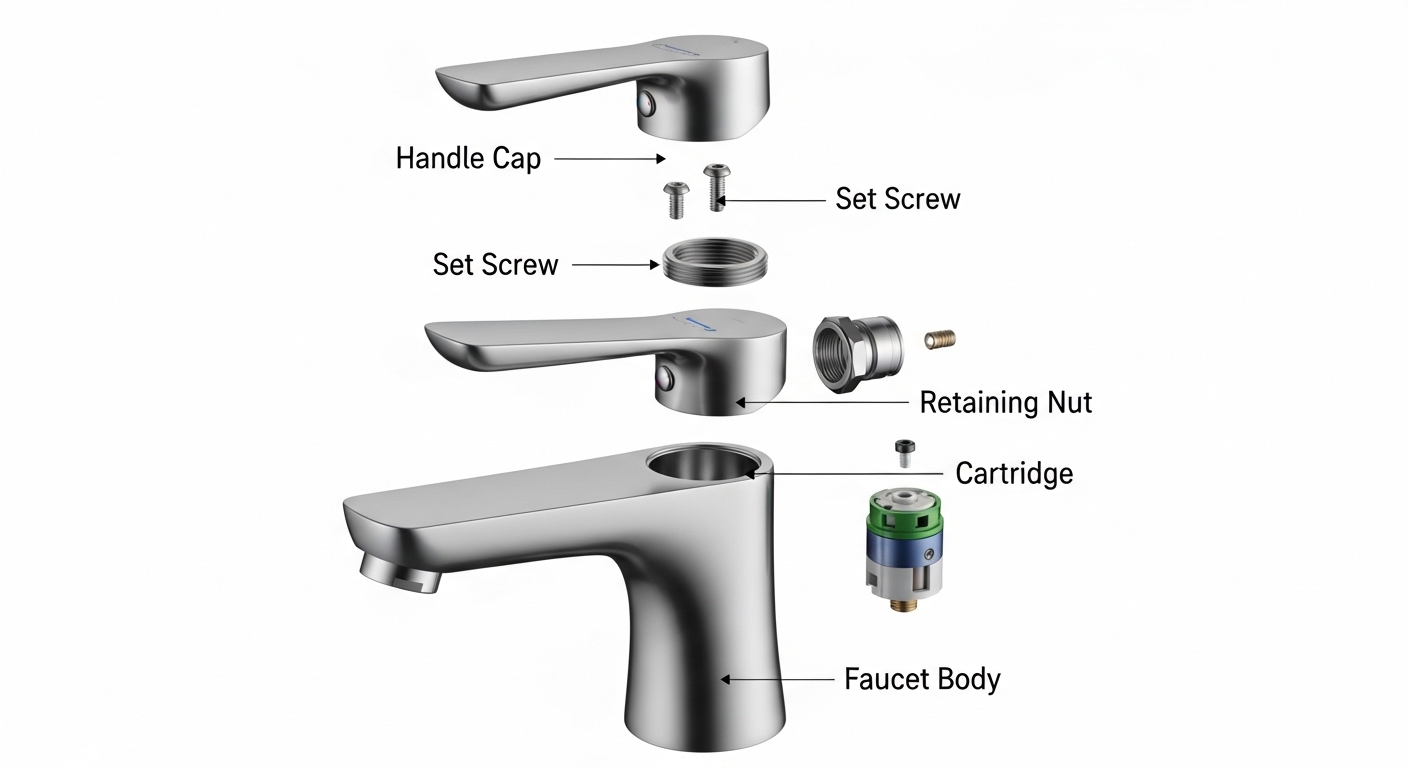
If your single-handle bathroom faucet drips nonstop, gets stuck, or mixes hot and cold poorly, learning how to replace a bathroom faucet cartridge single handle style is almost always the fix — and it’s one of the most beginner-friendly plumbing repairs there is. The cartridge is the little valve inside the faucet body that controls water flow and temperature. When its internal seals wear out, you get drips and hard-to-turn handles. You don’t replace the whole faucet; you swap this one part. Below is exactly how to do it, what tools you need, how to identify your cartridge, and how to avoid the three mistakes that turn a quick job into a flooded bathroom.
What actually is a faucet cartridge — and how do I know mine is the problem?
A faucet cartridge is a cylindrical valve, usually plastic or brass, that sits inside the faucet body and opens and closes as you move the handle. On a single-handle faucet it also blends hot and cold. When the rubber O-rings and seals inside it wear down, water sneaks past even when the handle is “off.” That’s your drip.
You almost certainly have a bad cartridge if you’re seeing any of these:
- A steady drip from the spout that keeps going after you firmly shut the handle.
- A handle that’s suddenly stiff, loose, or spins too far in one direction.
- Water temperature you can’t dial in — it’s all hot or all cold with no middle.
- A whistle or screech when the water runs, which is often a cracked or scaled cartridge.
Not every drip is the cartridge, though. If water is pooling around the base of the faucet rather than coming out the spout, that’s more likely a bad O-ring or gasket under the deck — closer to the issue in our guide on why a kitchen faucet leaks at the base, which applies to bathroom faucets too. And if only one temperature drips, it’s worth reading why faucets drip hot or cold water and how to tell which side is failing before you buy parts. A single-handle faucet has just one cartridge, so this diagnosis is simpler than a two-handle unit, but the symptoms are the same.
What tools and parts do I need before I start?
You need a replacement cartridge that exactly matches your faucet, plus a small handful of common tools — most people already own everything except the cartridge itself. Do not start disassembly until the new cartridge is in your hand, because you’ll want the water off the whole time and you can’t run the sink mid-project.
Here’s the full checklist:
- The exact replacement cartridge (more on identifying it below).
- An adjustable wrench or channel-lock pliers for the retaining nut.
- A Phillips and/or Allen (hex) key for the handle set screw.
- Needle-nose pliers to pull a retaining clip.
- A flathead screwdriver to pop the decorative cap.
- Plumber’s grease (silicone), a rag, and a small bowl for parts.
- A cartridge puller — optional, but a lifesaver on older, scaled-in cartridges (Moen sells one for their 1225/1200 series).
How do I identify the right cartridge so I don’t buy the wrong one?
Match the cartridge by your faucet’s brand and model, not by eyeballing it in the store — single-handle cartridges look nearly identical but differ in length, splines, and stem shape. The fastest route is to pull the old one first (see the steps below), take a photo, and bring the old cartridge with you or match it online.
Each major brand uses its own cartridge families. Here’s how the common ones break down:
| Brand | Common single-handle cartridge | How to identify it | Typical part cost |
|---|---|---|---|
| Moen | 1225 / 1225B | Look for the model number on the spout or original box; 1225 is the standard residential unit | $18–$30 |
| Delta | RP19804 (ball) or ceramic stem cartridge | Delta single-handles often use a ball-and-spring assembly rather than a cartridge | $12–$25 |
| Kohler | GP series ceramic disc | Match by faucet model on Kohler’s site; ceramic disc cartridges are keyed | $25–$45 |
| Pfister / Price Pfister | 974-042 or 0X8 balance | Stamped model on the faucet; often a two-piece system | $15–$30 |
| Eve / generic ceramic-disc | 35mm or 40mm ceramic disc cartridge | Measure the cartridge diameter in millimeters; 35mm is most common in bathroom faucets | $8–$20 |
If you have a Delta, note that many Delta single-handle faucets use a ball assembly instead of a solid cartridge — the repair is similar but the parts differ. Our walkthrough on fixing a leaking Delta faucet handle without calling a plumber covers that ball-and-spring version in detail. For most other single-handle bathroom faucets, including Eve models, you’re pulling a ceramic-disc cartridge, and measuring its outside diameter (usually 35mm) is the surest way to match a generic replacement.
How do you actually replace the cartridge, step by step?
Replacing the cartridge takes six clear steps: shut off the water, remove the handle, remove the retainer, pull the old cartridge, insert the new one, and reassemble. Go in order and don’t force anything — patience beats muscle on every step here.
Step 1 — Shut off the water and open the faucet
Reach under the sink and turn both supply valves (hot and cold) fully clockwise. Then open the faucet handle to release pressure and drain the line. Confirm the water is truly off — a dribble means a valve isn’t fully closed. If your shutoff valves are seized or missing, close the home’s main supply instead. Plug or cover the drain now so no small screw disappears down it.
Step 2 — Remove the handle
Pop off the decorative button or cap on top of or behind the handle with a flathead screwdriver — this hides the set screw. Undo the set screw with a Phillips or hex key (turn it, don’t fully remove it if it’s captive), then lift the handle straight up and off. If it’s stuck from mineral buildup, wiggle gently side to side; never pry hard against the finish.
Step 3 — Remove the retaining nut or clip
Under the handle you’ll find either a threaded brass retaining nut or a small horizontal U-shaped clip. Unscrew the nut counterclockwise with pliers, or pull the clip straight out with needle-nose pliers. Set it in your parts bowl — you’ll reuse it. Note the orientation of everything as it comes apart; snapping a phone photo at each step saves you at reassembly.
Step 4 — Pull out the old cartridge
Grip the top stem of the cartridge with pliers and pull it straight up and out. Twist it slightly to break the seal if it resists, but keep pulling in line with the faucet body — don’t lever it sideways. Older cartridges scaled in with hard-water deposits may need a cartridge puller tool that threads on and extracts it cleanly. This is the step where a cheap puller earns its keep.
Step 5 — Insert the new cartridge
Smear a thin film of silicone plumber’s grease on the new cartridge’s O-rings, then push it straight down into the body. Critical detail: cartridges are keyed for hot/cold orientation. Line up the notch, tab, or flat on the cartridge with the matching slot in the faucet body. Install it backwards and your hot and cold will be reversed. Seat it fully — it should sit flush, not proud.
Step 6 — Reassemble and test
Reinstall the retaining nut or clip, put the handle back on, tighten the set screw, and press the cap back in place. Now slowly reopen both supply valves and run the faucet. Check for drips at the spout and around the handle base. Let it run hot and cold for a minute to confirm the temperature blends correctly and nothing weeps.
How long does this take, and is it cheaper than a plumber?
A first-timer finishes in 20–40 minutes; someone who’s done it before can do it in 15. Parts run $8–$45 depending on brand, so you’re spending well under $50 total. A plumber for the same job typically charges $120–$250 including a trip fee — so doing it yourself saves roughly $100–$200 on a single faucet.
Here’s the honest cost and difficulty comparison:
| Approach | Cost | Time | Difficulty |
|---|---|---|---|
| DIY cartridge swap | $8–$45 (parts only) | 20–40 min | Beginner |
| Handyman | $80–$150 + parts | Same day | None (for you) |
| Licensed plumber | $120–$250 + parts | Scheduled visit | None (for you) |
| Replace whole faucet | $60–$300+ | 1–2 hours | Intermediate |
The math strongly favors DIY here because the cartridge is a wear part, not a sign the whole faucet is dead. Unless your faucet body is cracked or badly corroded, a new cartridge makes a decade-old faucet feel new. If your faucet is genuinely worn out and you’d rather upgrade, that’s a different project — but for a drip, start with the cartridge.
What are the most common mistakes when replacing a single-handle cartridge?
The three mistakes that wreck this job are buying the wrong cartridge, installing it in the wrong orientation, and over-tightening the retaining nut. Each is easy to avoid once you know to watch for it.
- Wrong cartridge. Pull the old one first and match it exactly — brand, length, and spline count. A cartridge that’s 3mm too short won’t seal.
- Reversed hot/cold. Cartridges are keyed. Line up the tab before pushing it in, or you’ll get cold when you want hot.
- Over-tightening. Snug the retaining nut firmly but stop there. Cranking it can crack a plastic cartridge or the faucet body.
- Forgetting the grease. Dry O-rings tear on install and leak within weeks. A thin silicone film is non-negotiable.
- Not flushing the lines. After reassembly, run the faucet wide open for 30 seconds to clear debris before you judge whether it drips.
One more diagnostic note: if you replaced the cartridge and pressure is now weak, the culprit is usually debris in the aerator, not the new part — similar to what we cover in why a Moen faucet has low water pressure and how to fix it. Unscrew and rinse the aerator before assuming the cartridge is bad.
FAQ
Do I need to turn off the water main to replace a faucet cartridge?
Not usually. Most bathroom sinks have two local shutoff valves under the cabinet — turn both fully clockwise and you’re set. Only shut off the home’s main supply if those local valves are seized, missing, or won’t fully stop the flow.
How do I know if my faucet uses a cartridge or a ball valve?
Single-handle faucets from Moen, Kohler, Pfister, and most generic/Eve brands use a cartridge — a cylinder you pull straight up. Many Delta single-handles instead use a rotating ball with springs and seats. If you pull the handle and see a metal or plastic ball rather than a cylinder, you have a ball valve and need a Delta repair kit.
Can I use a universal cartridge instead of the brand-specific one?
Sometimes. Generic ceramic-disc cartridges sized by diameter (commonly 35mm or 40mm) fit many no-name and imported faucets. But brand faucets like Moen 1225 or Kohler GP series are keyed and sized specifically — a universal part often won’t seat or seal. When in doubt, match the exact OEM part; the $5 you save on a generic isn’t worth a redo.
My new cartridge still drips — what did I do wrong?
Usually one of three things: the cartridge isn’t fully seated, the O-rings weren’t greased and got pinched, or you bought a slightly mismatched part. Shut the water off, pull it, inspect the O-rings for tears, add silicone grease, and reseat it firmly and squarely. If it still drips with a correct, undamaged part, check the faucet body seat for scale or cracks.
How often do faucet cartridges need to be replaced?
A quality cartridge lasts 5–15 years. Hard water shortens that considerably because mineral scale chews up the seals and seats. If you’re on well or hard municipal water and replacing cartridges every couple of years, a whole-house filter or softener will extend cartridge life far more than buying pricier cartridges.
Is replacing the cartridge covered under my faucet’s warranty?
Often, yes. Many faucet brands, including Eve, back their valves with a limited lifetime warranty on the cartridge and finish for the original homeowner. You typically request the replacement cartridge free and install it yourself. Keep your model number and proof of purchase, and check the brand’s warranty page before buying a part you might get shipped for free.
A quick word on doing this right
Author note: This guide was written by the Eve Faucet product team, who spend their days testing faucet valves, cartridges, and finishes for real-world durability. We’ve disassembled and rebuilt hundreds of single-handle faucets across brands, and the steps above reflect what actually works on a Saturday morning — not just what’s in a manual.
About Eve Faucet: evefaucet designs and sells bathroom and kitchen faucets, shower systems, and fixtures built around ceramic-disc cartridges rated for 500,000+ open-close cycles, and independently tested to meet cUPC and NSF/ANSI standards for lead-free drinking water. Our single-handle faucets ship with a limited lifetime warranty on the cartridge and finish, so if the valve ever fails for the original owner, we replace it. When you match specs carefully and grease your seals, a cartridge swap is one of the most satisfying 30-minute fixes in the house — and it keeps a good faucet out of the landfill.