 EVE卫浴
EVE卫浴
How Do You Install a Shower Head With a Hose Without Leaks (And Without a Plumber)?
浏览次数:408 分类:Install
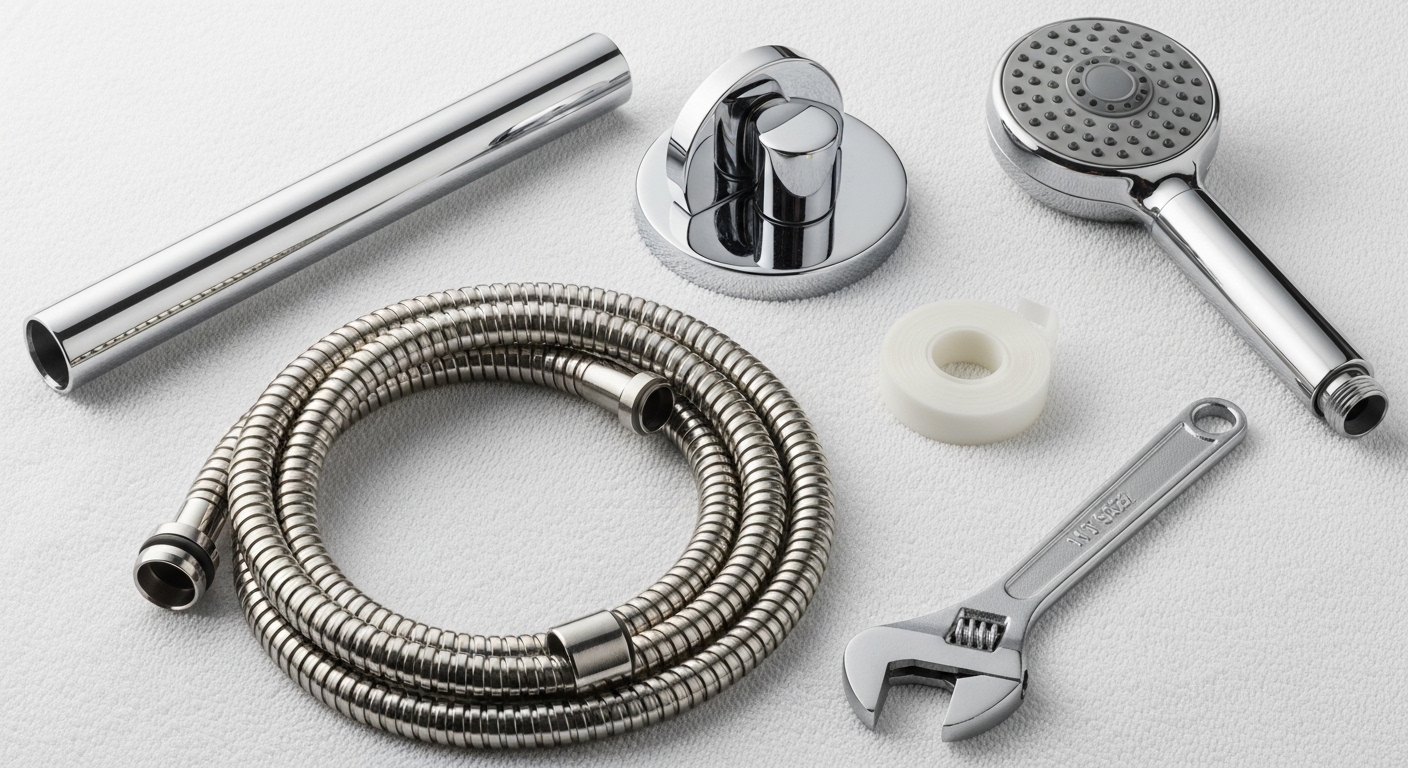
If you’ve ever asked yourself how to install a shower head with a hose and assumed it required a plumber, a torch, or pipe cutting — relax. A handheld shower with a hose is one of the most renter-friendly, beginner-friendly bathroom upgrades in plumbing. You’re not touching the wall, the valve, or any soldered connection. You’re only swapping what threads onto the existing shower arm — the same chrome pipe sticking out of your tile. This guide walks you through the exact sequence the EveFaucet workshop uses on production test rigs, plus the four mistakes that cause 90% of post-install drips.
What exactly comes in a shower head with hose kit, and what do you need to buy separately?
A standard handheld shower head with hose kit contains four parts: the handheld shower wand, a flexible hose (typically 59 inches / 1.5 meters), a wall-mount bracket or holder, and two rubber/silicone washers (gaskets). That’s it — everything else you may need (PTFE tape, possibly a diverter if your tub already has a fixed head) is sold separately and costs under $5 total.
Before you start, lay every piece out and confirm the threading. In North America and almost all of Europe/Asia, the shower arm thread standard is 1/2-inch NPT (in metric markets it’s labeled G1/2″). They’re physically interchangeable for this kind of low-pressure cold/hot domestic application — which is why a hose bought online almost always fits the arm already in your wall. If your kit is missing the conical washers inside the hose nuts, stop and contact the seller; without those rubber cones, the hose will leak no matter how tight you crank it.
- Tools you actually need: one adjustable wrench (8″ or 10″), PTFE plumber’s tape (the cheap white roll), and an old towel.
- Optional but smart: needle-nose pliers (to fish out the old washer if it sticks), a soft cloth to protect chrome finishes from wrench marks, and a flashlight if your shower stall is dim.
- What you do NOT need: a pipe wrench, thread sealant paste, a torch, a plumber, or to shut off the water main. The water valve at your shower handle stays closed during the swap — that’s all the shut-off required.
Do I need to turn off the water main to install a handheld shower head?
No. You only need to make sure the shower handle is in the OFF position. The shower arm is downstream of the mixing valve, so as long as the handle is closed, no water reaches the arm — there’s nothing to drain, nothing to pressurize, nothing to spray you when you unscrew the old head.
This is the single biggest reason a handheld swap is renter-safe: you are working entirely on the decorative side of the plumbing. The chrome arm sticking out of the tile is a standalone threaded pipe. Behind the wall is the actual valve body, and you are not going anywhere near it. If you want a belt-and-suspenders approach, you can shut off the bathroom branch valve (if your home has one), but in 99% of installations, just making sure the handle is OFF is enough.
Step-by-step: how to install shower head with hose in 10 minutes
Follow this exact sequence — it’s the same order used in the EveFaucet QC line where every wall-mount handheld is leak-tested at 0.6 MPa before shipping. Don’t skip the tape step; don’t overtighten anything.
- Remove the old shower head. Grip the chrome shower arm with one hand (this stops it twisting in the wall and cracking your tile grout). With the other hand, turn the old head counterclockwise. It should come off finger-tight. If it’s been there ten years and won’t budge, wrap a cloth around the connection and use the adjustable wrench — gently.
- Clean the threads. Look at the male threads on the shower arm. Pick off any old Teflon tape with your fingernail or pliers. The threads should be bare metal — no fuzz, no rust flakes, no leftover white tape. This 30-second step is the difference between a leak and a clean install.
- Apply fresh PTFE tape. Hold the end of the tape against the threads with your thumb and wrap 3-4 times clockwise as you look down the arm toward the wall. Clockwise matters — it’s the same direction you’ll screw the new fitting on, which tightens the tape into the threads instead of bunching it up. Pull the tape snug so it conforms into the thread valleys.
- Screw on the wall bracket (or diverter). If your kit is a wall-mount handheld holder, this is the round/oval bracket with a 1/2″ female fitting on top and a 1/2″ male outlet underneath where the hose attaches. Hand-tighten clockwise until it stops, then give it a quarter-turn with the wrench to seat it. Stop. Do not muscle it — over-torquing cracks the chrome plating and deforms the internal washer.
- Connect the hose. Look inside both nuts at the ends of the flexible hose. You should see a black or clear conical rubber washer seated at the bottom. The washer does the sealing — not the threads — so no Teflon tape is needed on hose connections. Thread one end onto the bracket outlet (or onto the shower arm if you’re not using a bracket), hand-tight plus a gentle quarter-turn.
- Attach the handheld wand. Screw the other end of the hose onto the bottom of the handheld shower head. Again — washer does the work, hand-tight plus a quarter-turn.
- Test under pressure. Hang the wand in the bracket. Turn the shower handle on cold first, then hot, then mix. Watch every connection for 30 seconds. A pinhole drip at a hose nut means the washer is missing or pinched — unscrew, reseat, retry. A drip at the wall arm means not enough tape — back it off, add 2 more wraps clockwise, reinstall.
How tight is “tight enough”? (The over-tightening trap)
Hand-tight plus a quarter-turn with a wrench is the rule. Roughly: tighten until you meet resistance with your fingers, then add just 90 degrees more. Anything beyond that risks crushing the rubber washer, splitting the hose nut (especially on plastic-cored kits), or cracking the chrome on the shower arm.
This is the most common mistake we see in customer support tickets: people assume “tighter = no leak” and end up causing the leak by deforming the very washer that’s supposed to seal the joint. A flat rubber washer that’s been over-compressed loses its rebound and starts weeping within a week. If a connection still drips after a moderate quarter-turn, the answer is almost never more force — it’s a fresh washer or more Teflon tape on the wall arm.
Wall-mount bracket vs. diverter vs. slide bar — which setup is right for me?
If you’re replacing a fixed shower head and want a handheld only, choose a simple wall-mount bracket kit. If you want to keep your existing rainfall/fixed head AND add a handheld, you need a diverter kit. If you share the shower with kids or someone using a bench, a slide bar is worth the extra $40.
| Setup type | Best for | Install difficulty | Typical price (USD) | Tools needed |
|---|---|---|---|---|
| Wall-mount bracket + hose + handheld | Renters, simple swap, small shower stalls | Easiest (10 min) | $25-$60 | Adjustable wrench, PTFE tape |
| 3-way diverter + fixed head + handheld | Keeping an existing rainfall head, adding handheld | Easy (15 min) | $45-$120 | Adjustable wrench, PTFE tape |
| Slide bar + handheld | Adjustable height, accessibility, families with kids | Moderate (45 min — requires drilling tile) | $60-$180 | Wrench, drill, tile/diamond bit, level, silicone |
| Ceiling-mount drop + handheld combo | Walk-in showers, luxury remodels | Hard (requires opening ceiling) | $200+ | Full plumbing rough-in tools |
For 80% of readers, the wall-mount bracket setup is the right pick — it’s the same configuration covered in this guide and the one we recommend in our guide to external shower faucets for outdoor and exposed wall installs, which uses the identical 1/2″ NPT threading. If you’re working with a compact bathroom and a short shower arm, also see our notes on 5-inch spout reach faucets — the same compact-fixture logic applies to hand-shower bracket placement.
Why is my new shower head with hose leaking at the wall? (Troubleshooting)
Nine times out of ten, a leak at the shower arm itself comes from not enough PTFE tape or tape wrapped the wrong direction. The fix takes 60 seconds: unscrew the fitting, peel off the old tape, re-wrap 4-5 times clockwise (toward the wall), and reinstall. If it still leaks, the arm threads themselves may be corroded or stripped.
Here’s how to diagnose by where the drip appears:
- Drip from the joint where bracket meets the wall arm: Insufficient or wrong-direction Teflon tape. Re-tape clockwise with 4-5 wraps.
- Drip from either hose nut: Missing, pinched, or hardened conical washer. Unscrew, inspect, replace if cracked. Never tape these threads.
- Drip from the handheld head itself when the water is OFF: Not actually a hose problem — your shower valve cartridge is failing and letting water through. That’s a different repair.
- Slow weep that only appears after 5 minutes of use: Hairline crack in a plastic hose nut from over-tightening. Replace the hose.
- White mineral crust around connections in a few weeks: Hard water. The seal is fine; you just need to wipe with vinegar monthly. Our faucet aerator clogging repair guide covers the same descaling approach for shower heads.
How do I install a handheld shower head if I want to keep my existing rainfall head?
You install a 3-way diverter between the shower arm and your existing head. The diverter is a small T-shaped brass body with three 1/2″ ports: one threads onto the wall arm (input), one feeds your existing fixed head (output #1), and the third has a 1/2″ male outlet that your handheld hose screws onto (output #2). A small lever on the diverter switches flow between the two outputs.
The install sequence is identical to the basic method above — only one extra step. After taping the shower arm, you screw the diverter onto the arm first (hand-tight + quarter-turn), then screw your original fixed head into the top output of the diverter (re-tape these threads too), then attach the hose to the side output, then the handheld to the hose. Total time: 15 minutes. This is the most popular handheld upgrade among homeowners who already invested in a nice rainfall head and don’t want to lose it.
One small pressure note: a diverter shares pressure across both outputs, so when both heads are running simultaneously, flow at each will be slightly lower than running either alone. Most modern diverters force you to pick one at a time, which sidesteps the issue.
Do hose length and material actually matter? (Most people pick wrong)
Yes — but probably not in the way you think. The standard 59-inch (1.5 m) hose is fine for most adult-only showers. If you have kids, pets, or anyone bathing seated, jump to a 71-inch (1.8 m) or 79-inch (2.0 m) hose. For material, choose stainless steel braided over PVC any day — it resists kinking, lasts 5x longer, and doesn’t off-gas plastic smell when first used in hot water.
The cheap PVC hoses included with bargain kits are usually the first thing to fail. They develop memory kinks, crack at the nut over a winter or two, and trap soap scum inside. A double-buckle stainless-braided hose costs about $5-10 more and outlasts the rest of the kit. If you’re already pricing fittings and finishes carefully — the same way we recommend in our 8-inch widespread bathroom faucet buyer’s guide — applying the same upgrade logic to your shower hose is a no-brainer.
How do I know my install is up to code and safe?
Any handheld shower head sold in the US should be certified to ASME A112.18.1 / CSA B125.1 (the joint North American plumbing fixture standard) and listed to NSF/ANSI 61 if it touches potable water — which all shower heads do. Federal flow limit is 2.5 gallons per minute (gpm) at 80 psi, and California, Colorado, New York, and Washington cap it lower at 1.8 gpm. Check the box or the product page; reputable brands print the certification.
For backflow protection, modern handheld shower kits include an integrated check valve or vacuum breaker in either the diverter or the wall bracket. This prevents a hose lying in a full tub from siphoning dirty water back into the supply line — required by code in most jurisdictions for any hand-shower where the wand can reach below the flood rim of a tub. If you’re buying budget gear from an unknown brand, confirm the backflow device is present before installing.
About the author & the EveFaucet workshop
This guide was written by the EveFaucet technical team based on internal install QC procedures. EveFaucet (伊唯伊) has manufactured 304 stainless steel and solid brass bathroom and kitchen fixtures since 2010, with every product pressure-tested at 0.6 MPa for 60 seconds before leaving the factory. Our handheld shower assemblies carry a 5-year limited warranty on the brass body and a 1-year warranty on hoses and finishes. The install steps above mirror the printed instructions shipped in every EveFaucet handheld shower box, refined over 15 years of customer support data. For warranty registration and post-purchase support, see our pre-sale and after-sale guidelines.
FAQ
Can I install a shower head with a hose without any tools at all?
Almost — but not safely. You can hand-tighten every connection, but without an adjustable wrench for the final quarter-turn and PTFE tape for the wall arm, you’ll get a slow drip within hours. Total tool cost if you don’t own them: under $15 at any hardware store.
Why is my shower head with hose dripping even after I tightened it really hard?
You tightened it too hard. Over-tightening crushes the conical rubber washer inside the hose nut and destroys its sealing rebound. Back the connection off, inspect the washer (replace if flattened or cracked), and re-tighten only hand-tight plus a 90-degree wrench turn.
Do I need Teflon tape on the hose ends too?
No. Hose ends seal with the conical rubber washer inside the nut, not with thread engagement. Adding Teflon tape there does nothing useful and can actually prevent the washer from seating properly. Tape only goes on the shower arm threads and (if used) the diverter outlets that mate with metal-on-metal fittings without a washer.
Will a handheld shower head with hose reduce my water pressure?
Slightly, but usually not noticeably. The extra few feet of 1/2″ hose introduces minimal friction loss. The bigger pressure factor is the flow rate of the wand itself — a 1.8 gpm low-flow head will obviously feel weaker than a 2.5 gpm head, regardless of hose. If pressure drops significantly after install, check that you didn’t pinch the hose at a nut or leave plastic shipping plugs inside the wand inlet.
How long does a shower head with hose last before it needs replacing?
The wand and bracket typically last 8-15 years. The hose is the wear part — expect 3-7 years for stainless braided, 1-3 years for PVC. Washers should be inspected yearly and replaced any time you see hairline cracks or permanent compression. Replacement washer packs cost about $2 and are universal across 1/2″ fittings.
Can I install this on an old shower arm or do I need to replace the arm too?
If the arm threads are clean and the chrome isn’t corroded green, keep it. If the threads are visibly pitted, the arm wobbles in the wall, or you see rust at the wall escutcheon, replace the arm first — it’s a $10 part that screws into the wall fitting with PTFE tape, exact same technique as the head install.