 EVE卫浴
EVE卫浴
Why Is My Kitchen Faucet Leaking at the Base — And How Do I Fix It Myself?
浏览次数:516 分类:Repair
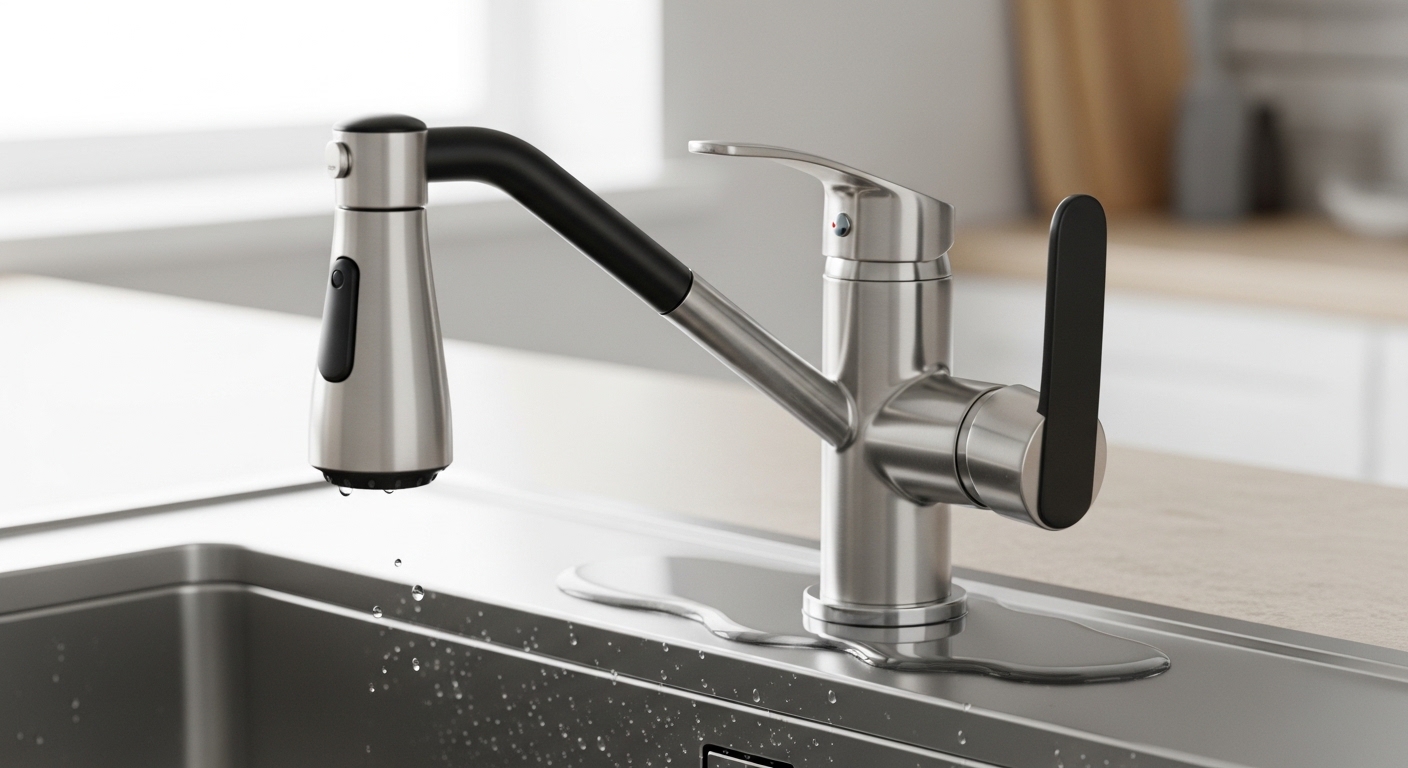
If you’ve got a leaking kitchen faucet base — water pooling around the bottom of the spout, seeping out from under the handle, or quietly running down behind the sink into the cabinet — the good news is that this is one of the most common and most fixable faucet problems there is. In nearly every case, the faucet body itself is fine. What’s failed is a small rubber seal: an O-ring, a base gasket, or the cartridge seals inside. These are cheap, standardized parts, and replacing them is a genuine DIY job for anyone comfortable holding a screwdriver.
This guide walks you through exactly why the base leaks, how to diagnose which seal failed, and how to fix each one — in plain language, with the real part names and the order of operations a working plumber would actually follow.
What causes a kitchen faucet to leak at the base?
A kitchen faucet leaks at the base for one of three reasons: a worn O-ring around the spout, a failed base plate gasket under the faucet body, or loose mounting nuts that let the whole faucet rock and break the seal against the sink. Less often, it’s the cartridge seals leaking water up through the handle. Identifying which one is leaking is 80% of the repair.
Here’s the underlying mechanic. Your faucet doesn’t just sit on the sink — it’s pressed against the deck and sealed by rubber, then clamped tight from below by nuts. Over years of swiveling the spout left and right, the round O-ring that wraps the spout base hardens, cracks, and stops sealing. Hot water, mineral-heavy “hard” water, and ordinary wear all accelerate this. When that seal goes, pressurized water escapes at the base every time you turn the faucet on.
To pin down the source, do this 30-second test. Dry everything completely with a paper towel, then turn the water on and watch:
- Water appears around the spout when you swivel it side to side → the spout O-ring is worn.
- Water seeps up from where the faucet meets the sink deck, even with the handle off → the base gasket or mounting seal has failed.
- Water comes up around or under the handle when running → the cartridge or its seals are leaking.
- Water only shows up in the cabinet below, not on top → check the supply line connections and the mounting nuts first.
Match your symptom to the cause and you already know which fix you need.
How do I tell if it’s the O-ring or the cartridge leaking?
Swivel-related leaks at the spout base mean the O-ring; leaks that come up around the handle when water is running mean the cartridge. The simplest tell: if the puddle forms only when you move the spout, it’s the O-ring. If it leaks whenever the water is on regardless of spout position, suspect the cartridge.
The O-ring is a single rubber loop (sometimes two) sitting in a groove where the spout tube slides into the faucet body. It’s a sub-$5 part. The cartridge is the larger valve mechanism inside the body that controls hot/cold mixing and flow — it costs more ($15–$40 for brand-name units) but is still a swap-in repair. Most base leaks are O-rings, which is why this guide leads with them.
One important note on diagnosis: a leak that looks like it’s coming from the base is sometimes actually running down from a loose spout or a bad connection higher up and collecting at the lowest point. Always dry the whole faucet and watch where the very first bead of water appears. If your pull-down model is also acting up in other ways — weak spray, a sticking diverter — it’s worth ruling out related issues; our guide on why a pull-out kitchen faucet stops working covers those overlapping symptoms.
What tools and parts do I need to fix a leaking kitchen faucet base?
You need very little: an Allen (hex) wrench, a Phillips and flat screwdriver, a basin wrench, plumber’s grease, and the replacement seal that matches your faucet. Total parts cost is typically $5–$40 depending on whether you’re replacing an O-ring or a full cartridge.
Here’s the full checklist before you start:
- Allen/hex wrench set — most modern handles are held by a hidden hex set screw.
- Phillips and flathead screwdrivers.
- Basin wrench — the long-reach tool that lets you loosen mounting nuts in the tight space behind the sink.
- Adjustable wrench or channel-lock pliers.
- Replacement O-rings, base gasket, or cartridge — buy the kit that matches your faucet model or brand.
- Silicone plumber’s grease — never petroleum jelly; it degrades rubber seals.
- Old towel, paper towels, and a small flashlight.
- White vinegar — for dissolving mineral crust on parts you reuse.
A quick word on parts: take a photo of your faucet and, if you can, find the model number (often printed under the spout or in your original paperwork) before buying seals. Universal O-ring kits exist, but a model-matched kit saves you a second trip. If you’ve been fighting hard-water buildup on this faucet, the same mineral deposits that crust your aerator also harden your O-rings faster — our walkthrough on cleaning a faucet head of hard-water buildup explains how to slow that down across the whole fixture.
How do I fix a leaking kitchen faucet base step by step?
To fix a base leak: shut off the water, remove the handle, lift off the spout, replace the worn O-ring or gasket, grease the new seal, and reassemble. Most people finish in 30–45 minutes. Here’s the sequence that works for the vast majority of single-handle kitchen faucets.
- Shut off the water. Turn the two valves under the sink clockwise until they stop (hot and cold). Then open the faucet to release pressure and confirm the water’s truly off. No valves under the sink? Shut off your home’s main.
- Plug the drain. Drop in a stopper or rag so a dropped screw or clip can’t disappear down the pipe.
- Remove the handle. Find the set screw — usually behind or under the handle — and loosen it with your Allen wrench. Lift the handle straight up and off.
- Remove the trim cap and retaining nut/clip. Under the handle you’ll see a dome cap or a threaded retaining nut, and often a horseshoe-shaped clip holding the cartridge. Note the order as you remove each piece — lay them out left to right.
- Lift off the spout. Pull the spout tube straight up off the faucet body. This exposes the O-rings sitting in their grooves.
- Replace the O-rings (or cartridge). Roll the old O-rings off with your fingernail or a pick. If you’re replacing the cartridge, pull it straight up and out, then seat the new one in the same orientation.
- Grease and reseat. Coat the new O-rings with a thin film of silicone plumber’s grease, slide them into the grooves, and lower the spout back over them — twist gently so you don’t pinch the rubber.
- Reassemble in reverse order — clip, retaining nut, cap, handle, set screw.
- Turn the water back on slowly and test. Run it, swivel the spout, and check both the base and the cabinet below for any seepage.
If, instead, your leak traced back to loose mounting nuts rather than a seal, the fix is even simpler: reach up behind the sink with your basin wrench and snug the mounting nuts evenly until the faucet sits firm and stops rocking. Don’t overtighten — hand-tight plus a quarter turn is plenty on most plastic mounting nuts.
O-ring vs. base gasket vs. cartridge: which repair do I actually need?
Use the symptom to choose the repair — here’s the side-by-side so you can match your leak to the right part, cost, and effort before you buy anything.
| Leak symptom | Likely culprit | Part cost | Difficulty | Time |
|---|---|---|---|---|
| Water at spout base only when you swivel | Spout O-ring | $3–$8 | Easy | 30 min |
| Water seeps up at the sink deck, handle off | Base plate gasket | $5–$12 | Easy–Moderate | 30–45 min |
| Water around the handle whenever it runs | Cartridge / cartridge seals | $15–$40 | Moderate | 45 min |
| Faucet rocks; leak appears at base | Loose mounting nuts | $0 | Easy | 15 min |
| Leak only in the cabinet below | Supply line / connection | $5–$15 | Easy | 20 min |
The pattern to remember: top-side base leaks are seals; bottom-side cabinet leaks are connections or mounting. When in doubt, start with the cheapest and most common fix — the O-ring — because it solves the majority of base leaks and costs less than a coffee.
When is a leaking faucet base not worth repairing — should I just replace it?
Replace the faucet instead of repairing it when the body itself is cracked, when replacement cartridges are discontinued for an old model, or when you’ve already reset the seals and it still leaks. As a rule of thumb, if parts will cost more than half the price of a solid new faucet — or the finish is corroded and pitted — it’s time to upgrade.
A few honest signals that point to replacement over repair:
- You can see a hairline crack in the brass or zinc body — no seal fixes a cracked casting.
- The faucet is 12–15+ years old and the cartridge is obsolete or unavailable.
- You’ve replaced the O-rings and cartridge and it still weeps — the seat surfaces inside are likely worn beyond sealing.
- The finish is flaking and the faucet looks tired anyway.
If you do land on replacement, this is also your chance to fix the root cause: a quality faucet with a solid brass body, a ceramic-disc cartridge, and replaceable O-rings will simply last longer before it ever leaks again. When you’re shopping, it’s worth knowing how the major brands stack up on durability and parts availability — our Moen vs. Kohler kitchen faucet comparison breaks down warranty and cartridge support, and if you’re replacing a worn pull-down hose rather than the whole unit, the pull-out hose replacement guide covers that specific swap.
How do I stop my kitchen faucet base from leaking again?
To prevent future base leaks, grease your O-rings with silicone whenever you service the faucet, address hard water buildup, and don’t crank the spout to its hard stops repeatedly. A faucet that’s installed level, kept free of mineral crust, and serviced every few years rarely leaks at the base.
Three habits make the biggest difference. First, every time you’re inside the faucet, apply a thin coat of silicone plumber’s grease to the O-rings — lubricated rubber flexes instead of cracking. Second, if you have hard water, consider a softener or at least regularly descale the faucet, because the same scale that clogs your aerator also grinds down your seals from the inside. Third, treat the spout gently; slamming it against its swivel stops is what tears O-rings prematurely.
It’s also smart to glance under the sink every few months with a flashlight. Catching a damp mounting nut or a sweating supply line early — before it becomes a steady drip into the cabinet — saves you from warped cabinet floors and mold. Two minutes of inspection beats a weekend of water-damage repair.
FAQ
Why is my kitchen faucet leaking from the base when I turn it on?
It’s leaking because the spout O-ring has worn out. When you turn the faucet on, pressurized water finds the path of least resistance, and a cracked or hardened O-ring lets it escape at the base. Swap the O-ring — a $3–$8 part — and the leak almost always stops.
Can I fix a leaking faucet base without removing the whole faucet?
Yes, in most cases. For the most common cause — a worn O-ring or cartridge — you only remove the handle and lift the spout off; the faucet body stays bolted to the sink. You only need to remove the entire faucet if the base gasket underneath has failed or a mounting nut is the problem.
How much does it cost to fix a leaking kitchen faucet base?
DIY, it costs $5–$40 in parts depending on whether you replace an O-ring (cheapest) or a full cartridge. Hiring a plumber typically runs $100–$250 in labor for the same job, which is why this is one of the most worthwhile repairs to do yourself.
What kind of grease should I use on faucet O-rings?
Use silicone-based plumber’s grease, never petroleum jelly or Vaseline. Petroleum products break down rubber and nitrile seals over time, which actually causes leaks. A small tube of silicone plumber’s grease costs a few dollars and lasts for years of repairs.
Is a leaking faucet base an emergency?
It’s not an immediate emergency, but don’t ignore it. A slow base leak that drips into the cabinet can warp the sink base, ruin the wood, and grow mold within weeks. Shut off the water under the sink when you’re not using the faucet until you can repair it, and fix it within a few days.
Why does my faucet base leak only when I move the sprayer or spout?
Because the movement breaks an already-marginal O-ring seal. A slightly worn O-ring may hold when the spout is still but lose its grip the moment you swivel it, opening a gap for water. This is a textbook sign that the spout O-ring — not the cartridge — needs replacing.
About EveFaucet & a Note From Our Workshop
Author note: This guide was written by the EveFaucet product and repair team, drawing on hands-on bench testing of single-handle and pull-down kitchen faucets in our workshop. We’ve torn down and rebuilt hundreds of faucets to document exactly where they fail and how to fix them.
About EveFaucet: EveFaucet (伊唯伊) designs and manufactures kitchen and bathroom faucets, sinks, and fixtures, with a focus on solid-brass bodies, ceramic-disc cartridges, and serviceable, replaceable seals. Our faucets are pressure- and durability-tested to standard cartridge lifecycle benchmarks (typically 500,000 open/close cycles for ceramic-disc valves), and quality components are backed by our manufacturer’s warranty — so when a seal eventually wears, it’s a five-dollar fix, not a throwaway. For descaling and maintenance that keeps those seals healthy, see our workshop guide on why a faucet aerator keeps clogging.