 EVE卫浴
EVE卫浴
What Is the Right 3 Hole Faucet Hole Size — and Will It Fit My Sink?
浏览次数:411 分类:Install
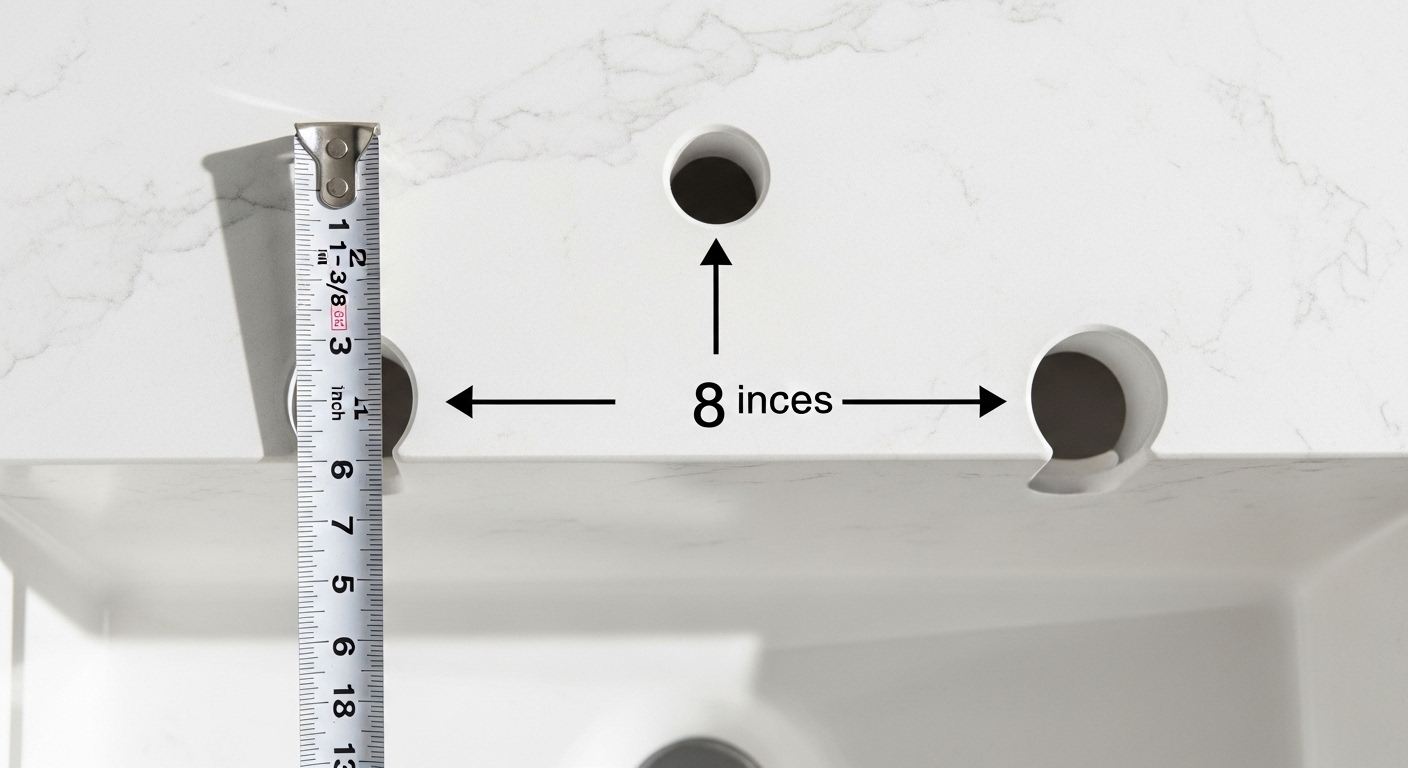
Getting the 3 hole faucet hole size right is the single thing that decides whether your new faucet drops in and tightens down in ten minutes — or whether you’re standing at the hardware store on a Sunday holding a tape measure and a faucet that won’t seat. The good news: there are only two measurements that matter, and both are standardized across the U.S. plumbing industry. Once you know the hole diameter and the hole spacing, you can match almost any 3 hole faucet to almost any sink.
This guide walks through exactly what those numbers are, how to measure your existing setup, the difference between centerset and widespread (they’re both “3 hole” but very different), and how to handle the classic problems — holes that are too big, too small, or one hole too many.
What Is the Standard Hole Size for a 3 Hole Faucet?
The standard mounting hole for a 3 hole faucet is 1‑3/8 inch (35 mm) in diameter. That’s the size drilled into virtually every drop-in sink, undermount sink, and pre-drilled bathroom vanity top sold in North America, and it’s the size faucet manufacturers design their shanks and mounting hardware around.
A little breathing room is built in on purpose. Most faucet manufacturers list a minimum hole requirement of 1‑1/4 inch (32 mm) and a maximum of about 1‑1/2 inch (38 mm). So even if your holes are a hair over or under 1‑3/8″, you’re usually fine. The faucet’s base plate (also called an escutcheon or deck plate) is sized to cover a slightly oversized hole, and the mounting nut underneath threads onto a shank that’s narrower than the hole.
Here’s the part people miss: “3 hole” describes the number of holes, not the spacing. Three holes can be packed tightly together (centerset) or spread far apart (widespread), and those are two completely different faucet families that are not interchangeable. Diameter is the same for both — 1‑3/8″ — but the spacing is what you have to match.
Why 1‑3/8 inch specifically?
The 1‑3/8″ standard exists because it comfortably clears the threaded shanks and supply-line connections that pass through the deck, while still being small enough that the faucet body and base plate hide it completely. It’s the same reason kitchen and bar faucets use it too. A shank needs room for the tailpiece, the mounting hardware, and — on pull-down or single-handle models — the hose or connector passing through. Anything smaller than 1‑1/4″ starts to pinch those parts; anything larger than 1‑1/2″ risks poking out past the edge of the base plate.
Centerset vs. Widespread: Which 3 Hole Faucet Do I Actually Have?
You have a centerset faucet if your three holes are 4 inches apart from the center of the far-left hole to the center of the far-right hole. You have a widespread faucet if those outer holes are 6 to 16 inches apart — most commonly 8 inches. Both use 1‑3/8″ holes; only the spacing differs.
This is the most important distinction in the whole topic, because a widespread faucet will not fit a 4‑inch centerset sink, and vice versa. Measure center-to-center on the two outer holes (the handle holes) and you’ll instantly know which family you’re in.
| Configuration | Hole diameter (each) | Center-to-center spacing | How the parts connect | Best for |
|---|---|---|---|---|
| Centerset (4″) | 1‑3/8″ (35 mm) | 4 inches, outer hole to outer hole | Handles + spout share one solid base; often connected under the deck | Standard bathroom sinks, tight vanities, budget builds |
| Widespread (8″) | 1‑3/8″ (35 mm) | 6″–16″ (8″ is standard) | Three separate pieces joined by flex hoses under the deck | Larger vanities, upscale looks, custom spacing |
| Mini-widespread | 1‑3/8″ (35 mm) | 4 inches, but with a slim escutcheon look | Separate-looking handles that still fit a 4″ sink | Retrofitting a widespread look onto a 4″ sink |
| 8″ spread kitchen/bridge | 1‑3/8″ (35 mm) | 8 inches typical | Two-handle kitchen or bar faucet on deck | Kitchen and bar sinks with 3 holes |
If you’re shopping the widespread route, it’s worth reading our deeper breakdown of the best bathroom faucets with an 8 inch spread, because 8″ is the spacing you’ll encounter most often and it has its own fit quirks. And because widespread faucets connect their three pieces with flexible hoses underneath, it helps to understand what a widespread faucet connector is and how to pick the right one before you buy — a mismatched connector is the second most common reason a “correctly sized” faucet still won’t finish the install.
How Do I Measure My 3 Hole Faucet Hole Size Correctly?
Measure the diameter of one hole across its widest point (should be ~1‑3/8″), then measure center-to-center between the two outer holes (4″ for centerset, ~8″ for widespread). Those two numbers are all you need to buy the right faucet. Do it with the old faucet removed for accuracy, but you can estimate with it in place.
Here’s the reliable way to do it:
- Turn off the water and remove the old faucet so you can see the bare holes. You can measure around an installed faucet, but the base plate hides the true hole edges.
- Measure one hole’s diameter. Lay a tape or ruler across the opening at its widest. Expect 1‑3/8″. If it reads between 1‑1/4″ and 1‑1/2″, you’re still in standard territory.
- Measure center-to-center on the outer holes. Put the tape on the center of the left hole and read to the center of the right hole. 4″ = centerset. 6″–16″ (usually 8″) = widespread.
- Confirm the middle hole lines up. On a true 3‑hole deck the center hole sits evenly between the two outer ones. If it’s off, you may have a mixed or custom drilling.
- Check deck thickness. Measure how thick your countertop or sink deck is (typically 3/4″ to 1‑1/2″). Faucets list a maximum deck thickness their mounting studs can clamp.
One tip from experience: measure in millimeters if you can. 35 mm reads cleaner than “1‑3/8‑ish,” and imported sinks are often metric. A 35 mm hole and a 1‑3/8″ hole are functionally identical.
What if my holes are drilled off-standard?
Occasionally — especially with older or imported stone tops — you’ll find holes that are 1‑1/2″+ or spaced oddly. If the diameter is oversized, a wider base plate or a mounting flange usually covers it. If the spacing is off, that’s harder: you either need a faucet built for that spacing or a deck plate that bridges the gap. When spacing is the problem, the spout reach and body size of your chosen faucet start to matter, which is why it’s worth checking guidance on choosing the right spout reach for a compact tap so the faucet you force to fit doesn’t end up dumping water at the wrong spot in the basin.
Can I Put a Single-Hole Faucet on a 3 Hole Sink?
Yes. A single-hole faucet installs on a 3 hole sink using a deck plate (escutcheon plate) that covers the two outer holes while the faucet body drops through the center hole. This is one of the most common and easiest conversions, and most single-handle faucets either include the deck plate or offer it as a snap-on accessory.
The reverse — putting a 3 hole faucet on a single-hole sink — is much harder, because you can’t add holes to a porcelain or stainless sink without specialized tools and real risk of cracking it. So when in doubt, more holes give you more options. A 3 hole deck can accept:
- A true 3‑piece centerset or widespread faucet (holes used as drilled).
- A single-hole faucet with a deck plate hiding the outer two holes.
- A single-hole faucet plus a separate soap dispenser or side sprayer in one of the outer holes.
- A two-handle faucet with a decorative cap plugging any unused hole.
The deck plate approach is genuinely painless — it’s the same 1‑3/8″ holes doing the work, just covered differently. If you’re going from a two-handle to a sleek single-handle look, this is usually the route.
Does the Sink or the Faucet Determine the Hole Size?
The sink (or countertop) determines the hole size and spacing you have to work with; the faucet has to match it, not the other way around. You measure the holes you’ve got, then buy a faucet configured for that diameter and spacing. Since 1‑3/8″ diameter is universal, the real matching happens on spacing — centerset vs. widespread.
There’s one exception: if you’re buying a brand-new sink and faucet together, the sink’s drilling decides everything, so pick the faucet style first, then buy the sink drilled to match. Vessel sinks and undermount installs change this too — with those, the faucet mounts through the countertop, and you (or your fabricator) drill the holes, so you control the size and spacing directly. For a granite or quartz top, a fabricator drills the 1‑3/8″ holes with a diamond core bit.
What about kitchen and bar 3 hole faucets?
Kitchen and bar setups follow the same 1‑3/8″ rule per hole, but the spacing is usually 8″ for a two-handle bridge or deck faucet, with the extra holes reserved for a side sprayer, soap dispenser, or air gap. The diameter never changes — a hole is a hole at 1‑3/8″ whether it’s feeding a bathroom lavatory faucet or a kitchen bridge faucet. Only the spacing and the accessories differ.
What Problems Come From the Wrong Hole Size — and How Do I Fix Them?
The two failures are holes too big (faucet wobbles or the base doesn’t cover the gap) and holes too small or too tightly spaced (the faucet won’t seat). Oversized holes are almost always fixable with a larger base plate or a mounting washer; undersized holes need re-drilling, which is doable on stone but not on porcelain or stainless without professional tools.
| Problem | What you’ll see | Fix |
|---|---|---|
| Holes slightly oversized (up to 1‑1/2″) | Faucet still seats, small gap around shank | Standard base plate + rubber gasket covers it; no action needed |
| Holes well over 1‑1/2″ | Base plate doesn’t fully cover; faucet can shift | Add a wider mounting flange/washer or a larger deck plate |
| Holes under 1‑1/4″ | Shank won’t pass through | Re-drill with a diamond bit (stone) — not DIY-safe on porcelain/steel |
| Wrong spacing (widespread faucet, 4″ holes) | Handles won’t reach the outer holes | Return faucet and buy the matching configuration |
| Extra unused hole | One hole left open after install | Hole cover / chrome plug, or add a soap dispenser |
The takeaway: an oversized hole is a five-dollar accessory fix; an undersized or mis-spaced hole is a return-the-faucet problem. That’s exactly why measuring first — before you buy — saves the most grief.
FAQ
Is a 3 hole faucet hole size the same for kitchen and bathroom?
Yes. The individual hole diameter is 1‑3/8 inch (35 mm) for both kitchen and bathroom 3 hole faucets. What differs is the spacing — bathroom faucets are usually 4″ centerset or 8″ widespread, while kitchen 3‑hole setups are typically 8″ with the extra holes for a sprayer or soap dispenser.
What is the minimum hole size a 3 hole faucet needs?
Most manufacturers require a minimum of 1‑1/4 inch (32 mm) diameter, though 1‑3/8 inch is the standard target. If your holes are smaller than 1‑1/4″, the faucet shank won’t pass through and you’ll need to enlarge them — safe on stone with a diamond core bit, risky on porcelain or stainless.
Can I convert a 3 hole sink to a single-hole faucet?
Absolutely. Use a single-hole faucet with a deck plate (escutcheon) that covers the two outer holes while the faucet body drops through the center hole. Most single-handle faucets include or offer this deck plate, making it one of the easiest bathroom faucet swaps.
How far apart are the holes on a widespread 3 hole faucet?
Widespread faucets have outer holes spaced 6 to 16 inches center-to-center, with 8 inches being by far the most common. Each hole is still the standard 1‑3/8″. The three pieces — spout and two handles — connect underneath the deck with flexible supply hoses.
Will a 4-inch centerset faucet fit holes drilled 8 inches apart?
No. A 4″ centerset faucet is built for holes 4 inches apart and physically cannot span 8‑inch-spaced holes. You’d need a widespread (8″) faucet for that sink. This is why measuring center-to-center on the outer holes before buying is essential — the diameter matching (1‑3/8″) is the easy part.
Do I need to remove my old faucet to measure the holes?
It’s best to, because the base plate hides the true hole edges. For a rough check you can measure around an installed faucet, but for buying decisions — especially confirming diameter and exact center-to-center spacing — take the old faucet off first for an accurate reading.
A Note From the evefaucet Team
This guide was written and reviewed by the product specialists at evefaucet, where we design and test bathroom and kitchen faucets against ASME A112.18.1 / CSA B125.1 fit-and-flow standards and back our fixtures with a limited lifetime warranty on finish and function. Every faucet we ship lists its exact hole diameter, spacing, and maximum deck thickness on the spec sheet, because we’ve handled enough returns to know that a 1‑3/8″ hole and a mismatched 4″-vs-8″ spread are the two things buyers most often get wrong. When in doubt, measure twice, and reach out to our support team with your numbers before you order — we’ll confirm the fit. For related installs, our guides on widespread faucet connectors and 8‑inch spread bathroom faucets pair naturally with this one.