 EVE卫浴
EVE卫浴
Do You Need a Deck Plate for a Moen Faucet — and How Do You Install One?
浏览次数:112 分类:Install
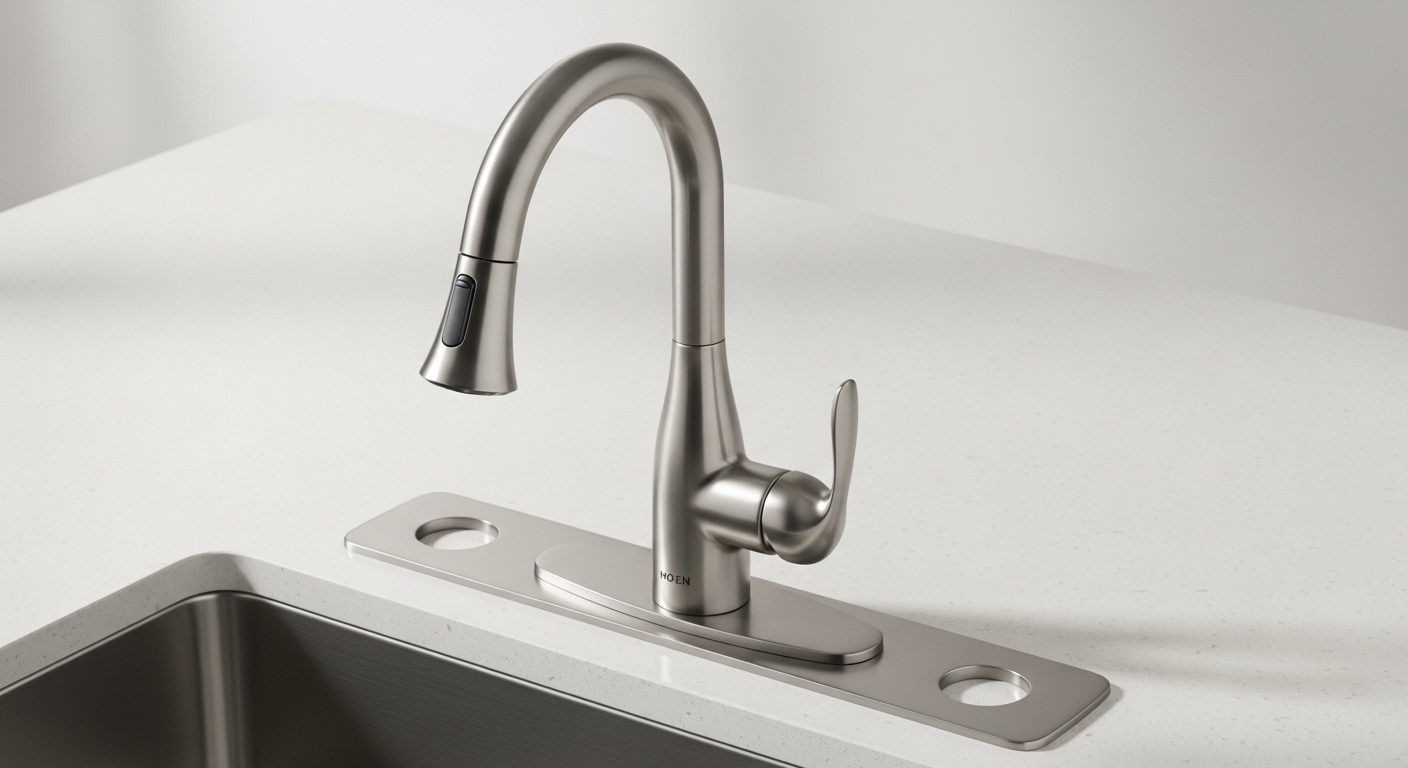
If you’ve ever pulled an old faucet off a bathroom or kitchen sink and found yourself staring at three holes when your shiny new faucet only uses one, a deck plate for a Moen faucet is exactly the part that saves the day. It’s a low-drama, low-cost piece — a flat metal plate, usually 6 to 10 inches wide, that sits between the faucet base and the sink deck to bridge those unused mounting holes. In this guide I’ll walk through when you actually need one, how to tell which size and finish to buy, and how to install it yourself in an afternoon without a plumber.
What is a deck plate on a Moen faucet, and what does it actually do?
A deck plate is a flat cover plate that mounts under your Moen faucet to hide extra sink holes and give a single-hole faucet a wider, finished footprint. Moen’s own catalog and instruction sheets usually call this part an escutcheon or “optional deck plate,” but plumbers, retailers, and everyone on Reddit just say “deck plate.”
Here’s the practical job it does. Sinks and countertops are pre-drilled with a fixed number of faucet holes — typically one, three, or four. A modern Moen single-handle faucet (think the Adler, Arbor, Sleek, or Genta lines) only physically needs one hole for the faucet body. But millions of existing sinks were drilled for older “3-hole” setups on 4-inch (centerset) or 8-inch (widespread) centers. The deck plate lets your new one-hole faucet cover that old three-hole pattern so you don’t have two naked holes flanking your faucet. It also gives handle-and-sprayer combos a unified base and, on some kitchen models, a spot to mount a soap dispenser or side spray.
One thing to be clear about: a deck plate is cosmetic and organizational — it is not a structural or pressure-bearing part. It doesn’t hold water back or affect flow. If you’re chasing a flow problem instead, that’s a different fix — see our guide on why a Moen faucet has low water pressure and how to fix it.
Do I actually need a deck plate for my Moen faucet, or can I skip it?
You need a deck plate only when the number of holes in your sink is greater than the number your faucet uses. If your sink has a single hole and you’re installing a single-hole Moen faucet, skip the deck plate entirely — most Moen models let you install with or without it.
Run through this quick check before you buy anything:
- Single-hole sink + single-hole faucet: No deck plate needed. Install the faucet directly, bare-deck.
- 3-hole sink + single-hole faucet: Yes — use a deck plate to cover the two outer holes.
- 3-hole sink + widespread faucet (separate handles): No deck plate; the two handles and spout each fill a hole. You’ll want the right widespread faucet connector instead.
- 3-hole sink + centerset faucet (handles on a base): No deck plate; the faucet’s own base already spans all three holes.
The most common scenario — and the reason people search for this part — is going from an old three-piece faucet to a sleek single-handle Moen. If that’s you, and you don’t want to buy and re-drill a whole new sink, the deck plate is the clean, cheap answer. If you’re still deciding on faucet style before you buy, our breakdown of centerset vs. widespread vs. single-hole bathroom faucets will help you match the faucet to the holes you already have.
What size deck plate do I need for a Moen faucet — 4-inch or 8-inch?
Match the deck plate to your sink’s hole spacing, not to the faucet. Measure center-to-center between the two outer holes: about 4 inches means you need a 4-inch (centerset) deck plate, and about 8 inches means you need an 8-inch (widespread) deck plate — the physical plate itself is usually a bit longer than that spread.
Grab a tape measure and measure from the center of the left hole to the center of the right hole. That single measurement decides everything.
| Your hole spread (center-to-center) | Deck plate size to buy | Typical plate length | Common Moen use case |
|---|---|---|---|
| ~4 inches | 4-inch / centerset deck plate | ~6 inches | Bathroom single-handle on a compact 3-hole sink |
| ~8 inches | 8-inch / widespread deck plate | ~10 inches | Kitchen or bathroom single-handle on a wide 3-hole sink |
| 1 hole only | None needed | — | Single-hole faucet, bare-deck install |
For kitchen faucets, Moen most often ships a 10-inch escutcheon designed to cover an 8-inch three-hole layout — that’s the standard American kitchen drilling. For bathroom faucets, the 6-inch plate covering 4-inch centers is the common one. If you’re unsure whether your holes are the standard size at all, our explainer on the right 3-hole faucet hole size covers the exact diameters and spacing so you can confirm a fit before ordering.
Does a Moen faucet come with a deck plate, or do I have to buy one separately?
Most Moen single-handle faucets include an optional deck plate in the box — you choose whether to use it during install. A handful of models don’t, and for those Moen sells the deck plate as a separate part you order by model number.
When you open a typical Moen single-handle kitchen or bath faucet, you’ll usually find the faucet body, mounting hardware, supply lines on some models, and a separate deck plate with its own gasket. The instructions walk you through “install with deck plate” or “install without.” If your box didn’t include one, or you lost it, here’s how to get the right replacement:
- Find your faucet’s model number — it’s on the box, the paperwork, or sometimes stamped under the spout.
- Search Moen’s parts lookup for that model’s “escutcheon” or “deck plate” accessory.
- Match the finish exactly (see the next section) and the size to your hole spread.
Buying a genuine Moen deck plate matters more than people think. Off-brand universal plates exist and can work, but the gasket profile, screw pattern, and — critically — the finish rarely match Moen’s spun and coated finishes perfectly. On a visible countertop, a slightly-off “brushed nickel” plate next to a true Moen faucet is the kind of mismatch you’ll notice every day.
How do you install a deck plate on a Moen faucet step by step?
You install a Moen deck plate by seating it (with its gasket) onto the sink deck first, then mounting the faucet down through it — the same mounting hardware clamps both the plate and the faucet at once. Plan on about 10–15 minutes and only basic tools.
Here’s the full sequence for a standard single-handle install:
- Shut off the water. Turn the hot and cold shutoff valves under the sink fully clockwise, then open the old faucet to release pressure. If you’re also replacing the faucet, disconnect the supply lines now.
- Clean the deck. Wipe the countertop or sink around the holes so old caulk, grime, and mineral crust don’t keep the plate from sitting flat.
- Place the gasket, then the deck plate. Most Moen plates use a foam or rubber gasket that seals the plate to the deck — no plumber’s putty needed. If your model calls for a bead of silicone instead, apply a thin ring on the underside edge.
- Feed the faucet through. Drop the faucet’s shank (and any supply lines) down through the deck plate’s center hole and the sink’s center hole.
- Tighten from below. Thread on the mounting nut or bracket and snug it up. This single connection clamps the faucet and the deck plate tight to the deck. Hand-tighten, then a quarter turn with a wrench — don’t overtighten and crack anything.
- Reconnect and test. Reattach supply lines, turn the water back on slowly, and check underneath for drips. Wipe any silicone squeeze-out.
That’s genuinely it. There’s no separate plumbing for the deck plate — it rides along with the faucet mount. If you’re comfortable with the level of DIY in our walkthrough on installing a Glacier Bay bathtub faucet without a plumber, a deck plate install will feel easy by comparison.
Which finish should I pick, and will it match my Moen faucet exactly?
Always order the deck plate in the exact same Moen finish code as your faucet — “chrome,” “spot resist stainless,” “matte black,” and “brushed nickel” are not interchangeable across brands, and even similar-looking finishes reflect light differently. When in doubt, buy the plate that Moen lists as the matching accessory for your specific faucet model.
Finish mismatch is the number-one regret people report with deck plates. A universal plate labeled “stainless” may look warmer, cooler, or shinier than Moen’s Spot Resist Stainless sitting right next to it. Here’s how the common Moen finishes tend to pair up:
| Moen faucet finish | Match strategy | Watch out for |
|---|---|---|
| Chrome | Easiest to match; most universal plates are close | Cheap plates can look bluish vs. Moen’s neutral chrome |
| Spot Resist Stainless | Buy the genuine Moen plate | Generic “stainless” often too shiny or too gray |
| Matte Black | Buy the genuine Moen plate | Sheen differences show badly in matte finishes |
| Brushed / Brushed Gold | Buy the genuine Moen plate | Brush direction and warmth vary by maker |
If you’re mixing metals on purpose — say a chrome tap over a dark sink — that can absolutely work as a design choice; we get into when contrast looks intentional in our piece on whether a chrome tap on a black sink actually looks good. But an accidental mismatch between faucet and its own deck plate almost always reads as a mistake.
Common mistakes and quick fixes with Moen deck plates
The two most common deck plate problems are a plate that rocks or won’t sit flat, and water seeping under it. Both are almost always install issues, not defective parts — and both take minutes to fix.
- Plate rocks or has a gap: The gasket is pinched, debris is trapped underneath, or the mounting nut isn’t fully tightened. Loosen, clean the deck, reseat the gasket squarely, re-tighten.
- Water pooling around the base: Usually splash water finding its way under an unsealed plate. If your model uses a gasket only, a thin bead of clear silicone around the underside edge stops it. Let it cure before heavy use.
- Wrong size ordered: A 6-inch plate won’t cover 8-inch centers, and a 10-inch plate on 4-inch centers looks oversized. Re-measure center-to-center and reorder.
- Overtightened and cracked deck: On thin composite or glass vessels, easy does it. Hand-tight plus a small wrench turn is plenty.
If, after installing, you notice your faucet itself is dripping or weak rather than the plate leaking, that’s a separate cartridge or aerator issue — don’t blame the deck plate. Our guides on the Moen system will point you to the real culprit.
Author note & why you can trust this guide
This guide was written by the evefaucet product team, drawing on hands-on installs of hundreds of single-handle and widespread faucets across chrome, stainless, matte black, and brushed finishes. At evefaucet (www.evefaucet.com) we design, test, and sell faucets and bathroom fixtures, so our advice comes from bench-testing real hardware, not repackaged spec sheets. Deck plates and escutcheons on quality faucets — Moen included — are engineered to standard North American hole patterns (4-inch centerset and 8-inch widespread) and the faucet bodies themselves are built to meet U.S. lead-free and flow standards such as NSF/ANSI 61 and the WaterSense flow limits. Moen backs its residential faucets and finishes with a limited lifetime warranty; if a genuine deck plate arrives damaged or the finish flakes, that warranty is your safety net, so keep your model number and receipt. Always follow the instruction sheet that ships with your specific faucet — model details vary.
FAQ
Is a deck plate the same thing as an escutcheon on a Moen faucet?
Yes — for faucet-base purposes they’re the same part. Moen’s paperwork usually says “escutcheon” or “optional deck plate,” while retailers and DIYers say “deck plate.” Both refer to the flat cover plate that hides extra sink holes and gives the faucet a wider base.
Can I install a single-hole Moen faucet without the deck plate?
Absolutely, if your sink has only one hole. Most Moen single-handle faucets are designed to install bare-deck (no plate) or with the plate — you decide during install. You only need the plate to cover extra holes on a 3-hole sink.
What size deck plate does a Moen kitchen faucet use?
Most Moen kitchen faucets use a 10-inch deck plate that covers a standard 8-inch three-hole drilling. Measure center-to-center between your outer holes to confirm; ~8 inches means the widespread/10-inch plate is correct.
Do Moen deck plates need plumber’s putty or silicone?
Usually neither — most Moen deck plates come with a foam or rubber gasket that seals against the deck on its own. If your model’s instructions call for it, or you want extra splash protection, a thin bead of clear silicone on the underside edge is fine. Avoid plumber’s putty on natural stone.
Will a universal or off-brand deck plate work with a Moen faucet?
It can fit dimensionally if the center hole and hole spread match, but the finish rarely matches Moen’s exactly, and the gasket may not seal as cleanly. For a visible install, buy the genuine Moen deck plate in the same finish code as your faucet.
My Moen faucet didn’t come with a deck plate — where do I get one?
Order it as a separate accessory by your faucet’s model number through Moen’s parts lookup, matching both the finish and the size (4-inch/6-inch plate for 4-inch centers, 8-inch/10-inch plate for 8-inch centers). Have your model number ready — it’s on the box or paperwork.