 EVE卫浴
EVE卫浴
What Is a Widespread Faucet Connector, and How Do You Pick the Right One in 2026?
浏览次数:397 分类:公司产品
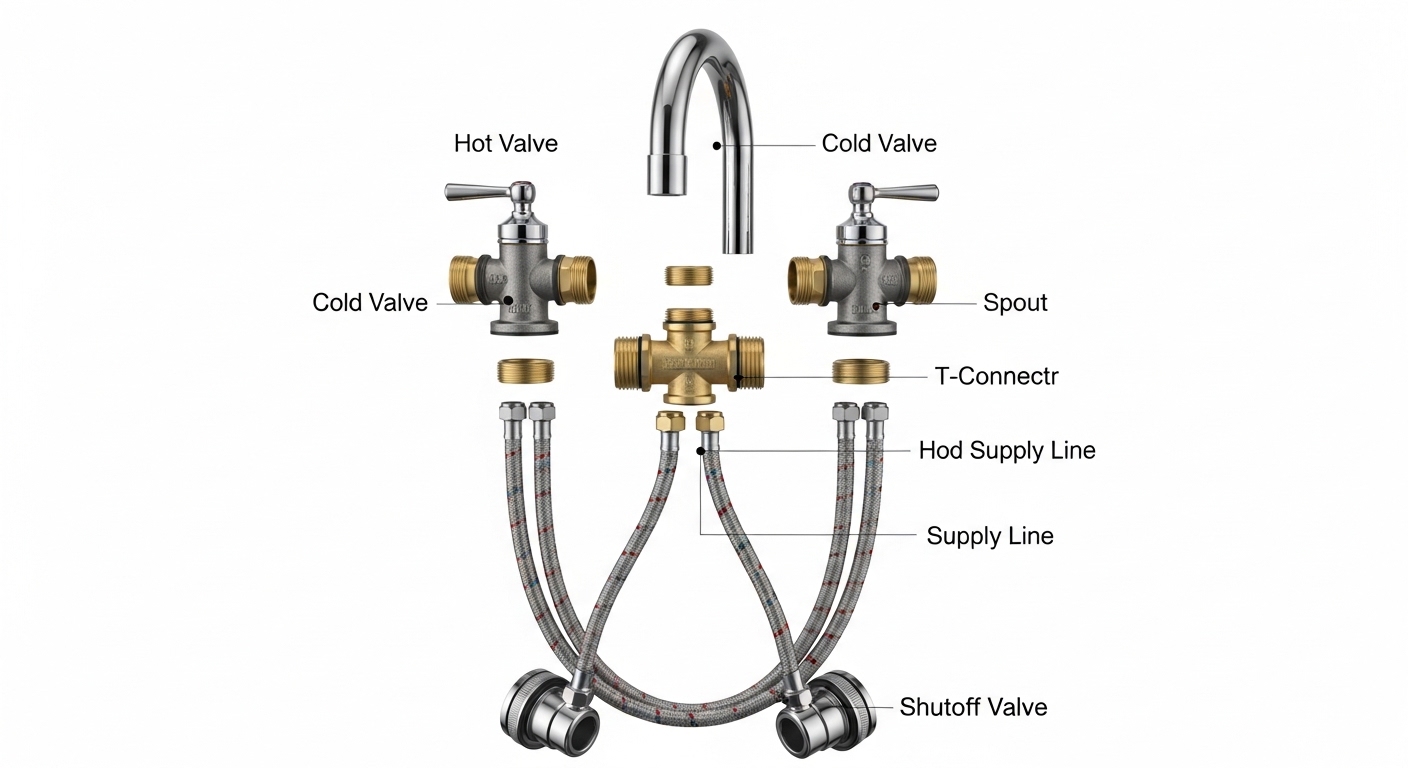
If you’ve ever pulled a widespread faucet out of the box and found a tangle of hoses, a brass T-piece, and two skinny valve bodies with no obvious “one hose fits all,” you’re in the right place. The widespread faucet connector is the small-but-critical part that ties that whole three-piece system together, and getting it wrong is the difference between a leak-free install in 30 minutes and three trips to the hardware store. Below, we’ll walk through exactly what these connectors are, the sizes and types you’ll run into, how to measure so you buy the right one the first time, and how to install it without calling a plumber.
What exactly is a widespread faucet connector — and why does a widespread faucet need one at all?
A widespread faucet connector is the plumbing linkage that carries water between the three separate pieces of a widespread faucet. Unlike a single-hole or centerset faucet where everything is one casting, a widespread faucet is genuinely three independent parts: a hot handle/valve, a cold handle/valve, and a spout in the middle. Water has to travel from each valve body into the spout, and from your wall shutoffs up into each valve. The connectors are what make that possible.
In practice you’re dealing with two connector jobs on the same faucet:
- Valve-to-spout connectors — usually a pair of flexible hoses (often 20″–24″ long) that meet at a central brass T-fitting under the spout. This is the part unique to widespread faucets. The T lets both hot and cold merge before they rise into the spout.
- Supply connectors — the braided stainless or PEX hoses that run from each valve body down to your under-sink shutoff valves. These are the same type of supply lines any faucet uses, but the length and thread must match your setup.
Because the two valve bodies sit 8 inches apart (measured center-to-center on a standard “8-inch spread”), the connectors have to be long enough and flexible enough to reach across that gap and still tuck neatly under the deck. That geometry is the whole reason a widespread faucet ships with dedicated connector hardware instead of a single rigid inlet. If you want the full picture on the 8-inch layout itself, our 2026 widespread buyer’s comparison guide for 8-inch spread bathroom faucets breaks down spacing, deck cutouts, and fit.
What size is a widespread faucet connector — and how do I know which threads I have?
Most widespread faucet connectors in the U.S. use one of two connection sizes: 3/8″ compression on the supply-line end (the end that meets your shutoff valve) and either 1/2″ NPT or a proprietary quick-connect on the valve-body end. The center T-fitting is typically a brass 1/2″ or push-fit coupling specific to that faucet brand.
Here’s the honest reality: the valve-to-spout connectors and the center T are often faucet-specific, so your safest replacement is the manufacturer’s part for that exact model. The supply hoses, on the other hand, are standardized and you can buy them anywhere. To identify what you have, look at three things:
- The shutoff-valve end — most modern angle stops are 3/8″ compression outlets. Older homes sometimes have 1/2″.
- The valve-body inlet thread — measure the outside diameter of the male threads or the inside of the female coupling. 1/2″ NPT is the most common.
- The T-connector style — is it threaded, or does it snap on with a locking collar (quick-connect)? Quick-connect T’s are increasingly common because they’re tool-free.
| Connector part | Typical thread/size | Where it connects | Standard or model-specific? |
|---|---|---|---|
| Supply hose (braided) | 3/8″ compression × 1/2″ FIP | Shutoff valve → valve body | Standard — buy anywhere |
| Valve-to-spout hose | Model-specific coupling, ~20″–24″ | Valve body → center T | Usually model-specific |
| Center T-fitting | Brass 1/2″ or quick-connect | Both hoses → spout riser | Model-specific |
| Spout riser tube | Push-fit or threaded | T-fitting → spout base | Model-specific |
How long should the connector hoses be for an 8-inch widespread install?
For a standard 8-inch widespread faucet, the valve-to-spout hoses need to be roughly 18″–24″ so they can reach across the spread with slack to spare, and your supply hoses should be long enough to run from the valve body to the shutoff with a gentle loop — never pulled taut. As a rule of thumb, measure the straight-line distance from your valve inlet to the shutoff and add 4–6 inches so nothing is under tension.
A hose that’s too short is the single most common reason a widespread install leaks. When a braided line is stretched tight, the compression nut can’t seat squarely and the ferrule won’t seal — you get a slow weep that shows up hours later. Too long is far less of a problem; excess hose just loops gently under the sink. If your rough-in is unusual — a deep vanity, an off-center drain crowding the shutoffs — err longer. This is also where you double-check your shower and sink rough-in dimensions in general; if you’re renovating, our guide on the right rough-in distance from the finished wall is a useful companion for planning valve placement.
Can I use any braided supply line, or does it have to be the faucet’s connector?
For the supply lines (shutoff-to-valve), yes — a quality universal braided stainless hose with the correct 3/8″ compression and 1/2″ FIP ends will work on virtually any widespread faucet. For the valve-to-spout connectors and the center T, no — those are usually specific to the faucet’s internal geometry, and you should replace them with the manufacturer’s part.
Why the difference? The supply lines just carry water at a standard thread. But the valve-to-spout hoses have couplings machined to seat against that particular valve body, and the T-fitting is sized to the spout riser. Swap in a generic T and you risk a coupling that won’t seal or a riser that sits at the wrong height. When in doubt, take a photo of your connector and match the part number, or contact the brand. Here at evefaucet, every widespread faucet ships with its matched connector kit, and we stock replacement T-fittings and spout risers separately so you’re never stuck sourcing an oddball part.
A quick note on materials: braided stainless steel with an EPDM inner tube is the durable choice for supply lines — it resists the mineral scaling that plagues cheaper vinyl hoses. If your home has hard water, that matters, because scale build-up inside a connector narrows the bore and chokes your flow over time. (Related: if your existing faucet is already suffering from buildup, our walkthrough on cleaning a faucet head from hard water without wrecking the finish covers the aerator and spout side of the same problem.)
How do you install a widespread faucet connector without leaks (and without a plumber)?
You install a widespread faucet connector by attaching the two valve bodies and spout to the deck, joining the valve-to-spout hoses to the center T under the sink, then running your braided supply lines from each valve down to the shutoffs — hand-tightening plus a quarter-to-half turn with a wrench, never gorilla-tight. Here’s the ordered process:
- Shut off the water at the under-sink stops and open the old faucet to drain pressure.
- Set the three pieces — drop the hot valve, cold valve, and center spout into their deck holes and secure them from below with the mounting nuts. Confirm the 8-inch spread lines up with your holes before tightening.
- Connect the valve-to-spout hoses to the T. Thread or snap each hose onto the central T-fitting. If it’s a threaded brass T, wrap the male threads with two to three turns of PTFE (plumber’s) tape. If it’s quick-connect, push until the collar clicks and tug to confirm it’s locked.
- Attach the spout riser from the T up into the spout base.
- Run the supply lines. Connect one braided hose from each valve inlet down to its matching hot/cold shutoff. Hand-tighten the compression nuts, then snug about a quarter turn with a wrench.
- Pressure-test. Open the shutoffs slowly, then open the faucet. Watch every joint for 60 seconds, then check again after an hour — slow weeps are the ones that hide.
If you do spot a drip, don’t just crank harder. Back the nut off, check that the hose isn’t stretched or cross-threaded, add PTFE tape on any tapered thread, and re-seat it square. Overtightening a compression nut deforms the ferrule and makes leaks worse. If your leak is at the faucet base rather than the connector, that’s a different fix — our guide on why a kitchen faucet leaks at the base and how to fix it yourself uses the same diagnostic logic that applies to bathroom widespreads.
Widespread connector vs. centerset: what’s actually different for the DIYer?
The core difference is that a widespread faucet has three separate connection points and a center T-fitting, while a centerset faucet is a single unit with one or two inlets — so a widespread install has more connectors to seal, but each one is individually easier to reach. More joints means more places to check, not necessarily harder work.
| Factor | Widespread faucet | Centerset faucet |
|---|---|---|
| Number of deck holes | 3 (8″ spread) | 1 or 3 (4″ spread) |
| Connector count | 2 supply + 2 valve-to-spout + 1 T | 2 supply (often pre-attached) |
| Center T-fitting | Required | Not used |
| Install difficulty | Moderate — more joints to seal | Easy — fewer joints |
| Best for | Larger vanities, upscale look | Compact or budget setups |
For most people, the widespread’s extra connectors are worth it: the 8-inch spread looks more custom, the handles are easier to grip, and if one valve cartridge ever fails you replace just that side. The trade-off is that measuring and buying the right connector kit matters more — which is exactly why identifying your thread sizes up front pays off.
How much should a widespread faucet connector cost, and when do you replace vs. reuse?
A universal braided supply line runs about $6–$12 each, a replacement brass T-fitting or spout riser is typically $10–$25, and a full manufacturer connector kit for a widespread faucet usually lands between $20 and $45. Replace connectors — don’t reuse them — whenever you install a new faucet, and inspect old ones any time you’re under the sink.
Reusing old braided lines to “save a few bucks” is a classic false economy. Rubber-lined hoses harden and crack with age, and a corroded compression ferrule rarely re-seats cleanly on a new valve. Signs a connector needs replacing:
- Visible green/white corrosion at the fittings
- Bulging, kinking, or a soft spot in the braid
- Any moisture or mineral crust at a joint
- Reduced flow that cleaning the aerator doesn’t fix (scale inside the hose)
When you buy new, spend the extra dollar or two on stainless braid over vinyl. It’s the cheapest insurance in your whole bathroom.
FAQ
Are all widespread faucet connectors the same size?
No. The supply-line ends are usually standardized at 3/8″ compression by 1/2″ FIP, so those are interchangeable. But the valve-to-spout hoses and the center T-fitting are frequently model-specific, machined to seat against that particular faucet’s valve bodies and spout riser. Always match the manufacturer’s part for the T and riser.
Can I replace just the connector hoses without replacing the whole faucet?
Yes, and you often should. Braided supply lines are wear parts — swapping a cracked or corroded hose is a five-minute job that doesn’t touch the faucet body. Replacing a model-specific valve-to-spout hose or T-fitting is also doable; just order the matching part number for your faucet so the couplings seal correctly.
Do widespread faucet connectors need plumber’s tape?
Only on tapered pipe threads (like 1/2″ NPT). Wrap PTFE tape two to three turns clockwise on those. Compression fittings and quick-connect couplings do not need tape — they seal on a ferrule or an O-ring, and adding tape there can actually prevent a proper seal. Match the sealing method to the connector type.
Why is my widespread faucet leaking under the sink after I installed the connectors?
The three usual culprits are an over-stretched supply hose that can’t seat squarely, a cross-threaded compression nut, or a T-fitting that isn’t fully clicked/tightened. Back the fitting off, confirm the hose has slack, re-seat it square, add tape on any NPT thread, and re-tighten gently. Overtightening deforms the ferrule and makes the leak worse, not better.
How long do widespread faucet connectors last?
A quality braided stainless connector typically lasts 8–10 years, though hard water and constant pressure can shorten that. Brass T-fittings last far longer — often the life of the faucet — since they don’t flex. The smart move is to inspect all connectors any time you’re under the sink and replace braided lines proactively at around the decade mark before they fail.
The bottom line
A widespread faucet connector isn’t one part — it’s a small system: two supply lines, two valve-to-spout hoses, a center T, and a spout riser working together to tie three separate faucet pieces into one leak-free unit. Nail three things — correct thread size, adequate hose length, and the right T-fitting for your model — and the install is genuinely a weekend-morning job. Buy stainless-braided supply lines, replace rather than reuse, and pressure-test before you walk away. If you’re choosing a new widespread faucet altogether, start with the layout and finish first, then let the included connector kit handle the plumbing side.
Author note: This guide was written by the evefaucet product team, drawing on real bench-testing of widespread faucet connector kits and years of fielding installer questions. evefaucet designs and manufactures bathroom and kitchen fixtures with connectors validated to standard 3/8″ and 1/2″ plumbing threads, and our widespread faucets ship with matched, pressure-tested connector kits backed by our limited lifetime warranty on the faucet body and finish. Fixtures are tested to meet U.S. plumbing standards (including ASME A112.18.1 / NSF/ANSI 61 material safety) so the parts you connect are certified for potable water.