 EVE卫浴
EVE卫浴
What’s the Best Low Cost Kitchen Faucet You Can Actually Buy Without Regretting It in 2026?
浏览次数:181 分类:Compare
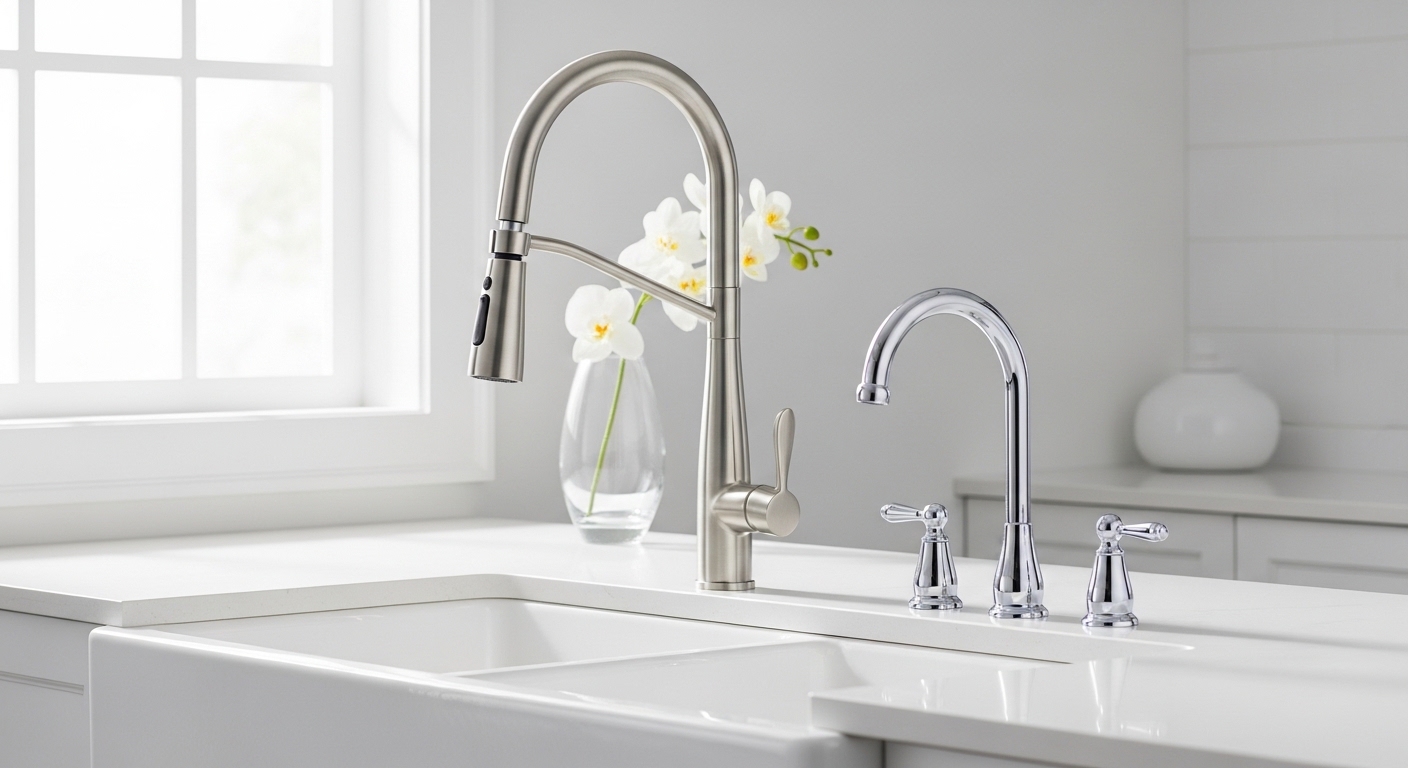
If you’re hunting for the best low cost kitchen faucet, here’s the honest truth up front: “cheap” and “good” aren’t opposites in 2026 — but “cheapest” and “good” usually are. The sweet spot sits between roughly $60 and $150. Below that you start gambling on plastic internals and thin finishes that peel; above it you’re mostly paying for brand names and cosmetic touches you don’t need. This guide walks you through what actually matters, what you can safely skip, and how to spot a bargain faucet that lasts a decade versus one that drips within a year.
What makes a low cost kitchen faucet “good” instead of just cheap?
A good budget faucet is defined by three things: a ceramic disc cartridge (not a rubber-washer valve), a metal or stainless waterway instead of pure plastic, and a PVD or brushed finish that resists scratching. Get those three right and the price tag almost doesn’t matter — you’ll get years of drip-free use for well under $150.
The part that fails first on cheap faucets is almost always the valve. A ceramic disc cartridge uses two polished ceramic plates that slide against each other; they don’t wear out the way old rubber washers do, and they’re what stops that maddening slow drip. When a $30 faucet starts leaking after six months, it’s usually a bottom-barrel cartridge or a plastic supply line that cracked. So the single smartest move on a budget is to spend your money on the guts, not the gloss.
Finish matters too, but differently. Brushed nickel and brushed stainless hide water spots and fingerprints far better than polished chrome — which is why a matte finish is the practical budget pick even though chrome is often a couple dollars cheaper. If the listing says “PVD” (physical vapor deposition), that’s a genuinely durable, scratch- and tarnish-resistant coating, and seeing it on a sub-$150 faucet is a great sign.
How much should you actually spend on a budget kitchen faucet?
Plan on $60 to $150 for a faucet that balances price and longevity. Under $60 you’re rolling the dice on internals; $150 to $250 is the mid-range where you pay for brand and design; and honestly, most kitchens never need to go above that. The extra durability from $200+ faucets is real but marginal for typical home use.
Here’s how the tiers break down in plain terms:
| Price tier | What you typically get | Best for | Watch out for |
|---|---|---|---|
| Under $60 | Plastic or zinc body, basic cartridge, thin chrome finish | Rentals, short-term fixes, garage sinks | Plastic waterways, weak spray head, quick drips |
| $60–$150 (sweet spot) | Stainless or brass body, ceramic disc cartridge, pull-down sprayer, braided hose | Most family kitchens | Verify “solid brass” vs. “zinc alloy” |
| $150–$250 | Better finish warranty, smoother pull-down retraction, name brand | Buyers who want a specific designer look | Paying extra for touchless you may not use |
The reason the $60–$150 band wins for value is simple: that’s where manufacturers start including the parts that actually determine lifespan — a real cartridge, a stainless-braided pull-down hose, and a body that isn’t hollow plastic — without charging you for luxury branding. At evefaucet, this is exactly the range we design most of our kitchen line around, because it’s where cost and durability meet for the everyday cook.
Which faucet type gives you the most value for the money?
A single-handle pull-down faucet gives you the best value, hands down. It’s the most useful configuration for real cooking — one hand controls temperature and flow, and the spray head pulls straight down into the sink for rinsing pots and washing produce. Pull-out (horizontal) sprayers and dual-handle bridge faucets look nice but cost more for less everyday convenience.
- Single-handle pull-down: Best all-around value. Easy one-hand operation, tall arc clears big pots, sprayer retracts on a spring or weighted hose. This is what to buy first.
- Pull-out sprayer: Good for shallow or low-clearance sinks under a window. The head pulls toward you horizontally. Slightly pricier for the same quality.
- Dual-handle / bridge: Traditional look, separate hot and cold. More holes to seal, more to leak, usually more money. Skip on a tight budget.
- Touchless: Convenient with messy hands, but adds a sensor and batteries that can fail. Nice-to-have, not a value pick.
If you want a deeper breakdown of the pull-down category specifically, we compared the top picks in the best single handle pull down sprayer kitchen faucet you can actually buy in 2026 — it pairs perfectly with this budget guide.
What features are worth paying for — and which are a waste on a budget?
On a budget, pay for a ceramic disc cartridge, a stainless-steel or solid-brass body, and a braided stainless supply/pull-down hose. Don’t pay extra for touchless sensors, built-in water filtration, or exotic finishes like matte black at a premium — those raise the price without extending the faucet’s life.
Think of it as spending where failure happens. Faucets don’t usually die from bad looks; they die from bad valves and cracked hoses. So here’s the priority order for your dollars:
- Ceramic disc cartridge — non-negotiable. This is your drip insurance.
- Metal waterway (brass or stainless) — resists cracking and doesn’t impart a plastic taste.
- Stainless-braided pull-down hose — the nylon-covered ones abrade and split over years of retracting.
- Spot-resist / PVD finish — worth a few dollars because it keeps the faucet looking new.
- Optional: magnetic spray-head docking (nice, keeps the head from drooping), single-hole or 3-hole flexibility, and a matching deck plate.
Features to treat as extras, not essentials: touchless activation, LED temperature displays, and pot-filler-style articulating arms. They’re fun, but on a low cost faucet they usually mean the manufacturer cut corners somewhere you can’t see to fund the gimmick. If your sink has a specific hole layout, double-check compatibility first — our guide to the right 3-hole faucet hole size and whether it fits your sink saves a lot of return-shipping headaches.
How do you make sure a cheap faucet fits your sink before you buy?
Count your sink’s mounting holes and measure the spacing before ordering. Most modern kitchen sinks have one to four holes; a single-handle faucet needs just one hole but usually ships with an optional deck plate (escutcheon) to cover three. Match the hole count, check the spout reach and height against your window or cabinet, and confirm the deck-hole diameter is the standard 1⅜ inch.
Quick pre-purchase checklist:
- Hole count: 1-hole faucet + deck plate covers a 1- or 3-hole sink. A 3-hole sink can also take a widespread setup.
- Spout height: Measure clearance above the sink — a tall gooseneck can hit a low window sill or upper cabinet.
- Spout reach: The spray should land near the center of the basin, not the back wall or the front edge.
- Under-sink space: Pull-downs need room below for the hose weight to travel. Cramped cabinets can jam the retraction.
- Water lines: Standard 3/8-inch compression connections; most budget faucets include braided supply lines, but confirm.
Installation on a decent budget faucet is genuinely a one-person, one-afternoon job — usually just a mounting nut from below and two supply-line connections. If you’re replacing a leaker, get familiar with the common failure points first, like why a kitchen faucet leaks at the base and how to fix it yourself, so you don’t reinstall a new faucet onto the same worn shutoff valve.
What are the most common regrets people have with cheap kitchen faucets?
The top three regrets are: a spray head that stops retracting and droops, a finish that flakes or water-spots badly, and a slow drip that starts within a year. All three trace back to the same root cause — a manufacturer that saved money on the cartridge, the hose, or the finish. Buying in the $60–$150 sweet spot with metal internals avoids nearly all of them.
A few real-world scenarios and how to dodge them:
- “The sprayer won’t stay docked.” Cheap nylon hoses lose their weighted retraction. Choose a model with a magnetic dock and a stainless-braided hose. If yours already sags, a kitchen faucet pull-out hose replacement you can do yourself is an easy fix.
- “The finish spotted immediately.” Polished chrome shows every drop. Go brushed nickel or spot-resist stainless.
- “It drips constantly.” That’s a worn or bottom-tier cartridge. Insist on ceramic disc, and check the warranty covers the cartridge.
- “The water tastes plasticky.” All-plastic waterways can do that when new. A brass or stainless waterway avoids it.
Worried about hard water? A budget faucet can still handle mineral-heavy water fine if you keep the aerator clean and consider an inline filter. Our walkthrough on how to change a kitchen faucet filter yourself without a plumber covers the low-effort maintenance that keeps flow strong for years.
Best low cost kitchen faucet: what should you actually put in your cart?
For most kitchens, buy a single-handle pull-down faucet, brushed nickel or stainless finish, ceramic disc cartridge, solid-brass or stainless body, and a stainless-braided hose, in the $80–$130 range. That combination is the reliable definition of a best low cost kitchen faucet — it covers 95% of real cooking needs and typically outlasts its warranty.
If you cook a lot and wash big pots, prioritize spout height and a strong two-mode spray (aerated stream plus a real rinse spray). If your sink sits under a low window, prioritize spout reach and a shorter arc, or a pull-out instead of a pull-down. And if the kitchen is a rental or a flip, it’s fine to drop toward the $60 line — just still insist on a ceramic cartridge so it survives the tenant.
FAQ
Is a $50 kitchen faucet ever worth buying?
Sometimes — for a garage, laundry, or short-term rental sink. For a daily-use kitchen it’s a gamble, because at that price the cartridge and waterway are usually plastic. If you do buy one, confirm it has a ceramic disc cartridge and a metal-braided supply line; those two specs alone lift a $50 faucet from disposable to serviceable.
Are stainless steel and solid brass faucet bodies better than zinc alloy?
Yes. Stainless steel and solid brass resist corrosion and hold threads better over years of use, while zinc alloy (sometimes called “metal” vaguely in listings) can corrode and crack, especially around the mounting threads. On a budget faucet, “solid brass” or “304 stainless” in the specs is worth prioritizing over a fancier finish.
Does a cheaper faucet mean weaker water pressure?
Not directly — flow rate is set by the aerator, and most U.S. faucets are capped at 1.8 gallons per minute by code regardless of price. Weak pressure on any faucet is usually a clogged aerator or a partly closed shutoff valve, not the faucet’s cost. A quick aerator clean restores most flow problems in minutes.
What finish is easiest to keep clean on a budget?
Brushed nickel and spot-resist stainless are the easiest — their matte texture hides fingerprints and water spots that scream on polished chrome. Matte black looks great but shows dried mineral spots and lime scale more visibly in hard-water areas, so factor in your water when choosing.
How long should a low cost kitchen faucet last?
A well-chosen budget faucet in the $60–$150 range should last 8 to 15 years with basic care — mostly just cleaning the aerator and wiping the finish. The cartridge is the wear part; many good budget faucets carry a limited lifetime warranty on the cartridge, and replacing one costs only a few dollars if it ever fails.
Can I install a budget kitchen faucet myself?
Yes, almost always. A single-handle faucet installs with one mounting nut underneath and two supply-line connections, typically taking 30–60 minutes with an adjustable wrench and a basin wrench. Shut off the under-sink water valves first, and if those valves are old or seized, replace them while you’re under there.
About the author: This guide was written by the evefaucet product team, who spec, test, and troubleshoot kitchen and bath faucets for a living. We pressure-cycle cartridges, test finishes for scratch and tarnish resistance, and validate that our waterways meet lead-free standards (NSF/ANSI 61 and 372 low-lead compliance). Every evefaucet kitchen faucet ships with a limited warranty on the finish and cartridge, and our team answers fit and installation questions directly. We stay strictly in the world of faucets and fixtures — that’s all we make, and it’s all we write about.