 EVE卫浴
EVE卫浴
How Do You Handle a Kitchen Faucet Pull Out Hose Replacement Yourself?
浏览次数:524 分类:公司产品
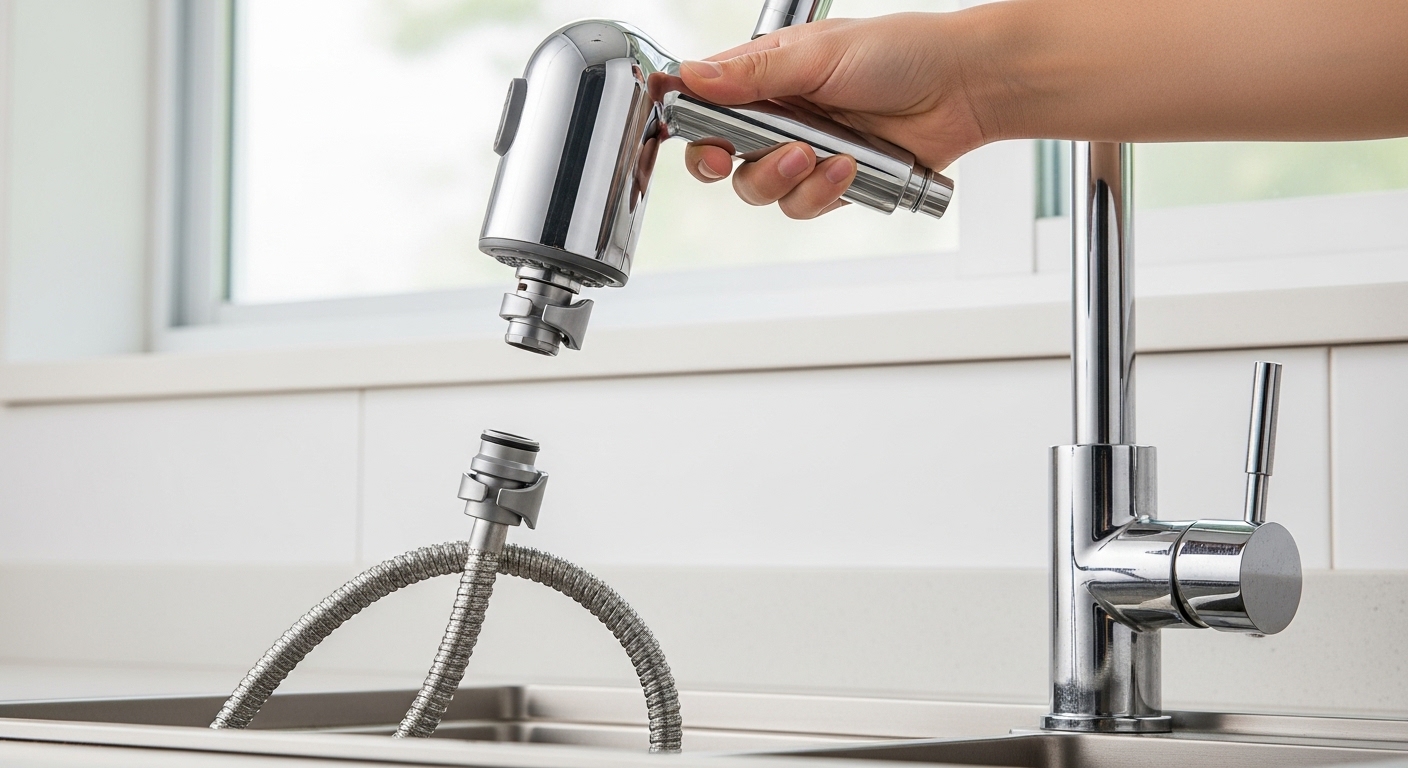
If your spray wand has gone limp, started dribbling under the sink, or simply won’t retract, a kitchen faucet pull out hose replacement is almost always the fix — and it’s one of the easiest plumbing repairs you can do at home. The hose is a wear part. It flexes thousands of times a year, rubs against the cabinet, and eventually cracks, kinks, or pops a fitting. Replacing it costs a fraction of a new faucet and takes less time than a trip to the hardware store.
This guide walks you through exactly how to identify the right hose, remove the old one, install the new one leak-free, and decide whether to repair or replace the whole faucet. We test hoses and faucets daily in the EveFaucet workshop, so the numbers and steps below come from real benchtop teardowns, not guesswork.
How do I know it’s the hose and not the whole faucet?
It’s the hose if the water flow is fine at the faucet base but the problem appears at the spray wand — weak spray, a leak that drips into the cabinet only when water runs, or a wand that won’t pull out smoothly or snap back. Those symptoms point straight at the hose or its fittings, not the faucet cartridge.
Here’s the quick diagnostic we run in the shop. Open the cabinet, turn the water on, and watch the hose while someone pulls the wand out and lets it retract:
- Drips at the spray head connection — the rubber gasket or the spray-head coupling has failed. Sometimes just the gasket; often the hose end.
- Water tracking down the hose mid-length — the hose sheath has cracked or split. Replace it.
- Wand won’t retract — the weight slid out of position, the hose is kinked, or it’s snagging on the shut-off valves. Reposition or replace.
- Weak spray but base flow is strong — the hose is partially collapsed internally, or your aerator/spray face is clogged.
If the flow is weak at the base too, or the handle is hard to move, that’s a cartridge or supply issue, not the hose. We cover that whole decision tree in our guide on why your pull-out kitchen faucet isn’t working and how to fix it fast. And if the spray pattern is patchy rather than weak, a clogged spray face is the usual culprit — see our aerator clog repair guide before you buy a new hose.
What kind of replacement hose do I actually need to buy?
You need a hose that matches three things: the connection type at the faucet body, the connection at the spray head, and the overall length. Get those right and almost any quality hose will work; get them wrong and you’ll be making a second trip.
Pull-out and pull-down faucets generally use one of these hose styles. Knowing yours before you shop saves a lot of frustration:
| Hose / Connection Type | What it looks like | Best for | Typical price |
|---|---|---|---|
| Quick-connect (clip or push-fit) | A plastic collar or metal clip that snaps the hose to the faucet shank | Most modern Moen, Delta, Kohler, EveFaucet pull-downs | $15–$45 (often OEM) |
| Threaded screw-on (1/4″ or 3/8″) | Brass nut threads directly onto the spray-head stem | Older and budget pull-out faucets | $10–$25 (universal) |
| Weighted nylon-braided | Braided sleeve with a clip-on counterweight | Pull-down faucets needing smooth retract | $15–$35 |
| PEX / poly inner hose | Flexible plastic core, lighter, gravity-return | Pull-out (side-spray style) faucets | $10–$20 |
The single most common mistake is buying a universal hose that’s too short. Measure your old hose end to end before ordering — most kitchen faucet hoses run 48 to 60 inches (roughly 1.2–1.5 m). A 60-inch hose gives you comfortable reach to both basins of a double sink. If your faucet is a brand-specific quick-connect, buy the OEM hose; the proprietary coupling rarely fits universal aftermarket parts.
Pull-out vs pull-down — does the hose differ?
Yes, slightly. A pull-out faucet has a low spout and you pull the whole wand toward you horizontally, so it uses a longer, lighter hose that returns by gravity or a small weight. A pull-down faucet has a tall gooseneck spout and you pull the wand straight down, so it relies on a heavier counterweight to retract the hose back up into the spout. If you’re replacing a pull-down hose, don’t skip the weight — without it, the wand dangles and won’t seat.
How do I replace the pull out hose step by step?
Replacing it takes five steps: shut off the water, disconnect the spray head, release the faucet-body connection, thread the new hose through the spout, and reconnect. Most people finish in 20–40 minutes with nothing more than a basin wrench and a flashlight.
- Shut off the water. Close both hot and cold shut-off valves under the sink, then open the faucet to release pressure. Lay a towel and put a small bowl in the cabinet to catch drips.
- Disconnect the spray head. Pull the wand out fully. Unscrew the spray head from the hose end (usually hand-tight, sometimes a quarter turn with pliers and a rag to protect the finish). Save the gasket if it’s reusable.
- Release the hose at the faucet body. Under the sink, find where the hose connects to the faucet shank. For quick-connect, squeeze the clip or twist the collar. For threaded, back off the brass nut with a basin wrench. Detach the counterweight if there is one.
- Thread the new hose. Feed the spray-head end of the new hose up through the spout (for pull-downs) or out through the spout opening (for pull-outs). Don’t yank it across the threads.
- Reconnect and test. Attach the spray head with a fresh gasket, reconnect the bottom fitting, clip on the counterweight at the same spot as before, then slowly reopen the shut-off valves. Run water for 60 seconds and check every joint for leaks.
A few pro tips from the bench: always use a new rubber gasket or washer at the spray-head joint — old ones take a set and leak. Hand-tighten quick-connects (they’re designed for it); don’t crank them with pliers or you’ll crack the collar. And wrap two turns of PTFE tape on threaded brass fittings, never on quick-connects.
What tools and parts do I need before I start?
Very few. You can do most of this by hand, but having these on the counter makes it painless:
- Basin wrench (for tight under-sink nuts) and adjustable pliers
- A flashlight or headlamp
- A new gasket/washer set (often included with the hose)
- PTFE plumber’s tape for threaded connections
- A towel and a catch bowl
- Your replacement hose — measured and matched per the table above
Can I use a universal hose, or do I need the exact brand part?
Use a universal hose if your faucet has standard threaded fittings; buy the OEM brand part if it uses a proprietary quick-connect. That’s the whole rule. Threaded 1/4″ and 3/8″ connections are an industry standard, so a $12 universal braided hose works fine. But many premium faucets use a uniquely shaped snap coupling that only the manufacturer’s hose fits.
If you’re not sure which camp your faucet falls into, photograph the coupling and check the brand’s parts page or model number. The big brands sell hoses as named replacement parts, and choosing among them often comes down to the same factors as choosing the faucet itself — reliability of the coupling and warranty coverage. Our breakdown of the best pull-down kitchen faucet brands and the head-to-head Moen vs Kohler comparison are useful here, because brands with strong parts support (Moen’s LifeShine, Delta, and EveFaucet all ship free or low-cost replacement hoses) make this repair far cheaper over the faucet’s life.
How much does it cost to replace versus just buying a new faucet?
A hose replacement costs $10–$60 in parts and zero labor if you DIY; a plumber charges $80–$200 for the same job. A whole new mid-range pull-down faucet runs $120–$350 installed. So unless the faucet body is also failing — a dead cartridge, a cracked spout, a finish flaking off — replacing only the hose is the obvious call.
| Fix | Parts cost | Labor | Time |
|---|---|---|---|
| Replace hose (DIY) | $10–$60 | $0 | 20–40 min |
| Replace hose (plumber) | $10–$60 | $80–$200 | 1 visit |
| New faucet (DIY) | $120–$350 | $0 | 1–2 hrs |
| New faucet (plumber) | $120–$350 | $150–$350 | 1 visit |
How do I stop the new hose from leaking or wearing out again?
The two biggest causes of repeat failure are over-tightened or under-gasketed fittings and a hose that rubs against the shut-off valves every time it retracts. Fix both during install and a quality hose lasts 8–12 years.
Always seat a fresh gasket at the spray head, and snug fittings firmly but don’t gorilla them. Then reposition the counterweight and route the hose so it travels in a clean loop without catching the supply lines or the disposal. A little silicone grease on the gasket helps the wand glide and seal. Hard water is the other silent killer — mineral scale builds up inside the wand and at the connection, stiffening the spray and corroding fittings. If you’re in a hard-water area, descale the spray face periodically using the method in our guide on cleaning a faucet head from hard water buildup without wrecking the finish.
Why won’t my new hose retract all the way?
Nine times out of ten the counterweight is in the wrong position or missing. On a pull-down faucet the weight should clamp to the lowest point of the hose loop so gravity pulls the wand back up. Slide it up or down a few inches until the wand seats firmly with a satisfying click. The other cause is the hose snagging on the shut-off valves or a tight cabinet — reroute the loop so it hangs free.
Author note, testing, and warranty
This guide was written by the EveFaucet product team, who bench-test pull-out and pull-down hose assemblies for burst pressure, retraction cycles, and coupling integrity. EveFaucet has manufactured stainless-steel faucets, sinks, and bathroom fixtures since 2010, and our replacement hoses are pressure-tested to well above standard household supply pressure and certified to meet common low-lead and flow-rate standards (the same benchmarks used for NSF/ANSI 61 and the U.S. 1.8 GPM kitchen flow guidance). Every EveFaucet pull-down faucet hose is covered by our replacement-parts warranty — if a coupling fails under normal use, we ship a new hose. As always, if your home plumbing is non-standard or you hit a corroded fitting that won’t budge, call a licensed plumber rather than forcing it.
FAQ
How long does a kitchen faucet pull out hose last?
A quality braided or PEX hose lasts 8–12 years under normal use. Cheap thin-wall hoses can fail in 2–3 years, especially in hard water or if the hose constantly rubs against cabinet hardware. Repositioning the loop so it moves freely is the easiest way to extend its life.
Are kitchen faucet hoses universal?
Threaded ones largely are — 1/4″ and 3/8″ connections are standardized, so universal hoses fit most faucets with screw-on fittings. But many modern brand faucets use proprietary quick-connect couplings that only accept the manufacturer’s own hose. Check your coupling type before buying.
Can I replace just the spray head instead of the whole hose?
Yes, if only the wand is the problem — a clogged spray face, a stuck diverter button, or a cracked wand body. The spray head usually unscrews from the hose end, so you can swap it alone. But if the leak or weak flow comes from the hose itself, replacing the head won’t help.
Do I need to turn off the main water supply?
No. Just close the two shut-off valves under the sink — the hot and cold supply stops directly below the faucet. Open the faucet afterward to relieve pressure before disconnecting anything. Only turn off the main if the under-sink valves are seized or leaking.
Why is my replacement hose leaking at the spray head?
Almost always a missing, damaged, or pinched gasket at the spray-head connection. Reseat a fresh rubber washer, make sure it’s lying flat, and hand-tighten plus a quarter turn. If it still drips, the spray-head threads may be cross-threaded or worn and need replacing.