 EVE卫浴
EVE卫浴
Where Should You Actually Put a Rainfall Shower Head? A Real Guide to Rainfall Shower Head Placement
浏览次数:3 分类:公司产品
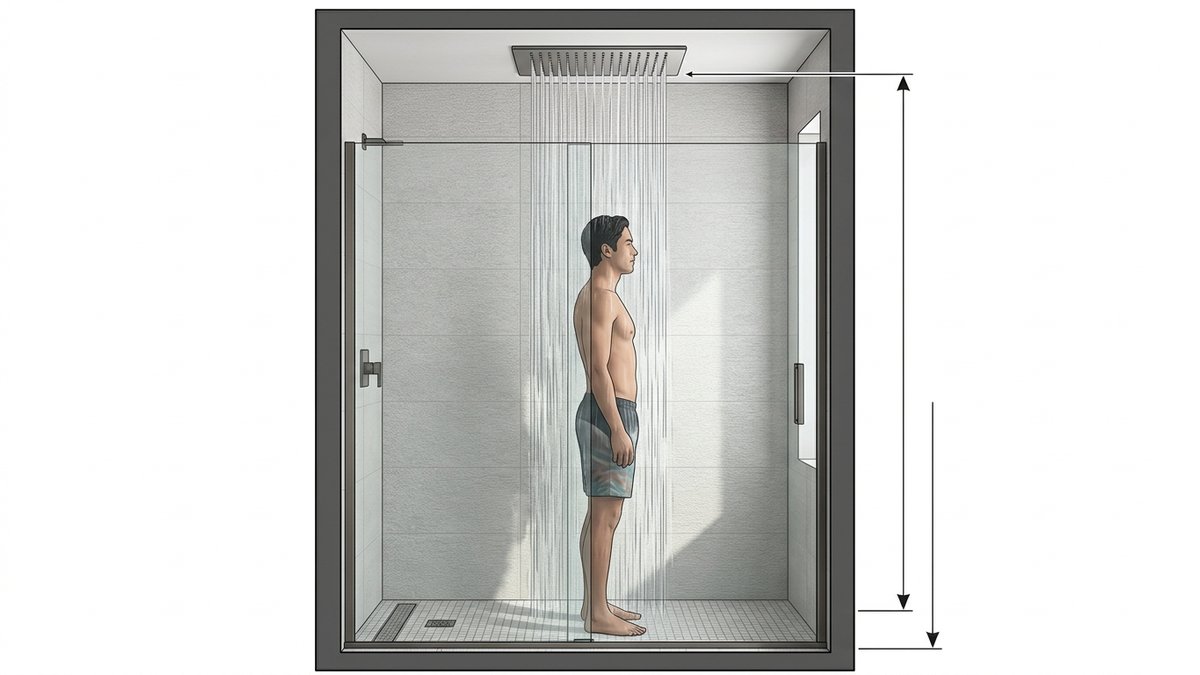
Getting rainfall shower head placement right is the single biggest factor in whether your fancy 8-, 10-, or 12-inch rain head feels like standing under a warm summer downpour — or like an awkward drizzle you have to lean into. Unlike a standard angled shower head, a rainfall head sprays straight down, so it has almost no ability to “reach” you. Where you put it is the experience. Below, we walk through exact heights, how far out from the wall to place it, ceiling vs. wall-arm mounting, and the small measurements that separate a spa-grade install from a soggy regret.
This guide is written for real bathrooms and real people — someone 5’4″, someone 6’3″, a shared family shower, a tiny 32-inch alcove, a walk-in wet room. We’ll give you numbers you can put on a wall with a pencil today.
How high should a rainfall shower head be mounted from the floor?
Mount the face of a rainfall shower head 82 to 86 inches off the finished floor, with 84 inches being the safe default for most households. That height clears the top of a tall adult’s head by a few inches, so no one has to duck, while keeping the water column short enough that the spray still feels firm instead of scattering into a limp mist on the way down.
Here’s the logic. A rain head sprays vertically, and water loses velocity and spreads out the farther it falls. Mount it too high — say, on a 9-foot ceiling with no drop — and by the time the water reaches a 5’6″ person’s shoulders it has spread thin and cooled slightly. Mount it too low and a 6’2″ person is bumping the head or standing partly behind the spray. The 82–86 inch band is the sweet spot for both feel and clearance.
- Average households (adults 5’2″–6’0″): 84 inches to the face of the head.
- Tall users (6’1″+): 86 inches, or add a downward-angled arm rather than raising it into the ceiling.
- Kids’ or accessible showers: 80–82 inches, and strongly consider pairing it with a handheld on a slide bar.
- High ceilings (9 ft+): use a ceiling drop of 12–16 inches so the head lands near 84 inches, not way up at the ceiling.
One important distinction: 84 inches is the height of the shower head itself, not the water outlet on the wall or the shower arm. If you’re plumbing a wall-mount rain head, the rough-in outlet sits lower and the arm rises up and over to reach that final head height — more on that below.
Should a rainfall shower head go on the ceiling or on a wall arm?
Use a ceiling mount if you want the water to fall dead-center over where you stand and you’re building or renovating (so you can run the pipe through the ceiling); use a wall arm if you’re upgrading an existing shower and don’t want to open the ceiling. Both can feel spa-like — the difference is mostly plumbing access, standing position, and how far the head reaches out over you.
A ceiling mount puts the head directly overhead, which is the most true-to-life “rainfall” feel and keeps water off the walls and glass. The catch is that the supply line has to travel up inside the wall and across the ceiling joists, which usually means opening drywall — easy during a remodel, a real project otherwise.
A wall-arm mount (often a gooseneck or an extended right-angle arm) reuses your existing in-wall shower valve outlet. It’s the far simpler retrofit. The trade-off: because the arm cantilevers out from the wall, you have to get the reach right so the water lands where you actually stand, not against the back wall.
| Factor | Ceiling Mount | Wall-Arm Mount |
|---|---|---|
| Best for | New builds & full remodels | Upgrading an existing shower |
| Plumbing work | Open the ceiling, run pipe across joists | Reuse existing wall outlet |
| Water position | Directly overhead, centered | Depends on arm reach (aim for 12–18 in. out) |
| Typical head height | Set by drop length (~84 in.) | Set by arm rise + valve outlet height |
| Head size that fits | Large (10–12 in.) looks great | 8–10 in. is easier to balance on an arm |
| Difficulty (DIY) | Moderate–hard | Easy–moderate |
If you’re already inside the wall for a valve change, it’s worth understanding how the valve depth is set before you commit to a head position — our explainer on what a shower valve rough-in is and how to set it up right the first time walks through the measurements that determine where your arm ultimately lands.
How far out from the wall should a wall-mounted rainfall head reach?
For a wall-mounted rainfall head, the center of the head should sit about 12 to 18 inches out from the back wall so the water falls onto your head and shoulders while you stand naturally — not pinned against the tile and not so far out that spray hits the glass door or curtain. In a standard 32–36 inch deep shower, 14–16 inches of reach is the reliable middle.
Why this matters so much: a rain head has no angle to “throw” water toward you. If the head only reaches 6 inches off the wall, you have to press your back against cold tile to get under it. Too much reach and you’re showering at the threshold, splashing the bathroom floor. The goal is for the falling water column to line up with where your body naturally wants to stand — roughly the middle of the shower footprint.
- Measure your standing zone: step into the (dry) shower and mark where the balls of your feet land. That’s your target.
- Reach = distance from back wall to that point, usually 12–18 in.
- Add an extended shower arm if your valve outlet is close to the wall — gooseneck and S-shaped arms add 8–16 inches of reach and lift.
- Keep 3–4 inches of clearance between the outer edge of the head and any glass panel to avoid constant water spots.
Big rain heads are heavier and wetter than they look, so the arm and its wall anchoring matter. A 12-inch stainless head full of water puts real leverage on the shower arm threads; make sure you’re threading into a solid drop-ear elbow in the wall, not just relying on the escutcheon.
Where should the shower head go relative to the controls and door in a small shower?
In a small or alcove shower, place the rainfall head toward the back of the enclosure and keep the valve/controls on the wall near the entry, so you can reach in and turn the water on without stepping under a cold blast. This “wet zone at the back, dry-reach controls at the front” layout is the standard for a reason — it keeps you dry while the water warms up and keeps spray away from the door seal.
For a typical 32″ x 32″ or 36″ x 36″ alcove, that usually means:
- Controls (valve/handle): mounted 38–48 inches off the floor on the wall closest to the door, reachable from outside.
- Rainfall head: centered over the back or back-center of the footprint at 84 inches.
- Optional handheld: on a slide bar on a side wall, so it doesn’t fight the rain head for space.
One common mistake in small showers: buying a 12-inch rain head for a 32-inch enclosure. A head that wide can push water right to the walls and glass. In compact showers, an 8-inch head placed correctly outperforms an oversized one that soaks everything but you. If your water pressure is also on the low side — common in older homes and upper floors — head size and placement interact with flow; our guide on how low-pressure shower heads work and how to fix weak flow explains why a giant rain head can feel weak even when it’s mounted perfectly.
What about placement for a two-person or shared shower?
For a shared or two-person shower, either center one large 12-inch rainfall head so its spray footprint covers the whole standing area, or install two separate heads on independent controls placed 24–30 inches apart. The right choice depends on whether you want one big shared downpour or two people showering at once without fighting over the water.
A single large head is simpler and cheaper. A 10–12 inch rain head at 84 inches throws a spray circle roughly 10–12 inches wide, so two people can share it if they stand close — cozy, but not truly independent. For genuine two-at-once comfort, plan two heads, each with its own valve, spaced far enough apart that the spray patterns don’t just overlap into one puddle. That’s a plumbing decision best made at the rough-in stage, not after tile.
If you go the twin-head route, keep both faces at the same height (84 inches) for a clean look, and make sure your water heater and supply lines can actually feed two rain heads at once — two 2.5 GPM heads running together is 5 gallons per minute, which can outrun an undersized supply or a small tank.
How do you position a rainfall + handheld combo so both actually work?
Mount the fixed rainfall head high and centered at 84 inches for the overhead soak, and put the handheld on a vertical slide bar on a side wall with its cradle around 48–54 inches high, fed by a diverter at the valve. That way the rain head owns the overhead position and the handheld stays out from under it — you never have to duck around the big head to grab the wand.
The combo is the most versatile setup for real households: the rain head for relaxing, the handheld for rinsing hair, kids, pets, and cleaning the shower itself. Placement keeps them from colliding:
- Rain head: ceiling or back-wall arm, centered, 84 in.
- Handheld cradle: side wall, 48–54 in., where you can grab it while standing under the rain head.
- Diverter: at the valve so you switch between (or run both, if your pressure allows).
Handheld positioning is its own small art — angle, hose length, and cradle height all change how usable it is day to day. If you’re adding one, our walkthrough on how to actually get the most out of a handheld shower head covers the details that pair naturally with a rainfall install.
What tools and rough-in do you need before you mount it?
Before placement, confirm three things: the shower arm or ceiling drop is the right length for your target reach and height, the in-wall (or in-ceiling) elbow is anchored to solid backing, and your valve/diverter is rated for the flow of the head you chose. Get these right at rough-in and the actual mounting is a 20-minute job.
Here’s a realistic pre-install checklist for a wall-arm retrofit:
- Confirm head height & reach on paper first — mark 84 in. on the wall and simulate where the water will fall.
- Choose the arm — straight, gooseneck, or extended S-arm — to hit that reach.
- Check thread size — most shower arms are 1/2″ NPT; match the head.
- Wrap threads with PTFE (plumber’s) tape, 3–4 turns clockwise.
- Hand-tighten, then a gentle quarter-turn with a wrapped wrench — over-torquing cracks finishes.
- Run water and check for drips at the arm and head face.
If your project also involves new valve trim, the same “measure twice, mount once” discipline applies. Our step-by-step on installing a shower valve trim kit in about an hour is a good companion when you’re doing the valve and head together.
Common rainfall shower head placement mistakes (and easy fixes)
The most common placement mistakes are mounting the head too high on a tall ceiling, not giving a wall-arm head enough reach, and oversizing the head for a small shower. All three make an expensive rain head feel disappointing — and all three are avoidable with a tape measure before you drill.
| Mistake | Why it ruins the feel | The fix |
|---|---|---|
| Head at the ceiling (9 ft, no drop) | Water spreads thin and cools before reaching you | Add a 12–16 in. ceiling drop to land near 84 in. |
| Wall arm too short | You must press against cold tile to get wet | Use a gooseneck/extended arm for 12–18 in. reach |
| 12-in. head in a 32-in. shower | Sprays the walls and glass, not you | Drop to an 8-in. head, centered |
| Controls under the spray | Cold blast every time you turn it on | Move valve to entry-side wall, reachable from outside |
| Head over the drain slope | You stand on the slope, off-center from water | Center over the flat standing zone, not the drain |
Finish choice interacts with placement too, because a ceiling or high wall head is very visible from below and shows water spots. A brushed or matte finish hides spotting better than polished chrome up there — if you’re weighing finishes, our take on whether a matte black shower finish is worth it is relevant to how the head looks once it’s mounted overhead.
A note from our team on rainfall shower head placement
At evefaucet, we design and sell showers, faucets, and bathroom fixtures directly to homeowners, and we’ve fielded thousands of “why doesn’t my rain head feel like the showroom?” questions — the answer is almost always placement, not the product. Our fixtures are pressure- and flow-tested to meet U.S. plumbing standards, and rainfall heads carry a manufacturer’s warranty against defects in materials and finish so you can install with confidence.
Author note: This guide was written by evefaucet’s product content team in consultation with our in-house plumbing product specialists, drawing on real install feedback, bench flow-testing at 2.5 GPM (the U.S. federal maximum), and the dimensional standards we use when speccing shower arms and valve rough-ins. Measurements here (84-inch head height, 12–18 inch reach) reflect widely accepted North American shower ergonomics — always confirm against your local plumbing code and your own household’s height range before drilling.
If you’re leaning toward a traditional look, note that placement rules don’t change with style — our breakdown of whether a Victorian rainfall shower head is worth it uses the same height and reach numbers you’ve read here, just in a different aesthetic.
FAQ
How high should a rainfall shower head be for a 6-foot person?
Mount it at 86 inches (about 7’2″) to the face of the head for someone 6 feet tall, giving a couple of inches of clearance above the head. If multiple people share the shower and heights vary a lot, split the difference at 84–85 inches and add a handheld on a slide bar so shorter users can supplement the overhead spray.
Can I put a rainfall shower head on a wall instead of the ceiling?
Yes. A wall-mounted rainfall head is the easier retrofit because it reuses your existing in-wall shower outlet — no need to open the ceiling. The key is using a shower arm (often a gooseneck or extended right-angle arm) that reaches 12–18 inches out from the wall so the water lands where you stand, and that rises high enough to put the head near 84 inches.
How far from the wall should a rain shower head be?
The center of a wall-mounted rain head should sit about 12–18 inches out from the back wall in a standard 32–36 inch deep shower, so the falling water lines up with your natural standing spot rather than dumping against the tile. Ceiling-mounted heads should be centered over the flat standing zone — not over the drain, where the floor slopes.
Do rainfall shower heads need higher water pressure?
Rainfall heads work at normal residential pressure (typically 45–80 psi), but because water falls straight down with gravity rather than being jetted at you, they can feel gentler than a standard head — and a very large head in a low-pressure home can feel weak. If your pressure is low, choose a smaller (8-inch) head, place it correctly at 84 inches, and check the flow restrictor. Weak flow is often fixable without changing the head at all.
Should the shower controls be under the rainfall head?
No. Place the valve and handle on the wall nearest the entry, reachable from outside the shower, so you can turn the water on and let it warm up without standing in a cold blast. Keep the rainfall head toward the back of the enclosure. This “controls at the front, rain at the back” layout is standard for both comfort and keeping spray off the door.
What size rainfall shower head is best for a small shower?
An 8-inch rainfall head is the best choice for a compact 32–36 inch shower. It delivers a genuine overhead-rain feel while keeping the spray footprint inside the enclosure, so water lands on you instead of soaking the walls and glass. Save 10–12 inch heads for larger showers or ceiling mounts with room to spare.