 EVE卫浴

What’s the Right Pot Filler Faucet Height From Floor — and How High Should You Mount It Over Your Range?
浏览次数:32 分类:公司产品
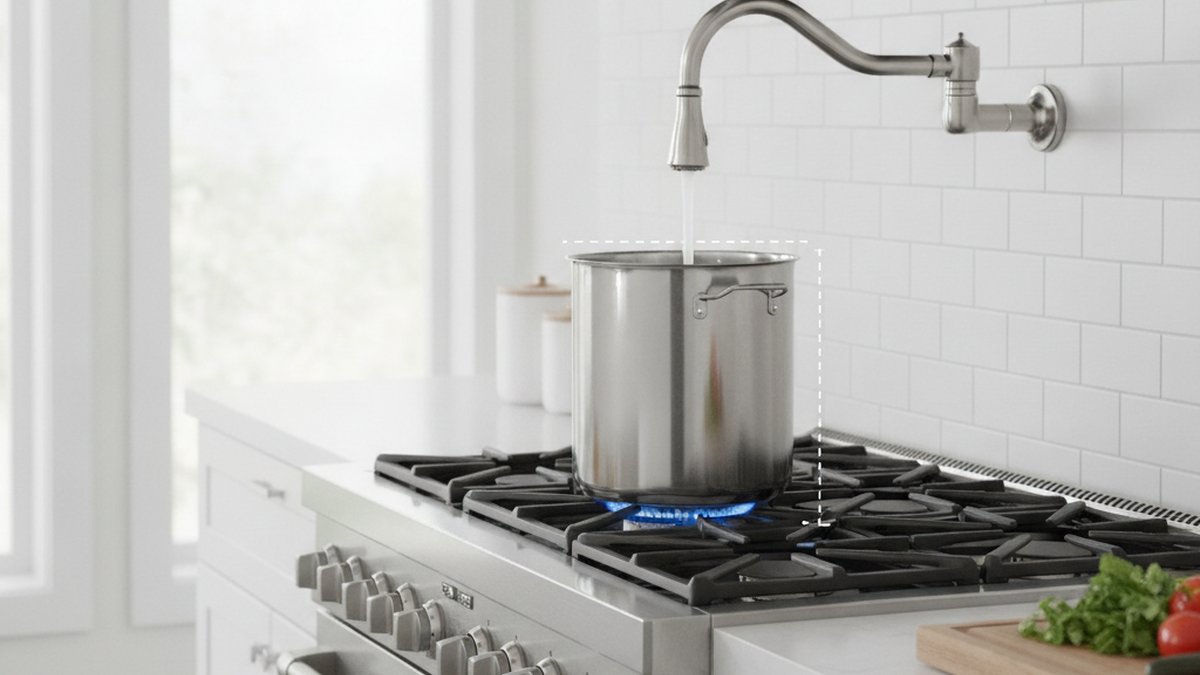
Getting the pot filler faucet height from floor right is the one measurement people most often wish they’d double-checked, because it’s set in the wall behind tile and it’s expensive to move later. Mount it too low and your 14-inch stockpot won’t fit under the spout; mount it too high and you’re reaching up over a hot burner to fill a pot. The sweet spot is a spout outlet that clears your tallest pot by a couple of inches while the swing-arm still drops water right over the back burner. Below, I’ll give you the actual numbers, the math to adapt them to your kitchen, and the mistakes that force a redo.
How High Should a Pot Filler Be From the Floor for a Standard Range?
For a standard 36-inch-tall range or cooktop, aim for a spout height of 48–56 inches from the finished floor. That range isn’t arbitrary — it’s built from three numbers stacked on top of each other: your cooktop height, the height of your tallest pot, and a small clearance gap so you can actually slide the pot in and out.
Here’s the stack most kitchens land on:
- Cooktop surface: about 36 inches from the floor (standard freestanding and slide-in ranges).
- Tallest pot you fill: a typical 12-quart stockpot is around 11–12 inches tall; a tall pasta/canning pot can hit 13–15 inches.
- Clearance: 2–4 inches between the top of the pot and the underside of the spout, so the pot clears without you tilting it under a running faucet.
Add those up: 36 + 12 + 3 ≈ 51 inches to the spout outlet for a common setup. If you regularly use a 15-inch pot, you’ll want the spout closer to 56 inches. If your biggest pot is a modest 10-inch Dutch oven, 48 inches is plenty. This is why “what’s the standard height” has a range answer instead of one magic number — it’s genuinely a function of your range and your cookware.
Where Exactly Do You Rough In the Water Line (and How Is That Different From Spout Height)?
Rough in the pot filler’s water supply stub-out roughly 18–24 inches above the cooktop surface — which is about 54–60 inches from the floor — not at the spout height itself. This trips up a lot of DIYers: the number your plumber needs is the center of the valve body / mounting flange, not where the water comes out.
The reason is simple geometry. A pot filler mounts to the wall at the flange, then its double-jointed arm angles down and out over the burner. The spout outlet ends up lower and further forward than the mounting point. So you mount the body high, and the folding arm brings the water down to pot level. When you buy the faucet, the spec sheet lists the drop from the mounting flange to the spout outlet — use that to back-calculate your rough-in height.
A quick way to get it right: decide your target spout height first (say, 52 inches), then add the faucet’s flange-to-outlet drop (often 4–8 inches) to find where the stub-out goes. Always confirm against the manufacturer’s installation sheet before anyone cuts the wall. If you’ve ever matched a tub spout’s projection to a tub — the same measure-the-reach logic we walk through in our guide to what “Roman tub faucet 9 inch reach” actually means — this will feel familiar. It’s reach and drop, just rotated onto a vertical wall.
How Far Above the Cooktop Should the Spout Sit?
Keep the spout outlet about 15–20 inches above the cooktop surface. That’s the vertical gap that matters most day to day, because it decides whether your biggest pot slides under the running spout without you lifting and tilting it over a hot burner.
Think of it from the cook’s point of view. You set a heavy stockpot on the back burner, swing the arm out, and the water should land cleanly inside the pot. If the spout is only 10 inches above the cooktop, a 12-inch pot won’t fit under it at all. If it’s 28 inches above, you’re splashing water from height and reaching up awkwardly. Fifteen to twenty inches of clearance over the burner keeps a tall pot comfortable and a short saucepan still easy to fill.
One more practical note: measure to the back burner, since that’s where a pot filler reaches. If your range has a tall grate or a griddle plate that raises pots an extra inch or two, factor that in too.
Does Pot Filler Height Change for a 30-Inch, 36-Inch, or 48-Inch Range?
The spout-above-cooktop clearance stays the same (15–20 inches), but the height from the floor shifts with your appliance and whether it sits on the floor or on a counter. A countertop induction cooktop changes the math more than most people expect.
Here’s how the common setups compare:
| Setup | Cooktop height from floor | Suggested spout height from floor | Rough-in (stub-out) from floor |
|---|---|---|---|
| Standard freestanding range | ~36 in | 48–56 in | 54–60 in |
| Slide-in range on tall legs | 36–37 in | 50–57 in | 55–61 in |
| Cooktop on a 36-in base cabinet | ~36 in | 48–56 in | 54–60 in |
| Countertop induction unit | ~38–39 in | 51–58 in | 57–62 in |
| Pro-style 48-in range (tall grates) | ~36 in + grate height | 52–58 in | 58–64 in |
The width of the range (30 vs 36 vs 48 inches) doesn’t change the height — but it does change horizontal centering. Center the pot filler over your most-used large burner, which on a 36- or 48-inch range is often not the dead center of the appliance. And always verify the cooktop height of your specific model; “36 inches” is a convention, not a law, and pro ranges with raised grates can add an inch or two to where pots actually sit.
What Length and Reach Does the Pot Filler Arm Need to Be?
Pick an arm that reaches your back burner with a few inches to spare — for most ranges that means a total extended reach of 18–24 inches, and ideally enough to reach the front burners too. Height gets all the attention, but reach is the other half of a pot filler that actually works.
Measure from the finished wall (over the backsplash) to the center of your back burner, then to the center of the front burner. A double-jointed pot filler folds flat against the wall when not in use and extends out when you need it. You want the extended reach to comfortably clear the back burner; reaching the front burner too is a nice bonus for big days.
- Short reach (15–18 in): fine for a shallow counter-depth cooktop against the wall.
- Standard reach (18–22 in): the most common choice, reaches the back burner on typical ranges.
- Long reach (22–24 in+): for deep ranges or when you want to hit the front burners too.
Also confirm the water supply: a pot filler ties into a cold line and needs a standard supply connection roughed into the wall. Getting the connection sizing and fittings right is the same kind of detail that trips people up on sink installs — our breakdown of what supply line size a faucet needs and how to get it right is worth a read before your plumber frames in the line.
What Are the Most Common Pot Filler Height Mistakes?
The single most common mistake is mounting the pot filler at eye level like a decorative piece instead of at working height for your pots. A pot filler is a tool, and its height should serve the stockpot, not the sightline.
Watch out for these:
- Measuring to the burner grate instead of the pot top. You need clearance above the tallest pot, not the cooktop.
- Forgetting the arm’s downward drop. People rough in at spout height and end up with the whole fixture 4–8 inches too low.
- Centering on the appliance instead of the burner. Water should land in the pot on the burner you actually use.
- Ignoring the hood and backsplash. Make sure the folded arm clears the range hood and that the mount lands on a solid stud or blocking, not just tile.
- Not test-fitting your real cookware. Before the wall closes up, hold a cardboard mock-up or a broom at the planned height and check it against your biggest pot on the back burner.
A five-minute mock-up before tile goes on will save you from the only thing worse than a crooked pot filler: a correctly installed one at the wrong height.
Which Pot Filler Finish and Style Fits a Modern Kitchen?
Match the pot filler finish to your main kitchen faucet and your range hardware — brushed nickel, matte black, and stainless are the safest, most timeless choices, while brass and bronze read warmer and more custom. Because the pot filler lives right next to your range and hood, finish continuity matters more here than almost anywhere else in the kitchen.
If your primary sink faucet is matte black, a matte black pot filler ties the room together; if you’ve gone with a classic stainless or nickel look, stay in that family. If you’re still choosing your main faucet, it’s worth seeing how finishes are trending — our look at which pull-out kitchen faucet in black to actually buy covers how black finishes wear and clean in a working kitchen, which applies just as much to a pot filler. And if you want a broader view of who makes dependable fixtures and what to look for in build quality, our rundown of the best faucet manufacturers to buy from in 2026 is a good starting point before you commit.
Whatever finish you choose, prioritize a solid brass body, ceramic-disc valves on both shut-off joints, and a smooth-folding double joint. A pot filler sees heat, steam, and grease — cheap internals fail faster here than at a sink.
FAQ
What is the standard pot filler faucet height from floor?
For a standard 36-inch range, the spout typically sits 48–56 inches from the finished floor, with the water line roughed in around 54–60 inches to account for the arm’s downward drop. The exact figure depends on your cooktop height and your tallest pot — stack cooktop height plus pot height plus 2–4 inches of clearance to find yours.
How much clearance should there be between the pot filler and my tallest pot?
Leave 2–4 inches between the top of your tallest pot and the underside of the spout. That gap lets you slide the pot in and out under the running faucet without lifting or tilting it over a hot burner. Measure your biggest stockpot — not an average pot — before setting the height.
Can I install a pot filler myself, or do I need a plumber?
The faucet trim and arm are DIY-friendly, but running and roughing in the cold water supply line inside the wall is usually best left to a licensed plumber, especially behind tile or near gas lines. If the supply stub-out already exists at the right height, mounting the fixture itself is a straightforward job with a wrench and plumber’s tape.
Does a pot filler need hot water?
No — a pot filler connects to a cold water line only. It’s designed for quickly filling pots at the stove, so there’s a single cold supply and no mixing valve. That also simplifies the rough-in, since you’re only running one line to the wall above the range.
How high above the cooktop should the pot filler spout be?
Keep the spout outlet about 15–20 inches above the cooktop surface. That clearance fits a tall stockpot on the back burner while keeping short saucepans easy to fill, and it stops you from reaching up awkwardly or splashing water from too high.
Will a pot filler work with my pro-style or raised-grate range?
Yes, but add for the grate. Pro-style ranges often sit pots an inch or two higher because of heavy grates or griddle plates, so measure to where the pot actually rests, not to the 36-inch convention, and bump your spout height up accordingly — usually into the 52–58 inch range.
About the author: This guide was written by the evefaucet product team, which specs, tests, and installs kitchen and bath fixtures day in and day out. We’ve mounted pot fillers over everything from compact 30-inch ranges to 48-inch pro units, and the height advice here comes from real rough-in jobs, not a spec sheet read in a vacuum.
Why trust evefaucet: evefaucet designs and sells faucets and fixtures built around solid brass bodies and ceramic-disc valves, and we pressure-test our pot fillers to the flow and leak standards expected under ASME A112.18.1 / CSA B125.1, backed by a manufacturer’s limited warranty on the valve and finish. When we give you a measurement, it’s one we’d stand behind on an install in our own kitchen.