 EVE卫浴
EVE卫浴
What’s the Best External Shower Faucet for an Outdoor or Exposed Wall Install in 2026?
浏览次数:918 分类:公司产品
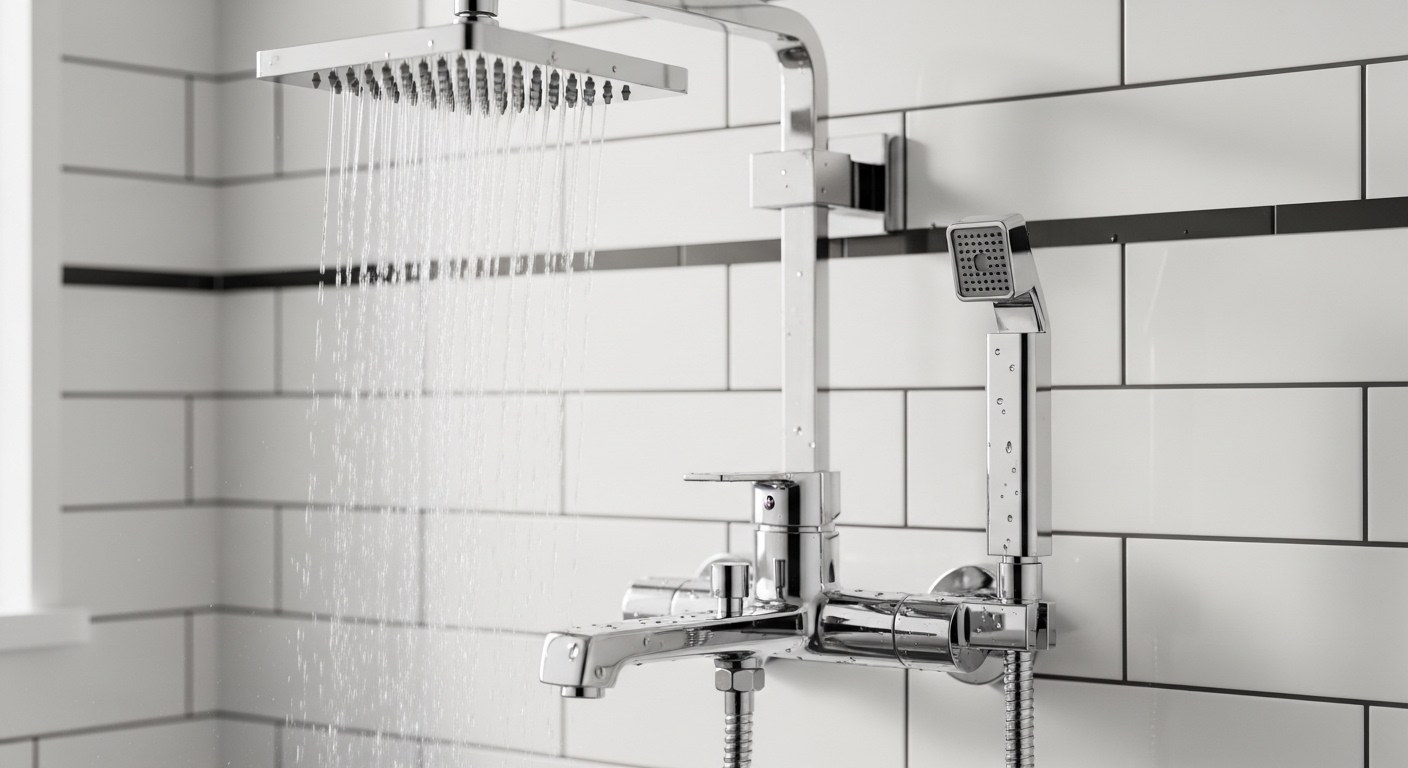
A shower faucet external (also called an exposed shower valve, surface-mounted shower mixer, or outdoor shower faucet) is any shower control where the valve body, pipes, and mixer sit on top of the finished wall instead of being buried behind tile. People search for this for three very different reasons: they’re building an outdoor/pool shower, they’re retrofitting a bathroom without tearing out tile, or they’re outfitting a commercial gym, spa, or rental property where exposed valves are easier to service. This guide answers every version of that question — what to buy, what to avoid, and what it actually costs.
What exactly is an “external” shower faucet, and how is it different from a regular one?
An external shower faucet is a shower mixer where the valve body is mounted on the wall, not inside it. You see the chrome (or black, or brushed nickel) pipe risers, the horizontal mixer bar, and the supply elbows — everything is exposed. A standard “concealed” or “rough-in” shower valve, by contrast, is buried behind the wall with only the trim plate and handle visible.
The practical difference is huge. With an exposed shower faucet you can:
- Install it in a few hours without opening a wall.
- Service the cartridge, check valves, or thermostat without breaking tile.
- Mount it outdoors, in a pool house, or on a deck where there’s no wall cavity to hide pipes in.
- Retrofit an old clawfoot tub or a vintage bathroom that was never plumbed for a shower.
The trade-off: the pipes are visible, so the finish quality matters far more than on a concealed unit. A cheap chrome plate that pits in two years looks fine behind a wall — outside it looks awful.
The three install scenarios people are actually buying for
When we look at customer orders and search data at EveFaucet, almost every “shower faucet external” search falls into one of these three buckets:
- Outdoor / pool / beach showers — usually a single-handle exposed mixer with a fixed showerhead, sometimes with a foot-rinse spigot.
- Retrofit indoor showers — adding a shower over an existing tub or in a bathroom where you can’t (or don’t want to) cut into the wall.
- Commercial / multi-unit — gyms, dorms, Airbnbs, RV parks, spa changing rooms. Service access is the whole point.
Each scenario has slightly different priorities, and we’ll cover them all below.
How much should I actually spend on an exposed shower faucet?
For a quality external shower faucet that lasts, plan on $150–$400. Under $80 is almost always thin brass or zinc alloy with a plastic cartridge — fine for a one-season outdoor rinse, terrible for daily use. Over $500 you’re paying for brand or designer finish, not better function.
Here’s the realistic breakdown by use case:
| Use Case | Realistic Budget | What You’re Paying For | Expected Lifespan |
|---|---|---|---|
| Seasonal outdoor rinse (cold-only) | $40–$90 | Basic brass body, single handle, no thermostat | 3–5 years |
| Year-round outdoor shower (hot + cold) | $180–$350 | Solid brass, freeze-resistant design, PVD finish | 8–12 years |
| Indoor retrofit (clawfoot or tub-to-shower) | $150–$300 | Thermostatic mixer, dual outlets, anti-scald | 10–15 years |
| Commercial (gym, spa, dorm) | $220–$450 | ADA-compliant lever, vandal-resistant, ASSE 1016 cert | 10+ years (heavy use) |
| Luxury / designer exposed system | $400–$900+ | Rain head + handheld + body jets, designer finish | 10–20 years |
If you’re tempted by a $35 Amazon special, do the math: you’ll replace it three times in the time a $200 brass unit lasts once, and the cheap one will probably stain your wall with rust streaks along the way.
Thermostatic vs. pressure-balance vs. manual — which mixer do I actually need?
For any exposed shower faucet that delivers hot water, get a thermostatic mixer. It’s the single biggest upgrade for safety and comfort, and on an external install it’s also the easiest to service.
The three mixer types you’ll see on the market:
- Manual mixer — two handles, hot and cold, mixed by feel. Cheapest, fine for cold-only outdoor showers. No scald protection.
- Pressure-balance valve — single handle, automatically adjusts the hot/cold ratio when someone flushes a toilet elsewhere. Won’t hold an exact temperature, but prevents the classic “scalding when the dishwasher kicks on” moment. ASSE 1016 standard.
- Thermostatic mixer — separate temperature dial and flow dial. Holds your set temperature to within ±2°F regardless of pressure or inlet temperature swings. ASSE 1017 / EN 1111 standard. This is the gold standard for exposed showers because the thermostatic cartridge is right there in the visible bar — replacing it takes 10 minutes with a wrench.
For an outdoor shower in a cold climate, the thermostat is non-negotiable: inlet water temperature swings 40°F between summer and winter, and a manual mixer will surprise you badly. For an indoor retrofit, a thermostatic mixer also lets the elderly, kids, and anyone with reduced sensation use the shower safely — most US codes now require either ASSE 1016 or 1017 compliance for new installs.
What body material and finish actually survive outdoors?
For exposed installations — and especially outdoor ones — only two body materials are worth considering: solid brass (preferably low-lead C46500 or DZR brass) or marine-grade 316 stainless steel. Anything else fails fast.
Here’s what you’ll see on spec sheets and what it actually means:
| Body Material | Outdoor-Safe? | Corrosion Resistance | Typical Price Range |
|---|---|---|---|
| Zinc alloy (Zamak) | No | Poor — pits and cracks in 1–2 winters | $25–$70 |
| Standard brass | Yes, with quality finish | Good — can dezincify in saltwater | $120–$250 |
| DZR / low-lead brass | Yes, including coastal | Excellent — designed for hard/salty water | $180–$350 |
| 304 stainless steel | Yes, inland | Excellent — light surface rust in salt air | $200–$400 |
| 316 marine stainless | Yes, oceanfront | Best in class for salt spray | $300–$600 |
Finish matters as much as the metal underneath
On an exposed shower faucet, the finish is exposed to UV, soap, chlorine, and (outdoors) salt or pool chemicals 24/7. The two finish technologies worth your money:
- Triple-plated chrome over nickel over copper — the traditional standard. Lasts 10–20 years indoors, 5–10 outdoors.
- PVD (Physical Vapor Deposition) — a vacuum-bonded coating that’s 10× harder than electroplating. Brushed nickel PVD, matte black PVD, and brushed gold PVD all hold up to outdoor exposure and pool chemicals far better than painted or powder-coated finishes.
Avoid “oil-rubbed bronze” and “antique copper” finishes outdoors — they’re usually a colored lacquer over brass, and UV will fade or peel them within two seasons. If you want a dark finish outside, look specifically for matte black PVD or genuine living-finish unlacquered brass that’s allowed to patina.
How do I install an external shower faucet without flooding my house?
An exposed shower faucet install is one of the simplest plumbing projects a homeowner can do, but there are three things people get wrong that turn it into a disaster: wrong inlet spacing, no shutoffs, and no freeze protection.
The basic process:
- Confirm inlet spacing. Almost all exposed mixers use 150 mm (about 5-15/16″) center-to-center between hot and cold inlets. Some imports use 6″ or 8″. Measure before you order.
- Add ½” NPT shutoff valves on both supply lines, behind or below the mixer. This lets you service the cartridge without shutting off the whole house.
- Use the eccentric (S-union) couplings that ship with the faucet. They let you adjust ±15 mm to perfectly align the mixer with whatever your wall stub-outs actually look like.
- Wrap threads with 3–4 turns of PTFE tape, snug the eccentrics, then mount the mixer body and tighten the union nuts by hand first, then a quarter-turn with a wrench. Overtightening cracks the chrome.
- Pressure-test for 15 minutes before you walk away. Hot side AND cold side, both at full pressure.
- For outdoor installs in any climate that freezes: add a stop-and-waste valve on each supply line inside the heated envelope of the house, so you can drain the exposed pipes before winter. Or use a frost-free design with a sloped self-draining body.
For a clawfoot tub or tub-to-shower retrofit specifically, you’ll also need a deck-mounted or wall-mounted diverter and a flexible riser to a fixed shower head. EveFaucet’s installation guide for our hot-and-cold pull-out kitchen faucet walks through the same eccentric-coupling and PTFE-tape technique that applies to exposed shower valves — the supply-side plumbing is identical.
What shower head should I pair with an exposed valve?
The answer depends on your scenario: outdoors you want a single robust fixed head, indoors you almost always want a fixed head plus a handheld on a slide bar, and commercial settings want vandal-resistant fixed heads only.
Three pairings that work:
- Outdoor pool shower: single 8″ round rain head on a fixed arm, or a wall-mounted “telephone” handset. Skip anything with delicate spray plates — they clog with pool chemicals and bird debris.
- Indoor retrofit (most popular): 8″–10″ square rain head on a swivel arm + a handheld on a 24″ slide bar. Lets one person rinse a kid or a dog without flooding the floor.
- Commercial/gym: vandal-resistant 4″–5″ fixed head with no removable parts, mounted high enough that it can’t be tampered with. Flow-restricted to 1.5 GPM to meet WaterSense.
Watch the flow rate. US federal max is 2.5 GPM, but California, Colorado, New York, and Washington cap residential shower heads at 1.8 GPM. WaterSense-certified heads at 1.5 GPM actually feel great on a thermostatic valve because the pressure stays steady — the old “low-flow heads suck” complaint was really a complaint about cheap pressure-balance valves with poor pressure compensation.
Will an exposed shower faucet freeze and crack in winter?
Yes — if you don’t drain it. Any exposed shower faucet with water sitting in the body below 28°F for more than a few hours will likely crack the brass casting. This is the single most common failure mode for outdoor shower faucets in the northern US.
Three ways to handle it:
- Drain it down each fall. Add stop-and-waste valves on both supply lines inside the heated part of the house. In October, shut them off, open the exposed shower handles, and let everything drain out. Takes 10 minutes.
- Use a self-draining design. A few outdoor-specific exposed mixers (look for “frost-free” or “anti-freeze” on the spec sheet) have a sloped internal body and a small weep hole, so any residual water drains out automatically when you shut off the valve.
- Heat-trace the supply lines. Overkill for most homes, but standard for hotel pool decks. Self-regulating heat cable + foam insulation on the exposed pipe runs.
If you’re in Florida, Southern California, Texas coast, or anywhere that genuinely doesn’t freeze, ignore all of the above. Just rinse the head with fresh water occasionally to flush out chlorine or salt.
How do I clean and maintain an exposed shower faucet?
Wipe it down weekly with a damp microfiber cloth, descale the head every 3–6 months with white vinegar, and replace the cartridge every 5–8 years. That’s the entire maintenance program for a quality exposed mixer.
The killers to avoid:
- Abrasive cleaners (Comet, Bar Keepers Friend powder, magic erasers on PVD) — they micro-scratch the finish and let corrosion start.
- Bleach — pits chrome and discolors PVD black.
- Letting the showerhead clog — once the spray plate fully blocks, back-pressure damages the cartridge.
Hard water is the #1 cause of premature failure. If your water tests above 7 grains per gallon (120 ppm), the aerator and spray plate will clog within months. Our deep dive on why faucet aerators keep getting clogged applies word-for-word to shower heads on exposed systems — same scale buildup, same fix.
Which finishes pair best with which exterior styles?
For a coastal or modern outdoor shower, brushed nickel PVD or matte black PVD almost always wins. For a cedar-clad rustic outdoor shower, unlacquered brass that’s allowed to patina to a warm bronze looks incredible after one season. For a clean indoor retrofit over a white tub, polished chrome is timeless and the cheapest to replace later.
If you’re matching an exposed shower faucet to other fixtures in the same bathroom — especially the sink — check our buyer’s comparison of 8-inch widespread bathroom faucets to see which finishes are available across a full coordinated set. Mixing finishes (e.g., polished chrome shower with matte black sink) is a trend that dates fast; matched finishes age better.
For an industrial-loft aesthetic — exposed pipes, edison bulbs, raw wood — our guide to industrial-style copper taps covers the finish considerations that apply equally to exposed shower systems in that style.
Common mistakes I see people make
After helping thousands of customers spec exposed shower systems, the same five mistakes come up over and over:
- Buying based on photo, not specs. That gorgeous “antique gold” finish is often spray lacquer that peels in a year. Always check whether the finish is PVD, electroplated, or painted.
- Ignoring inlet spacing. Imported units sometimes use metric 150 mm centers, US units sometimes use 6″. Wrong spacing means buying new eccentrics or, worse, re-piping.
- Skipping the thermostatic mixer to save $80. The first time the temperature spikes 20°F when someone flushes a toilet, you’ll wish you hadn’t.
- No shutoff valves. Replacing a $30 cartridge then becomes a “shut off the whole house, drain the lines, hope nothing else needs water” project.
- Outdoor install without freeze planning. One January night below freezing and you’ve cracked a $300 brass body. Drain it or buy frost-free.
FAQ
Can I install an external shower faucet over an existing tile wall?
Yes — that’s actually the most common reason people choose an exposed system. As long as your hot and cold supply stubs are roughly where you want the mixer (and the eccentric couplings can absorb ±15 mm of misalignment), you can mount the entire faucet on top of finished tile in an afternoon. Drill carefully through tile with a diamond bit for the mounting screws and seal everything with silicone.
Do I need a plumber to install one?
For an indoor retrofit where the supply stubs already exist, no — a handy homeowner can do it. For an outdoor install that requires running new ½” PEX or copper from inside the house and adding shutoffs, hire a plumber. Cost is typically $200–$500 in labor depending on the run length and whether they need to fish lines through walls or crawl spaces.
What’s the minimum water pressure for an exposed shower faucet?
Most thermostatic exposed mixers need at least 15 psi (1.0 bar) of dynamic pressure to function correctly, and they perform best between 30–80 psi. If your home pressure is below 30 psi, look specifically for a “low-pressure compatible” thermostatic — the cartridge geometry is different. If you’re above 80 psi, install a pressure-reducing valve at the main, or the cartridge will wear out 2–3× faster.
Can I use an exposed shower faucet with a tankless water heater?
Yes, and a thermostatic mixer actually helps. Tankless heaters have a “cold sandwich” effect where the temperature dips briefly when you turn the shower off and back on; a thermostatic exposed mixer smooths that out. Just make sure the heater’s minimum activation flow (usually 0.5 GPM) is below your shower’s actual flow rate, or it will cycle on and off.
How long should a quality external shower faucet last?
A solid-brass exposed shower faucet with a quality ceramic-disc or thermostatic cartridge should last 10–15 years of daily use with only cartridge replacements (every 5–8 years) as routine maintenance. Outdoor units in coastal salt air may need finish touch-ups sooner, but the body and internals will easily outlast a cheap concealed valve buried in a wall.
Are exposed shower faucets allowed by US plumbing code?
Yes, in every state. The IPC and UPC both permit exposed shower valves provided the mixer is ASSE 1016 (pressure-balance), ASSE 1017 (thermostatic), or ASSE 1070 (point-of-use temperature limiting) compliant. For commercial installations, also check local accessibility codes — ADA requires the handle to be operable with a closed fist and within reach ranges defined in §608 of the ADA Standards.
Can I convert my existing concealed shower valve to an exposed one?
Yes — cap off the old valve inside the wall (or remove it if accessible), bring the supply lines out through the tile to ½” NPT male stub-outs at standard 150 mm centers, and mount the exposed mixer on top. Patch the old trim hole with a chrome cover plate or a small tile repair. It’s the single fastest way to “renovate” a tired shower without a full demo.
About this guide
Written by the EveFaucet product team. EveFaucet has been manufacturing faucets and bathroom fixtures since 2008, with our products sold across China, North America, and Europe. Every shower faucet we ship is independently tested to ASSE 1016/1017 standards where applicable, uses ceramic-disc cartridges rated for 500,000 cycles, and is backed by a 5-year limited warranty on the finish and a 10-year warranty on the brass body. For pre-sales or post-sales questions, see our customer service and shopping guide.