 EVE卫浴
EVE卫浴
Which Freestanding Tub Faucet Floor Mount Should You Buy — and How Does It Actually Install?
浏览次数:391 分类:公司产品
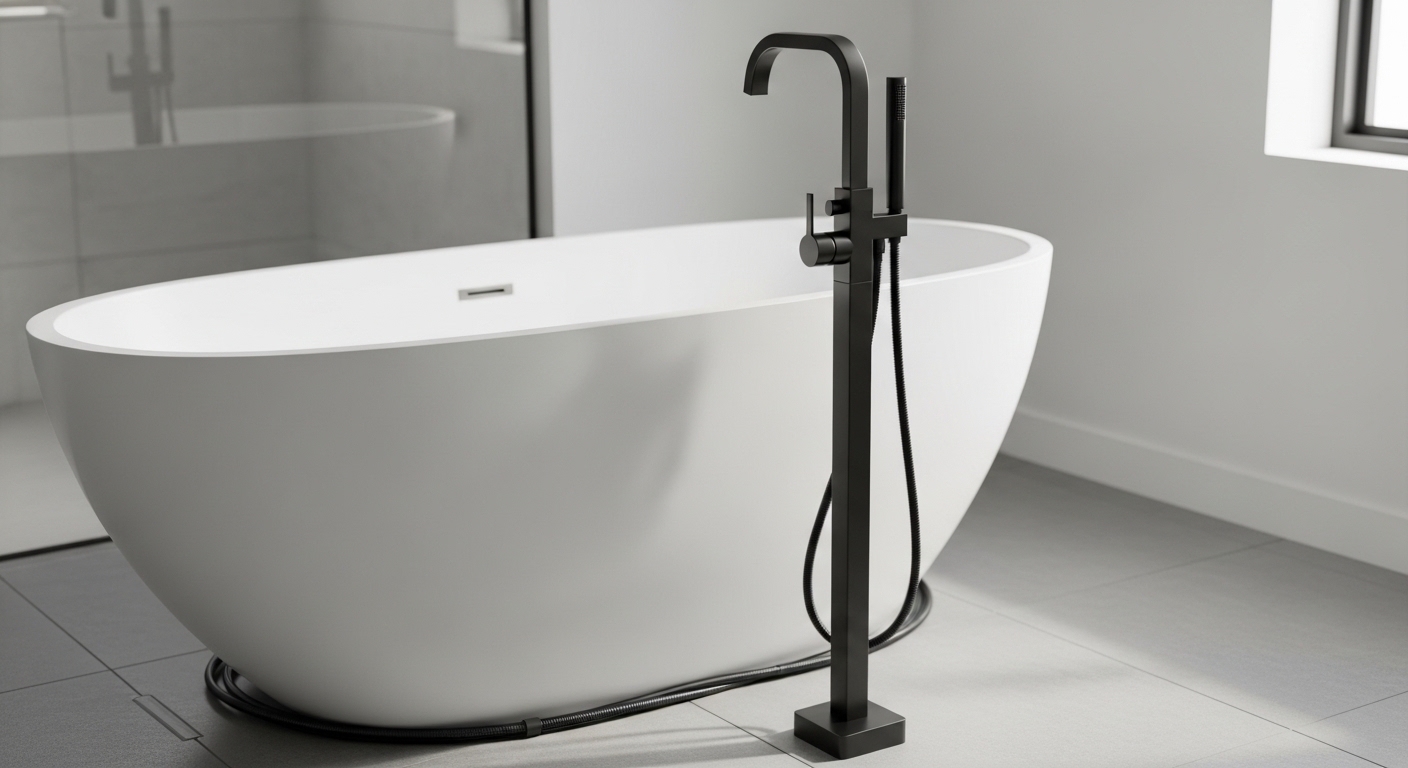
If you’ve bought a beautiful standalone soaker and now realize it has no faucet holes, a freestanding tub faucet floor mount is almost certainly what you need. It’s the tall column faucet you see rising straight out of the floor beside a clawfoot or modern egg-shaped tub — no wall plumbing, no deck holes, just a supply line coming up through the bathroom floor. This guide walks through how to choose one, how it installs, what it costs, and the mistakes that cause leaks and wobble so you can get it right the first time.
What Exactly Is a Freestanding Tub Faucet Floor Mount?
It’s a self-supporting faucet that mounts to the floor and delivers water to a freestanding tub that has no faucet holes of its own. Instead of attaching to the tub rim (deck mount) or the wall behind it (wall mount), the entire faucet body stands on the floor and connects to hot and cold supply lines that rise up through the subfloor.
These faucets are tall — usually 40 to 44 inches from the floor to the spout — because the spout has to reach up and over the lip of a deep soaking tub. Most include a swiveling gooseneck or high-arc spout, a diverter, and a hand-held shower wand on a hose. The base sits on a round or square escutcheon plate that covers the floor penetration and hides the mounting hardware.
The key thing to understand: a floor mount faucet is a plumbing decision as much as a style decision. Because the water comes up through the floor, you commit to a supply location early — ideally before the tub is set and the floor is finished. Get that rough-in location right and installation is straightforward; get it wrong and you’re cutting tile.
Floor Mount vs. Deck Mount vs. Wall Mount — Which One Do You Actually Need?
You need a floor mount if your tub is freestanding and has no faucet holes, and your supply lines run under the floor. Deck mount is for tubs with pre-drilled holes in the rim; wall mount is for faucets plumbed through the wall behind the tub. Here’s how they compare:
| Mount Type | Where Water Comes From | Best For | Typical Difficulty |
|---|---|---|---|
| Floor mount (freestanding) | Up through the floor | Standalone soaking tubs with no faucet holes | Moderate–hard (subfloor access needed) |
| Deck mount | Through holes in the tub rim | Tubs with pre-drilled deck holes or a tile deck | Easy–moderate |
| Wall mount | Through the finished wall | Tubs set against a wall with in-wall valve | Moderate (rough-in behind wall) |
If you’re weighing wall versus floor placement, our guide on whether a wall mount faucet in black is worth it for your bathroom or kitchen breaks down when running plumbing through the wall makes more sense than through the floor.
How Do You Install a Freestanding Tub Faucet Floor Mount Yourself?
You install it in five stages: rough-in the supply lines, anchor the mounting bracket to the subfloor, set the faucet body over the risers, connect the supply hoses, then test for leaks before finishing the escutcheon. A confident DIYer can do the final assembly in an afternoon — but the rough-in plumbing is the part most people should plan carefully or hand to a plumber.
Here’s the realistic sequence:
- Confirm the rough-in. Your hot and cold supply stubs should come up through the floor at the exact spacing the faucet requires — commonly 3⅜ inches (about 85 mm) center-to-center, but check your model’s spec sheet. This is set before tile goes down.
- Mount the anchor bracket. Floor mount faucets come with a metal mounting bracket that bolts to the subfloor. On a wood subfloor you screw into blocking; on a concrete slab you drill and use anchor bolts. This bracket is what keeps the tall faucet from wobbling.
- Slide the faucet body over the risers. The faucet column drops down over the bracket and the flexible supply risers thread up inside it.
- Connect the hot and cold lines. Attach the braided supply hoses to your shutoff valves, keeping hot on the left and cold on the right (as you face the faucet).
- Test, then finish. Turn the water on slowly, check every joint for drips, run the diverter to the hand shower, and only then snug down the decorative escutcheon plate over the base.
The single most important spec is the rough-in — the distance and spacing of your supply lines relative to the finished floor and the tub. Getting rough-in dimensions right is the same discipline that trips people up with showers; if you want to understand how pros think about measuring from the finished surface, our explainer on the right shower valve rough-in distance from the finished wall uses the exact same logic you’ll apply to your floor penetration.
Do You Need to Open the Floor or Ceiling Below?
Usually yes — at least during the rough-in phase. To bring hot and cold lines up through the floor, a plumber typically needs access to the joist bay below, either from an unfinished basement ceiling or by opening a section of floor. On a slab foundation, the supply lines are run before the slab is poured or brought up through a cored hole.
If your tub is already placed and the floor is finished with no access below, retrofitting a floor mount faucet gets expensive fast — that’s the scenario where a wall mount or deck mount alternative may save you a demolition. Plan the plumbing route before you fall in love with a specific faucet.
What Should a Good Freestanding Tub Faucet Cost in 2026?
Expect to pay roughly $180 to $450 for a solid-brass floor mount tub faucet with a hand shower and a lifetime-rated ceramic disc cartridge. Below about $150 you start seeing zinc-alloy bodies and plastic internals that corrode or loosen within a few years; above $600 you’re mostly paying for designer branding, not better function.
Here’s what your money actually buys at each tier:
| Price Range | What You Typically Get | Watch Out For |
|---|---|---|
| Under $150 | Zinc or thin-wall body, basic cartridge, limited finishes | Wobble over time, finish flaking, short warranty |
| $180–$450 | Solid brass body, ceramic disc cartridge, hand shower, sturdy floor bracket | Confirm valve and hose are included, not sold separately |
| $450–$700+ | Designer styling, premium PVD finishes, heavier flow rate | Paying for brand more than performance |
A quick buying checklist that separates a faucet that lasts from one that disappoints:
- Solid brass body — heavier is better; zinc alloy is the tell of a cheap unit.
- Ceramic disc cartridge — outlasts rubber-washer valves by a decade or more.
- A real floor-mount bracket — not just a flange; the anchor plate is what stops wobble.
- PVD or brushed finish over electroplate for scratch and corrosion resistance.
- Included supply hoses and diverter — check the box contents so you’re not buying parts twice.
- A meaningful warranty — a lifetime finish and cartridge warranty signals the maker trusts the build.
Which Finish Holds Up Best — Chrome, Matte Black, or Brushed Gold?
For durability and easy matching, polished chrome is the safest choice; matte black looks stunning but shows water spots and dust; brushed gold (champagne bronze) hides spots well and is the 2026 favorite for warm, modern bathrooms. All three are fine functionally — the difference is maintenance and how they coordinate with your other fixtures.
A few real-world notes from finishes people actually live with:
- Polished chrome — nearly bulletproof, cheapest, wipes clean, but reads a bit clinical.
- Matte black — dramatic against a white tub, but hard water leaves visible spotting; wipe after use.
- Brushed nickel — the neutral workhorse; hides spots, goes with almost anything.
- Brushed gold / champagne bronze — warm and on-trend, forgiving of fingerprints and water marks.
The trickiest decision is mixing metals. A chrome faucet against a dark tub or dark floor can look intentional or accidental depending on the room — we dug into exactly that tension in our piece on whether a chrome tap on a black sink actually looks good or is a mistake, and the same color logic applies to a floor mount faucet standing against a dark tile floor.
Will a Floor Mount Faucet Fit Any Freestanding Tub?
Almost, but not automatically — you need to confirm three things: spout height clears your tub wall, the faucet reaches over the rim without splashing outside, and your floor can be plumbed at the right spot. A 40-inch tall faucet is standard, but very deep Japanese-style soakers or tall pedestal tubs may need an extra-tall model.
Measure from your finished floor to the top of the tub wall. Your spout should clear that rim and arc far enough inward that water lands well inside the tub, not on the rolled edge. As a rule of thumb, position the faucet so the spout’s outlet sits 2 to 4 inches inside the tub’s inner wall. Too close and the stream hits the lip; too far and it’s an awkward reach for the diverter and hand shower.
Also confirm your home’s water pressure. Tall column faucets can feel weak on low-pressure systems because the water has to climb 40 inches. If you already fight low pressure elsewhere in the house, address it first — the same troubleshooting mindset in our guide to why a Moen faucet has low water pressure and how to fix it applies to a tub filler that trickles instead of gushes.
How Long Should It Take to Fill the Tub?
A good freestanding tub faucet flows around 5 to 8 gallons per minute, filling a standard 60-gallon soaker in roughly 8 to 12 minutes. Unlike bathroom sink faucets, tub fillers are intentionally not flow-restricted to a low aerated rate, because nobody wants to wait 25 minutes for a bath. If a spec sheet lists 1.2 GPM, that’s a sink aerator rating on the wrong product — skip it for a tub filler.
Common Mistakes That Cause Leaks and Wobble
The two failures people report most are a faucet that rocks when you grab the handle and a slow leak at the floor. Both trace back to the rough-in and the mounting bracket, not the faucet quality. Here’s how to avoid them:
- Skipping the subfloor blocking. The anchor bracket needs solid material to bite into. Add blocking between joists so the bolts don’t pull loose over months of use.
- Wrong riser length. If the flexible supply risers are too short, the connections get strained; too long and they kink inside the column. Measure to your shutoff height.
- Over-tightening compression fittings. Snug plus a quarter turn is plenty — cranking cracks brass nuts and deforms ferrules, which is a slow leak waiting to happen.
- No test before finishing. Always pressurize and inspect every joint before you set the escutcheon and grout around it. Finding a drip after tile is heartbreaking.
If you do get a nuisance drip at a handle or joint later, it’s usually a cartridge or a compression fitting — the same fixes that solve a leaking single-handle faucet. Our walkthrough on why a kitchen faucet leaks at the base and how to fix it yourself covers the base-leak diagnosis logic that transfers directly to a floor mount column.
Why Buy Your Floor Mount Tub Faucet From evefaucet?
evefaucet builds freestanding tub fillers on solid-brass bodies with ceramic disc cartridges, and every floor mount model ships with the anchor bracket, braided stainless supply risers, and diverter in the box — so you’re not hunting for missing parts on install day. Our finishes are PVD-coated for corrosion and scratch resistance, and each faucet is pressure-tested before it leaves the line.
We back the finish and cartridge with a limited lifetime warranty, and our fixtures are built to meet U.S. plumbing standards for lead-free wetted surfaces (NSF/ANSI 372) and flow performance (ASME A112.18.1). That combination — real materials, complete kits, tested and standards-compliant — is what keeps a tall faucet solid and drip-free for years, not months.
Author note: This guide was written by evefaucet’s fixtures team, drawing on years of hands-on installation support and customer feedback across freestanding tub, wall mount, and deck mount faucet lines. We test the products we sell and answer install questions from real buyers every week.
FAQ
Can I install a freestanding tub faucet floor mount without a plumber?
You can handle the final assembly — setting the faucet on the bracket, connecting the supply hoses, and testing — yourself in an afternoon if the rough-in plumbing is already in place. The part most people should not DIY is running new hot and cold supply lines up through the floor, which requires access below and a solid understanding of your home’s plumbing. If the water is already stubbed up at the right spot, it’s a very doable DIY job.
How far from the tub should the floor mount faucet be placed?
Position it so the spout’s outlet sits about 2 to 4 inches inside the tub’s inner wall — close enough that water lands well inside the tub, far enough that the stream doesn’t splash the rolled edge. The faucet body itself usually stands 2 to 6 inches from the outside of the tub. Always check your specific tub and faucet spec sheets, since spout reach varies by model.
What size are the water supply lines for a floor mount tub faucet?
Most freestanding tub faucets use standard ½-inch supply connections, fed by ⅜-inch or ½-inch flexible braided risers that come up through the floor to your shutoff valves. Confirm the exact rough-in spacing — commonly around 3⅜ inches center-to-center — from your faucet’s installation sheet before setting the supply stubs, because that spacing is fixed once the floor is finished.
Do freestanding tub faucets come with a hand shower?
Most mid-range and up models include a hand-held shower wand on a hose plus a diverter to switch flow between the spout and the wand. Budget units sometimes omit it, so check the box contents. A hand shower is genuinely useful for rinsing the tub, washing hair, or bathing kids and pets — it’s worth prioritizing.
Why does my floor mount tub faucet wobble?
A wobbling floor mount faucet almost always means the anchor bracket wasn’t secured to solid subfloor blocking, or the bracket bolts have loosened. Because the faucet is tall, any play at the base is magnified at the handle. The fix is to remove the escutcheon, re-tighten or re-anchor the bracket into proper blocking, and confirm the bolts bite into wood or concrete rather than just the subfloor surface.
Is a floor mount tub faucet worth it over a wall mount?
It’s worth it when your tub sits away from any wall and you want that dramatic standalone look — the floor mount is the only clean option for a tub in the middle of the room. If your tub sits against a wall, a wall mount faucet can be simpler and cheaper to plumb. The deciding factor is tub placement and whether you can route supply lines through the floor versus the wall.