 EVE卫浴
EVE卫浴
Which Pull Out Kitchen Faucet in Black Should You Actually Buy in 2026?
浏览次数:12 分类:公司产品
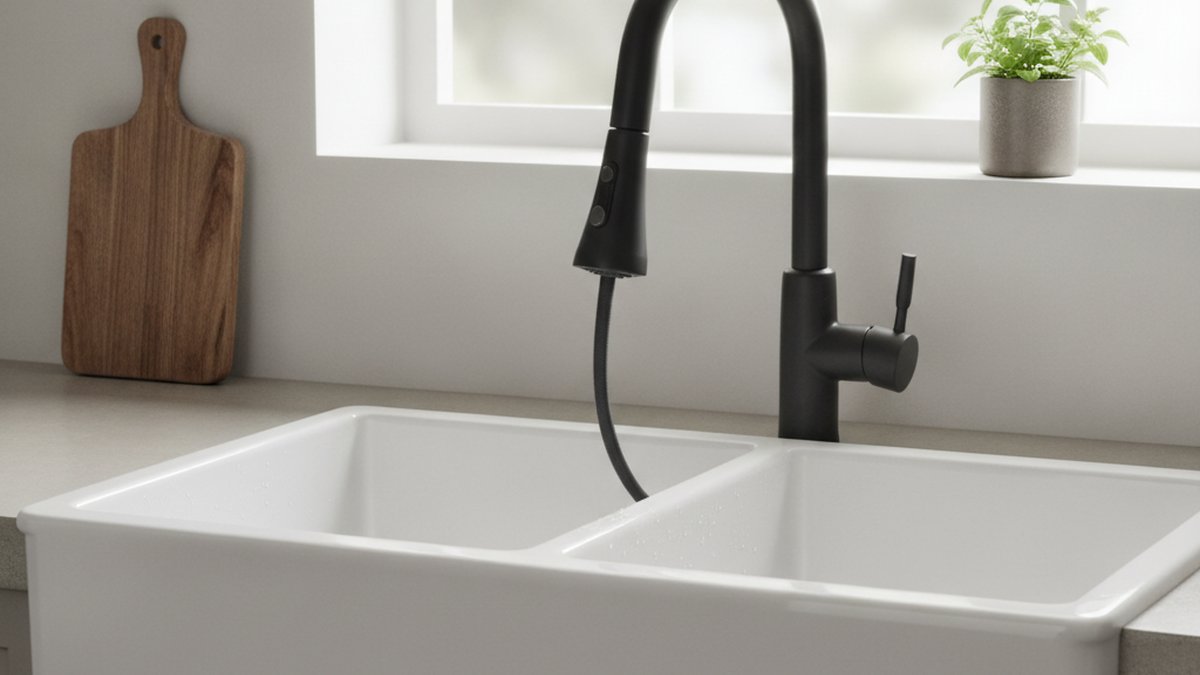
A pull out kitchen faucet black finish is popular right now for a simple reason: it looks high-end, works with almost any countertop, and — unlike chrome — doesn’t broadcast every fingerprint and water droplet. But “black” covers everything from a $45 no-name spray head to a $400 designer piece, and the differences that actually matter (the cartridge, the hose, the coating, the dock) are the ones you can’t see in a product photo. This guide walks through exactly what to look for, what to skip, and which style fits your sink and budget.
What’s the difference between a pull-out and a pull-down faucet — and does it matter for a black finish?
A pull-out faucet has a spray head that pulls straight out toward you on a hose, while a pull-down faucet has a taller, gooseneck spout with a spray head that pulls down into the sink. The black finish behaves the same on both — the choice is about ergonomics and your sink, not color.
Pull-out models sit lower and shorter, which makes them a better fit for kitchens with a window or upper cabinet directly behind the sink where a tall gooseneck wouldn’t clear. Because the spray head extends horizontally, they’re also easier for filling pots on the counter and rinsing awkward items. Pull-down faucets give you more clearance under the spout for big stockpots but need vertical room above the sink.
- Choose pull-out if you have a window, low cabinet, or shallow sink, or you want a more compact, traditional profile.
- Choose pull-down if you have open space above the sink and frequently wash large pots or baking sheets.
In matte black specifically, the lower-profile pull-out reads as clean and understated, which is why it pairs so well with white, wood-tone, and light stone countertops.
Is matte black or glossy black better for a kitchen faucet?
For a kitchen, matte black is almost always the better call. It hides water spots, fingerprints, and light smudges far better than glossy black, which shows every drip like a piano lid. Glossy (sometimes sold as “black stainless” or “gloss black”) looks striking in a showroom but demands constant wiping in real daily use.
The one real weakness of matte black is hard water. Matte finishes are slightly textured, so when mineral-heavy water dries on them it can leave chalky white streaks that are more visible than on chrome. If your home has hard water, look for a faucet that specifically advertises a spot-resistant or fingerprint-resistant PVD coating — that physical-vapor-deposition layer is bonded to the metal and resists both corrosion and mineral filming. If your tap barely trickles or leaves crusty buildup, that’s a hard-water signal worth addressing; our guide on a blocked faucet aerator explains how mineral scale collects and how to clear it.
| Finish type | Hides water spots | Durability | Best for |
|---|---|---|---|
| Matte black (PVD) | Excellent | Very high — scratch & corrosion resistant | Most kitchens; hard-water homes |
| Matte black (painted/powder) | Very good | Moderate — can chip over years | Budget builds, rentals |
| Glossy / gloss black | Poor | High | Low-use or statement sinks |
| Black + gold/brass accent | Good | High (if PVD) | Design-forward kitchens |
How much should you spend on a black pull-out kitchen faucet?
Plan on $120–$250 for a black pull-out faucet that will genuinely last 8–10 years. Below about $80 you’re usually getting a painted finish over zinc alloy with a rubber or low-grade cartridge — it’ll look fine for a year, then chip, drip, or lose spray pressure. Above $250 you’re mostly paying for brand name and designer styling, not meaningfully better function.
Here’s where the money actually goes and what’s worth paying for:
- Ceramic-disc cartridge ($): The single most important part. It controls flow and is what fails first on cheap faucets. A quality ceramic-disc cartridge is rated for 500,000+ open/close cycles.
- Solid brass body ($$): Resists corrosion far better than zinc alloy and holds the finish longer. Heavier is generally better.
- Braided nylon hose + dock ($): A good hose won’t kink, and a magnetic or spring dock makes the spray head snap cleanly back into place instead of drooping over time.
- PVD finish ($): Worth the small premium over painted black for scratch and spot resistance.
A practical rule: spend on the cartridge and the body, don’t overspend on the badge. The difference between a $150 and a $400 faucet is rarely the water experience.
What features actually matter on a pull-out kitchen faucet?
The features that matter day to day are the spray modes, the dock strength, the reach of the hose, and the handle type — in that order. Everything else is marketing.
Look for at least two spray modes (an aerated stream for filling and a stronger spray for rinsing) with an easy thumb toggle. A pause button on the spray head is genuinely useful when moving between the sink and a pot on the counter. Check the hose reach — 20–24 inches of usable pull-out length covers a standard double sink; less than 18 inches feels short.
Handle placement matters too. A side-mounted single lever is the most common and intuitive; make sure there’s enough clearance behind the faucet if you have a backsplash or window ledge. Touch-activated and motion-sensor models exist in black, but they add cost and a failure point — if you go that route, know that the electronics can misbehave; here’s what to do when a touch faucet stops working.
Do black faucets scratch or fade over time?
A quality PVD matte-black faucet will not fade and strongly resists scratching — the color is part of a bonded metal layer, not a coat of paint on top. Cheap “black” faucets that are simply powder-coated or spray-painted are the ones that chip at the spout tip and around the handle base after a couple of years. To keep any black finish looking new, wipe it with a soft damp cloth and mild soap only; never use abrasive pads, ammonia, or bleach-based cleaners, which strip and dull the finish.
Will a black faucet match my sink and hardware?
Black is one of the most forgiving finishes to match — it works with stainless steel, white, black, granite composite, and fireclay sinks alike, and it coordinates with almost any cabinet color. The key is deciding whether you want the faucet to blend or stand out.
Over a stainless sink, a matte-black faucet creates a deliberate, high-contrast look that reads as intentional rather than mismatched — the same logic that makes mixed metals work when you commit to the contrast. (If you’re weighing metal-on-metal combinations instead, our piece on whether a brushed nickel faucet goes with a stainless steel sink covers how to make a finish pairing look purposeful.) For cabinet hardware, you don’t have to match black to black — black faucet with brushed-gold pulls is a very current combination — but keeping your faucet and soap dispenser in the same finish family looks the most cohesive. If you’re also updating a bathroom, matching the kitchen’s black tone to a matte-black shower faucet finish keeps the whole home consistent.
How many mounting holes do I need?
Most pull-out kitchen faucets are single-hole (one 1.375-inch hole), and nearly all come with an optional deck plate (escutcheon) to cover a 3-hole sink from an older setup. So a single-hole black faucet fits both new single-hole sinks and older 3-hole configurations — just use the included deck plate for the latter. Measure your sink’s hole spacing before buying: standard 3-hole sinks are drilled 4 or 8 inches apart, and the deck plate needs to cover that span.
How hard is it to install a pull-out kitchen faucet yourself?
Most people can install a black pull-out kitchen faucet in about 45–90 minutes with basic tools — a basin wrench, an adjustable wrench, and plumber’s tape. It’s one of the more DIY-friendly plumbing jobs because there’s no wall demo and the connections are all under the sink.
The general sequence:
- Turn off the hot and cold shutoff valves under the sink and open the old faucet to release pressure.
- Disconnect the supply lines and remove the old faucet’s mounting nuts (this is where a basin wrench earns its keep).
- Clean the deck, drop in the new faucet (with deck plate if needed), and tighten the mounting hardware from below.
- Connect the supply lines, wrapping threads with plumber’s tape, and attach the pull-out hose and its counterweight.
- Turn the water back on slowly, remove the aerator, and run water for 15 seconds to flush debris before checking for leaks.
The one step people forget: attach the hose counterweight so the spray head retracts fully. If your spout ever starts weeping or the flow seems off after install, the cause is often the cartridge, not the install — understanding the cartridge inside a faucet handle makes troubleshooting a drip much faster.
Which type of black pull-out faucet fits your kitchen?
Here’s a quick decision guide based on real scenarios:
| Your situation | Best pick | Why |
|---|---|---|
| Window behind the sink | Low-profile matte-black pull-out | Clears the ledge; spray head still reaches |
| Hard water area | Spot-resistant PVD black | Coating resists mineral streaking |
| Big pots, deep single-bowl sink | Tall pull-down in matte black | More under-spout clearance |
| Rental / tight budget | Powder-coated black single-handle | Cheap, decent for 2–3 years |
| Design-focused remodel | Black + brushed-gold two-tone PVD | Statement look, durable finish |
FAQ
Do black kitchen faucets show water spots more than chrome?
Matte black actually hides fingerprints and light water spots better than chrome. Its one weakness is hard water: dried mineral deposits leave chalky white streaks that are more visible on matte black than on shiny chrome. A spot-resistant PVD coating and a quick daily wipe eliminate the issue in almost all cases.
Are matte black faucets hard to clean?
No — they’re easy to clean but picky about how. Use only a soft, damp cloth with mild dish soap or water. Avoid abrasive scrubbers, vinegar left to sit, ammonia, and bleach cleaners, all of which can dull or strip the finish over time. That’s the whole maintenance routine.
Can I put a single-hole pull-out faucet on my 3-hole sink?
Yes. Almost every single-hole pull-out faucet includes an optional deck plate that covers the two extra holes on a standard 3-hole sink. Just confirm the deck plate spans your sink’s hole spacing (usually 4 or 8 inches) before you buy.
What’s the most common problem with pull-out faucets?
The two most common issues are a spray head that stops retracting (a slipped or missing hose counterweight) and reduced flow or dripping (a clogged aerator or worn ceramic cartridge). Both are inexpensive fixes and don’t require replacing the whole faucet.
Is a black pull-out faucet worth it over a standard chrome one?
If you like the look and buy a PVD-finished model, yes — black hides daily smudges better and coordinates with more countertop and cabinet styles, for roughly the same price as a comparable chrome faucet. The one caveat is very hard water, where you’ll want the spot-resistant coating to avoid mineral streaking.
Where should I buy a black pull-out kitchen faucet?
Buy from a specialist faucet retailer or a brand that publishes cartridge specs, finish type (PVD vs. painted), and warranty terms — those details tell you far more than the price. Buying online from a dedicated fixtures brand usually gets you better cartridge quality and warranty support than a generic marketplace listing, though some shoppers still prefer to find a faucet locally to see the finish in person first.
The bottom line
A black pull-out kitchen faucet is one of the safest style upgrades you can make — it looks premium, matches nearly everything, and hides the daily mess of a working kitchen. Buy a single-handle matte-black model with a ceramic-disc cartridge, a solid brass body, and a spot-resistant PVD finish in the $120–$250 range, add the deck plate if your sink has three holes, and you’ll have a faucet that looks and works great for the better part of a decade.
Author note: This guide was written by the evefaucet product team, drawing on hands-on testing of pull-out and pull-down kitchen faucets across chrome, brushed nickel, and matte-black finishes. evefaucet designs and sells kitchen and bathroom fixtures direct to homeowners at www.evefaucet.com. Our kitchen faucets use ceramic-disc cartridges tested to over 500,000 open/close cycles, lead-free brass waterways that meet U.S. NSF/ANSI 61 and low-lead standards, and PVD finishes backed by a limited lifetime finish-and-function warranty.