 EVE卫浴
EVE卫浴
Centerset Faucet vs Widespread vs Single-Hole: Which Bathroom Faucet Should You Actually Buy?
浏览次数:305 分类:公司产品
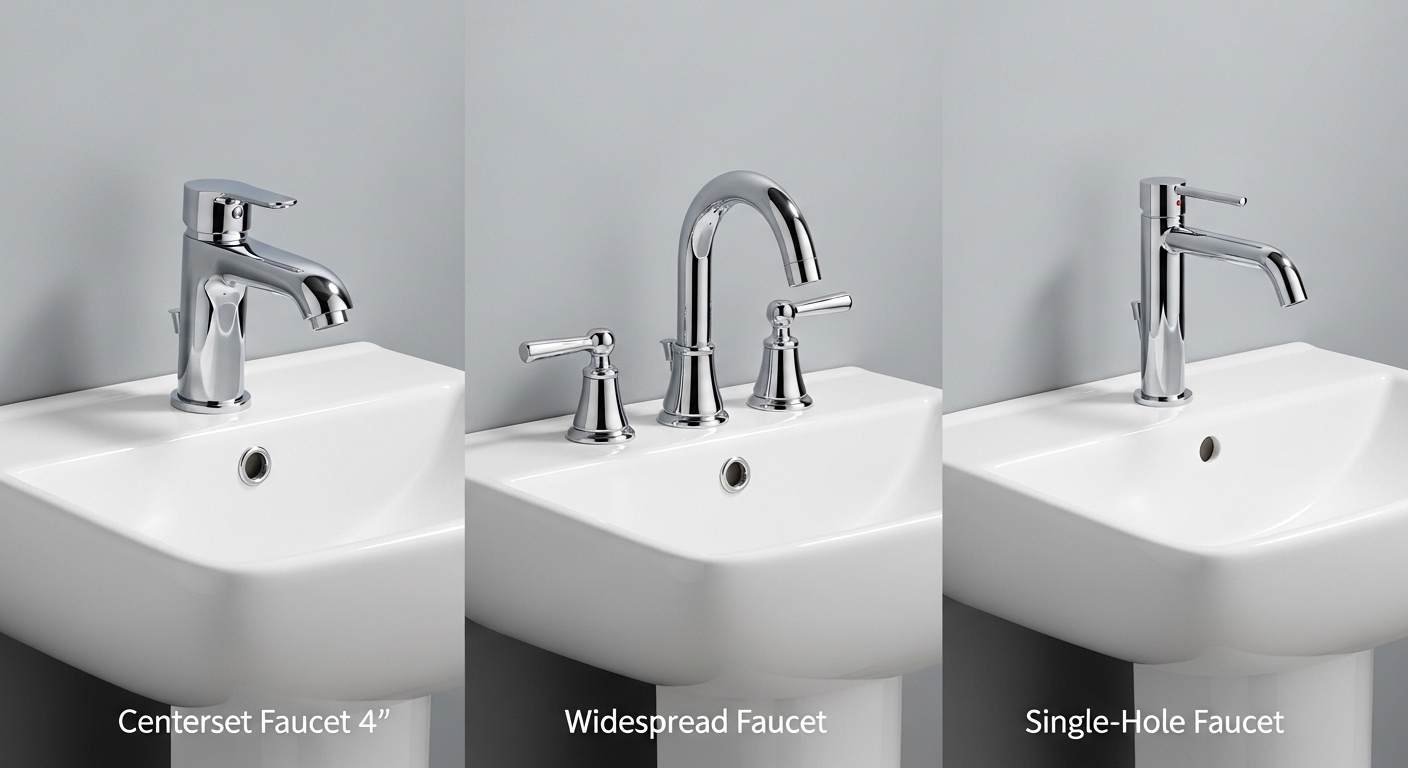
When people compare a centerset faucet vs the other common bathroom faucet styles — widespread and single-hole — they’re really asking one practical question: “Which one actually fits my sink and looks right without turning into a plumbing headache?” The honest answer comes down to your sink’s hole spacing, your budget, and the vibe you’re after. Below, we’ll break down exactly how these faucet types differ, who each one is for, and how to measure so you don’t order the wrong thing.
What exactly is a centerset faucet, and how is it different from a widespread?
A centerset faucet is a bathroom faucet where the spout and both handles are mounted on a single base plate (usually 4 inches wide, sometimes 6), designed for a sink with three holes spaced 4 inches apart, center-to-center. A widespread faucet, by contrast, has three completely separate pieces — the spout and two independent handles — that connect underneath the sink and typically span 8 to 16 inches.
The simplest way to picture it: a centerset is “all-in-one” on one deck plate, while a widespread is “three separate parts” with visible countertop between the spout and each handle. That gap is the whole point of a widespread — it reads as more custom and high-end. A centerset reads as tidy, compact, and traditional. Both can be single-handle or two-handle, but the classic centerset is a two-handle unit sitting on one plate.
There’s also a middle option people forget: the mini-widespread (sometimes called a “mini-spread”). It looks like a widespread — three separate pieces — but the handles are only 4 inches from the spout, so it fits the same 4-inch three-hole sink a centerset uses. It’s a nice trick if you want the widespread look on a small sink.
Centerset faucet vs widespread vs single-hole: which fits my sink?
Fit is decided by your sink’s hole count and spacing, not by taste — so measure before you fall in love with a finish. Here’s the quick rule: 3 holes at 4 inches apart = centerset (or mini-widespread); 3 holes at 8 inches apart = widespread; 1 hole = single-hole faucet.
| Faucet type | Sink holes needed | Hole spacing | Look | Typical price | Best for |
|---|---|---|---|---|---|
| Centerset | 3 (or 1 with deck plate) | 4″ center-to-center | Compact, traditional | $40–$180 | Small vanities, guest baths, easy swaps |
| Widespread | 3 | 8″–16″ adjustable | Upscale, custom, spacious | $120–$500+ | Large vanities, master baths, remodels |
| Mini-widespread | 3 | 4″ center-to-center | Widespread look, small footprint | $90–$250 | Small sinks wanting a premium look |
| Single-hole | 1 | N/A | Modern, minimal | $50–$300 | Vessel sinks, modern vanities, tight sinks |
If your sink already has three holes at 4 inches and you don’t want to change the sink, a centerset (or mini-widespread) is the path of least resistance. If you’re buying a brand-new sink or vanity top, you get to choose the drilling — and that’s when the decision really opens up. Not sure how to check your spacing? Our guide on the right 3-hole faucet hole size walks through measuring exactly where those holes sit so you don’t guess.
Is a centerset faucet cheaper and easier to install than a widespread?
Yes — in almost every case a centerset is both cheaper and faster to install than a widespread. Because everything sits on one base plate and the connections are pre-plumbed as a unit, you’re typically dealing with fewer supply-line hookups and no fiddly under-counter tubing to align across 8 inches of countertop.
A widespread has three separate bodies, which means the spout connects to each handle underneath the deck with additional flex hoses or a T-connection. It’s not hard, exactly, but it’s more parts, more room to work in, and more chances to overtighten or misalign a connector. A confident DIYer can still do it in an afternoon — but a centerset is genuinely a “install it in 20–30 minutes” job for most people.
- Centerset: One deck plate, gasket down, two supply lines, tighten mounting nuts, connect drain. Done.
- Widespread: Set spout, set each handle, connect the T-fitting or flex hoses under the deck, align everything so the handles sit square, then connect supplies. More steps, more finesse.
- Single-hole: Often the easiest — one body drops through one hole, one mounting nut, one or two supply lines.
Whichever you pick, the connector hardware matters. If you go widespread, the flexible tubing that links the pieces isn’t universal — read up on what a widespread faucet connector is and how to pick the right one before you buy, because the wrong connector length or thread is the most common reason a widespread install stalls.
Does a centerset or widespread faucet look more expensive?
A widespread almost always reads as the more expensive, upscale choice — the visible space between the handles and spout signals a custom, designer installation. A centerset looks neat and classic but more “builder-grade” or traditional, which is exactly right for a guest bath, a rental, or a compact vanity where a sprawling widespread would look cramped.
That said, “looks expensive” isn’t the same as “looks right.” On a small 18-inch vanity, a wide 8-inch widespread can look oversized and awkward, while a tidy centerset looks intentional and proportional. On a large double vanity or a stone countertop in a master bath, a widespread is where the money shows. Match the faucet’s scale to the sink’s scale first, then chase the look.
Finish plays into this too. A brushed gold or matte black widespread on a light stone top is a showpiece; a polished chrome centerset is timeless and hides water spots better in a busy family bathroom. If you’re pairing a bold fixture with a dark basin, our take on whether a chrome tap on a black sink actually looks good is worth a read before you commit to a finish.
Can I replace a centerset faucet with a widespread (or vice versa)?
You can go from widespread to centerset easily, but going from centerset to widespread usually requires re-drilling or replacing the sink. That’s because a centerset sink has holes 4 inches apart, and a true widespread needs them 8 inches apart — you can’t move existing holes in porcelain or stone.
Here’s how the swaps actually play out:
- Widespread → centerset: Easy. An 8-inch three-hole sink can accept a centerset if you use a base/deck plate, but note the outer holes may be too far apart to line up under a standard 4-inch plate — you may need a 6-inch (or “minispread”) centerset or a wider escutcheon. Check the plate width against your hole spread.
- Centerset → widespread: Hard. Your 4-inch holes won’t reach a widespread’s 8-inch handles. Your realistic options are a mini-widespread (fits 4-inch spacing and looks the part) or a new sink/countertop drilled for 8 inches.
- Either → single-hole: Possible with a deck plate that covers the two unused outer holes, giving you a clean single-hole look on a three-hole sink.
The takeaway: if you even think you might want a widespread someday, drill (or buy) for 8-inch spacing now. Downsizing later is trivial; upsizing means new stone.
Which is more reliable long-term — one-piece or separate-part faucets?
Reliability depends far more on valve quality (ceramic disc cartridges vs cheaper rubber-washer designs) than on whether the faucet is centerset or widespread. A well-made centerset with ceramic cartridges will outlast a bargain widespread, and vice versa. Don’t let the style category stand in for quality.
That said, there’s one honest structural difference: a widespread has more connection points underneath the deck, which is more potential leak locations if it’s installed sloppily or with worn connectors. A centerset’s integrated body has fewer joints. In practice, a correctly installed faucet of either type with quality connectors and a ceramic cartridge should give you 10–15+ years of service.
When you do eventually get a drip, it’s usually the cartridge, not the whole faucet — and that’s a cheap, DIY fix on either style. Both centerset and widespread faucets are serviceable; you replace the worn cartridge rather than the whole unit, which is one reason we push people toward faucets with standard, widely-available cartridges over sealed no-name designs.
A note on aerators and flow
Both styles use a threaded aerator at the spout tip, and both are subject to the same U.S. maximum bathroom faucet flow rate of 1.5 GPM (some states like California cap it lower at 1.2 GPM). If your new faucet feels weak or sputters, it’s nearly always the aerator or a supply issue, not the faucet type. Style has zero bearing on water pressure — spacing and looks are the only real differences at the deck.
How do I measure my sink before buying — step by step?
Measure the center-to-center distance between the two outermost holes; that single number tells you which faucet type fits. Do this before you shop, because a returned faucet is a wasted weekend.
- Count the holes. One hole = single-hole faucet (or add a deck plate). Three holes = centerset, mini-widespread, or widespread depending on spacing.
- Measure outer hole spacing. Put a tape measure across the center of the left hole to the center of the right hole. About 4 inches = centerset/mini-widespread. About 8 inches = widespread.
- Check hole diameter. Standard faucet holes are 1 3/8 inches (about 35 mm). Some vessel and single-hole faucets need 1 3/4 inches — verify against the faucet’s spec sheet.
- Measure the deck depth. The flat area behind the holes needs enough room for the faucet base and handles to clear the backsplash and sink lip.
Write those three numbers down and match them to the product listing’s spec sheet. Every reputable faucet page lists required hole count, spacing, and diameter — if it doesn’t, that’s a red flag.
The bottom line: which should you buy?
Buy a centerset faucet if you have a 4-inch three-hole sink, you’re on a budget, you want the simplest install, or you’re outfitting a compact/guest bathroom. Buy a widespread if you have (or are drilling for) 8-inch spacing, a larger vanity, and you want that upscale, custom look. Buy a mini-widespread if you want the widespread look on a small 4-inch sink. And buy a single-hole faucet for modern vanities, vessel sinks, or the cleanest minimal look. When weighing a centerset faucet vs any of these, let your sink’s existing holes make the first cut, then decide on style and budget.
FAQ
Is a centerset faucet the same as a 4-inch faucet?
Mostly, yes. “4-inch centerset” is the most common size, referring to the 4-inch center-to-center spacing of the mounting holes. There are also 6-inch centersets for slightly wider three-hole sinks, so always confirm the spacing on the spec sheet rather than assuming every centerset is 4 inches.
Can a centerset faucet fit an 8-inch (widespread) sink?
Not cleanly. A standard 4-inch centerset plate won’t span 8-inch holes, and the outer holes will be left exposed beyond the plate. If you have an 8-inch sink, buy a widespread or a mini-widespread designed for that spacing, or use a large escutcheon/deck plate sized to cover the gap.
Is a widespread faucet worth the extra money?
On a large vanity in a master or main bathroom where the fixture is a focal point, yes — the custom look and adjustable spacing justify the cost. On a small guest bath or a rental, a centerset gives you 90% of the function for a fraction of the price, and looks more proportional on a compact sink.
Do centerset and widespread faucets use different valves or cartridges?
Not inherently. Both can use ceramic disc cartridges (the durable modern standard) or older washer-based valves. Cartridge quality — not faucet style — determines drip resistance and lifespan, so prioritize a faucet with standard, replaceable ceramic cartridges regardless of type.
Which faucet type is easiest for a first-time DIY install?
A single-hole faucet is usually the easiest (one hole, one nut), followed closely by a centerset (one integrated base plate). A widespread is the most involved because you’re connecting three separate pieces under the counter — still very doable, just plan for more time and double-check your connectors.
What if my new faucet has low pressure after installing it?
That’s almost never caused by the faucet style. Check the aerator for debris first, then confirm the supply valves are fully open and the flex lines aren’t kinked. Faucet type — centerset, widespread, or single-hole — has no effect on water pressure; flow is set by the aerator rating and your home’s supply.
About the author: Written by the evefaucet product team, a group of bathroom and kitchen fixture specialists who spec, install, and test faucets year-round. We’ve handled hundreds of centerset, widespread, and single-hole installs across every common sink configuration, so this guidance comes from hands-on fitting, not spec sheets alone.
Why trust evefaucet: evefaucet designs and sells faucets and bathroom fixtures direct to homeowners at www.evefaucet.com. Our faucets use ceramic disc cartridges tested to industry cycle standards, meet U.S. lead-free (NSF/ANSI 372) and 1.5 GPM flow requirements, and are backed by a limited lifetime warranty on finish and function — so the faucet you choose here is one you can service and keep for years.