 EVE卫浴
EVE卫浴
What Is the Cartridge in a Faucet Handle, and Why Does It Matter When Your Faucet Drips?
浏览次数:170 分类:Faq
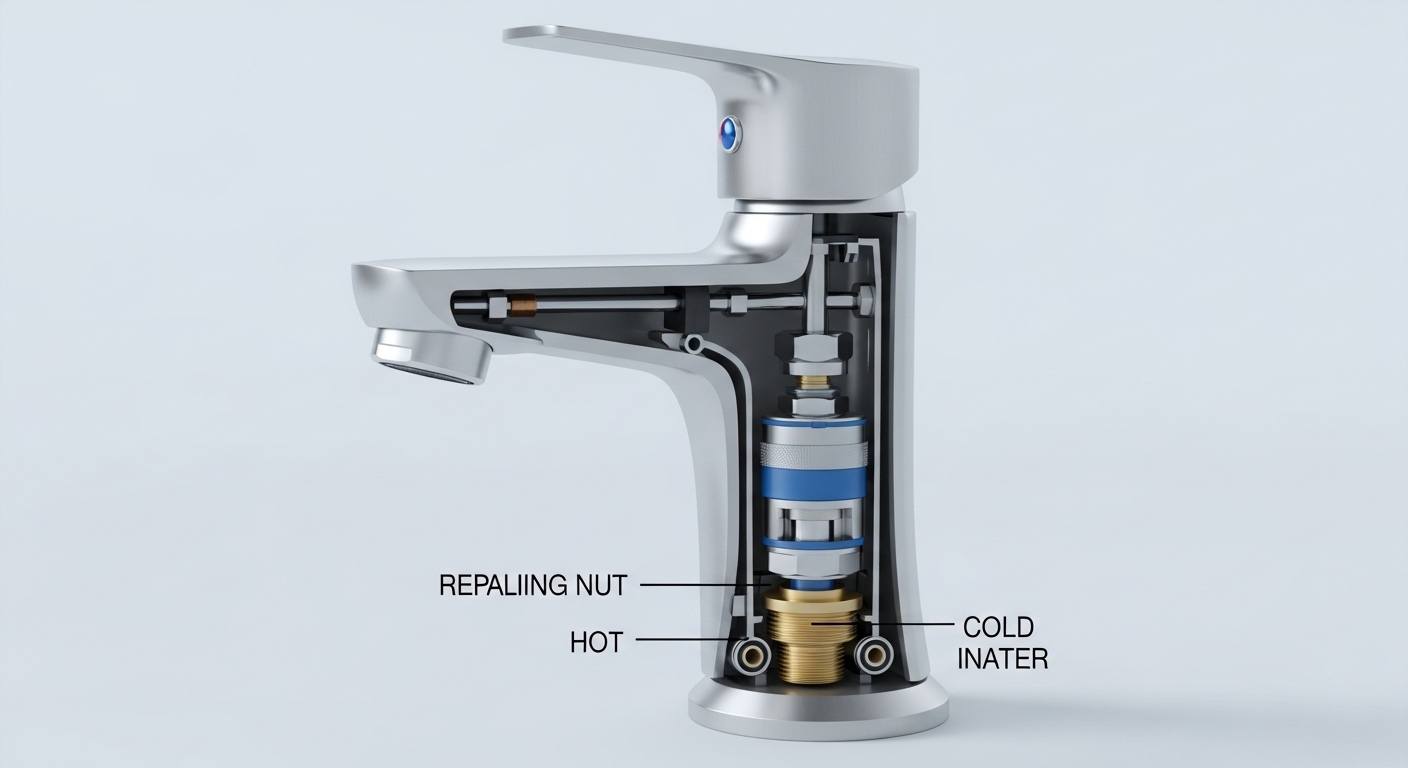
If you’ve ever wondered what is the cartridge in a faucet handle, here’s the plain-English version: it’s the heart of the faucet. Every time you lift, twist, or push the handle, you’re actually moving a cartridge hidden inside the faucet body. That cartridge controls how much water flows and whether it’s hot, cold, or somewhere in between. Understand this one part and you understand about 80% of why faucets leak, drip, and get stiff — and how to fix them cheaply.
At evefaucet, we design and test faucets and their internal valves for a living, so we spend a lot of time explaining cartridges to customers who just want their sink to stop dripping. This guide walks you through exactly what the cartridge is, what it does, how to tell when yours is failing, and what your options are — in the same plain language we’d use talking to a neighbor over the fence.
What exactly is a faucet cartridge, and what does it do inside the handle?
A faucet cartridge is a self-contained valve that sits inside the faucet body, directly under the handle. Its whole job is to open and close water passages as you move the handle — controlling flow (how much water) and temperature (the hot-to-cold mix). Think of it as the “engine” of the faucet: the handle, spout, and decorative finish are just the body panels around it.
Inside, most modern cartridges use one of two sealing systems. Older and budget designs use rubber O-rings and seals pressed against the cartridge body; when you turn the handle, ports line up and water flows through. Better designs use two polished ceramic discs — one fixed, one that rotates with the handle. When the holes in the discs align, water flows; when they don’t, the water shuts off. Ceramic-disc cartridges are the reason a good faucet can feel smooth for 15–20 years.
The key thing to understand: the cartridge is a wear part. It’s designed to be replaced. Faucet makers expect that after years of use, the seals harden or the discs get grit between them, and you’ll swap the cartridge rather than throw away a perfectly good faucet.
What are the main types of faucet cartridges, and how do I tell which one I have?
There are four main valve types you’ll run into, and they behave very differently. The quickest way to tell which you have is to look at how the handle moves and how many handles the faucet has. A single handle that moves up/down and side to side is almost always a cartridge or ball valve; two separate hot/cold handles are usually compression or ceramic-disc.
| Valve type | How the handle feels | Sealing method | Typical lifespan | Best for |
|---|---|---|---|---|
| Cartridge (rubber-seal) | Smooth up/down, no “grind” | O-rings & rubber seals | 5–10 years | Single-handle bath & kitchen faucets |
| Ceramic-disc cartridge | Very smooth, short quarter-turn | Two polished ceramic discs | 15–20+ years | Mid- to high-end faucets, hard-water homes |
| Ball valve | Loose, wobbly single lever | Slotted ball + springs & seats | 5–8 years | Older single-handle kitchen faucets |
| Compression (stem) | Multiple turns, gets tight at the end | Rubber washer squeezed onto a seat | 3–6 years (washer) | Older two-handle faucets, utility taps |
Technically, plumbers reserve the word “cartridge” for the insert-style valves (rows 1 and 2), while ball and compression are their own categories. But in everyday use, people call almost any handle-controlled internal valve a “cartridge,” and that’s fine — the important thing is identifying which physical part to buy. To nail down the exact replacement, note your faucet brand, the model number (often stamped under the spout or on the original box), and whether you have one handle or two.
How do I know if the cartridge in my faucet handle is bad?
You know the cartridge is bad when the faucet drips after you’ve shut it off, the handle gets hard to turn, the water temperature won’t hold steady, or you feel grinding when you move the handle. These are the classic symptoms, and they almost always point to the valve rather than anything else.
Here are the most common warning signs, roughly in order of how often we see them:
- Constant drip from the spout even when the handle is fully off — the seals or discs no longer close completely.
- Dripping only when hot or only when cold — one side of the cartridge is worn. If you’re trying to figure out which side is failing, our guide on why faucets drip hot or cold water and how to tell which side is failing walks through it step by step.
- A stiff, hard-to-turn handle — mineral buildup or hardened rubber inside the cartridge.
- Water temperature that drifts or won’t sit where you set it — the mixing section is worn.
- A leak at the base of the handle rather than the spout — often a worn O-ring on the cartridge. If your tub faucet is leaking specifically from the handle, see why your bathroom tub faucet leaks from the handle and how to stop it.
- Sputtering or reduced flow — debris lodged in the cartridge ports.
Before you condemn the cartridge, rule out two cheaper culprits: a clogged aerator (the little screen on the spout tip) causing weak flow, and low household water pressure causing weak flow on one side. But if the faucet drips when off or the handle feels wrong, the cartridge is your prime suspect.
Can I replace a faucet cartridge myself, or do I need a plumber?
Yes, most people can replace a faucet cartridge themselves in 20–45 minutes with basic tools — no plumber required. It’s one of the most beginner-friendly plumbing repairs there is, because you’re swapping a single part, not cutting pipe or dealing with permanent connections.
Here’s the general process for a single-handle faucet:
- Shut off the water at the two supply valves under the sink (or the main if there aren’t any). Open the faucet to release pressure.
- Plug the drain so you don’t lose small screws, and lay down a towel.
- Remove the handle. Pop off the decorative cap, loosen the set screw (usually a hex/Allen screw), and lift the handle off.
- Remove the retaining clip or nut holding the cartridge in place. Some brands use a small U-shaped brass clip; others use a threaded nut.
- Pull the cartridge straight out. If it’s stuck from mineral buildup, a cartridge puller tool (brand-specific) makes this painless.
- Insert the new cartridge in the same orientation — this matters, because getting it 180° off will reverse your hot and cold.
- Reassemble, turn the water back on slowly, and test for leaks and correct temperature.
For a full brand-agnostic walkthrough with photos, see our detailed guide on how to replace a bathroom faucet cartridge on a single-handle faucet yourself. And if you specifically own a Delta and the leak is at the handle, we have a targeted piece on fixing a leaking Delta faucet handle without calling a plumber.
Call a pro instead if: the cartridge is seized and won’t budge even with a puller, the faucet body is corroded, you can’t find a shutoff valve, or you simply aren’t comfortable working under the sink. There’s no shame in it — a plumber visit for this runs roughly $100–$200, versus the $10–$40 part on its own.
How much does a faucet cartridge cost, and is it worth replacing versus buying a new faucet?
A replacement cartridge typically costs $10–$40, which makes it almost always worth replacing over buying a whole new faucet — unless the faucet body itself is cracked, badly corroded, or you were already planning to upgrade the look. Compared to a new mid-range faucet at $80–$300 plus installation, a cartridge swap is a bargain.
A few cost factors to keep in mind:
- Brand-specific vs. universal. Name-brand cartridges (Moen, Delta, Kohler, and so on) cost more but guarantee a proper fit. “Universal” cartridges are cheaper but you must match the dimensions carefully.
- Ceramic-disc cartridges cost more than rubber-seal ones, but they last far longer — usually worth the extra few dollars in a hard-water home.
- Buy two if you have a matching pair of faucets or a two-handle setup; if one side is worn, the other isn’t far behind.
The one scenario where a new faucet wins: if your current faucet is old, the finish is peeling, and cartridges for it are discontinued or hard to source. At that point you’re throwing good money after bad, and a new faucet with a fresh warranty makes more sense.
How long should a faucet cartridge last, and how do I make it last longer?
A quality cartridge should last 5–20 years depending on type — rubber-seal cartridges around 5–10 years, ceramic-disc cartridges 15–20+ years. The single biggest factor in how long yours survives is your water: hard, mineral-heavy water and grit shorten cartridge life dramatically.
To stretch the life of the cartridge in your faucet handle:
- Address hard water. Mineral scale is the number-one killer of cartridges. A water softener or periodic descaling helps.
- Don’t crank the handle shut. Ceramic and rubber seals close with gentle pressure — forcing the handle just wears the seals faster.
- Flush new plumbing. After any pipe work, sediment and solder debris can score the cartridge; run the water with the aerator removed first.
- Clean the aerator regularly so the faucet isn’t fighting back-pressure that stresses the valve.
When you buy, look for cartridges and faucets that meet recognized standards. Reputable valves are tested to standards like ASME A112.18.1 / NSF 61 for safe drinking-water contact and durability cycling. At evefaucet, our faucet valves are cycle-tested — opened and closed hundreds of thousands of times in the lab — to simulate years of real use before they ever ship, and they’re backed by our warranty coverage on the cartridge and finish.
FAQ
Is a faucet cartridge the same as a valve?
Essentially, yes — the cartridge is the valve mechanism inside the faucet. “Cartridge” refers to the insert-style, replaceable version of the valve. Ball valves and compression stems do the same job but with different internal mechanics, and people often lump them all under “cartridge” in everyday conversation.
Are all faucet cartridges the same size or interchangeable?
No. Cartridges vary widely by brand and even by model within a brand. Length, diameter, the shape of the stem, and how it’s retained (clip vs. nut) all differ. Always match the exact cartridge to your faucet’s brand and model number, or bring the old one to the store to compare.
Can a bad cartridge cause low water pressure at one faucet?
Yes. Debris or scale lodged in the cartridge ports can restrict flow, and a worn cartridge can leak internally. If only one faucet is weak, the cartridge or aerator is usually to blame rather than your whole-house pressure.
Why does my faucet still drip after I replaced the cartridge?
Usually one of three things: the new cartridge was installed in the wrong orientation, an old O-ring or seat/spring wasn’t replaced along with it, or debris got caught under the new seals when you turned the water back on. Turn the water off, pull it out, check the seats, and reseat it correctly.
Do I need to turn off the water to replace a faucet cartridge?
Absolutely — always shut off the supply valves under the sink (or the main shutoff) before removing a cartridge. Skipping this step floods the cabinet in seconds. After shutting off, open the faucet handle to relieve the remaining pressure in the lines.
How often should I replace my faucet cartridge as maintenance?
You don’t replace it on a fixed schedule — replace it when symptoms appear (dripping, stiffness, temperature drift). That said, if you have hard water and a rubber-seal cartridge, plan on roughly every 5–10 years; ceramic-disc cartridges often outlive that by a wide margin.
About the author: This guide was written by the evefaucet product and support team, who design, cycle-test, and service faucet valves and cartridges day in and day out. We build our recommendations on real teardown data and the questions our customers actually ask — not marketing copy. When we say a cartridge should last a certain number of years, it’s based on lab cycle-testing and warranty return data, and every faucet we sell is backed by a manufacturer warranty covering the cartridge and finish.