 EVE卫浴
EVE卫浴
What’s the Best Single Handle Pull Down Sprayer Kitchen Faucet You Can Actually Buy in 2026?
浏览次数:280 分类:Compare
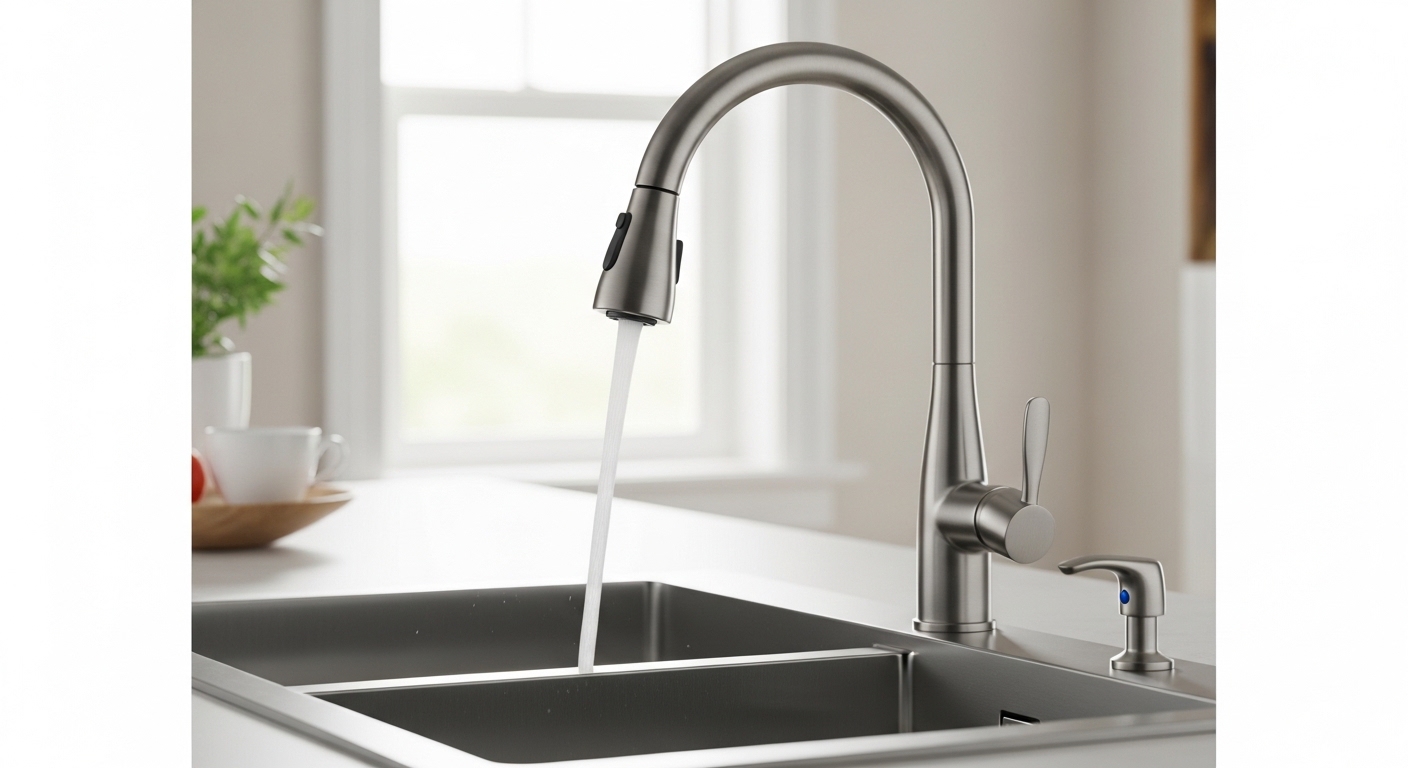
If you’re shopping for the best single handle pull down sprayer kitchen faucet, the honest truth is that the “best” one is the one that matches your sink depth, your water quality, and how hard your household actually uses it — not whatever has the shiniest photo. A single-handle pull-down means one lever controls both temperature and flow, and the spray head pulls straight down into the sink on a retractable hose. It’s the layout most people want because it’s intuitive, easy to clean around, and gives you a wand you can aim into pots and corners. Below, I’ll break down exactly what separates a faucet that lasts from one that leaks, what to spend, and how the popular finishes and spray types actually compare in daily use.
What actually makes one pull-down faucet better than another?
The four things that decide quality are the body material, the cartridge, the hose, and the dock magnet — in that order. Everything else (finish, spout height, “touchless” gimmicks) is preference. Get those four right and you have a faucet that will outlive your countertop.
Here’s what each one means in plain terms:
- Body material: Solid brass is the gold standard — it resists corrosion and won’t crack. Cheaper faucets use zinc alloy, which looks identical on day one but pits and leaks within a few years, especially with hard water. If a listing won’t tell you the material, assume zinc.
- Cartridge: This is the valve that mixes hot and cold. A ceramic-disc cartridge is what you want — it’s the part that decides whether your faucet drips at year three. Ceramic discs are rated for 500,000+ cycles. Rubber-washer or cheap plastic valves are not.
- Hose: A braided nylon or PEX-lined hose beats bare vinyl. Look for at least 20 inches of usable pull, and a hose that’s rated for the faucet’s warranty period.
- Dock magnet: The best pull-downs use a strong magnetic dock (often marketed as MagneDock, Boost, or similar) so the spray head snaps back and stays put. Gravity-only or weight-and-clip docks droop over time — the wand sags and won’t sit flush.
If you’ve ever dealt with a wand that won’t retract, you already know how much the dock matters — it’s the single most common complaint, and it’s often fixable, as we cover in why your pull-out kitchen faucet stops working and how to fix it fast.
Pull-down vs. pull-out: which sprayer style is right for my sink?
Choose a pull-down if you have a deep single-bowl sink and want a tall, statement arc; choose a pull-out if you have a shallow sink, a window behind the faucet, or low clearance. The mechanism is nearly identical — the difference is the direction the wand travels and the spout shape.
A pull-down has a high gooseneck and the wand drops vertically, which gives you great room to fill stockpots. A pull-out has a lower, more horizontal spout and the wand pulls toward you — better under a low window and easier for shorter users to reach. Both use the same core parts, so replacement hoses and heads are broadly similar; here’s a walkthrough of a kitchen faucet pull-out hose replacement if you ever need it.
| Feature | Pull-Down Sprayer | Pull-Out Sprayer |
|---|---|---|
| Spout height | Tall (14–18 in typical) | Lower (8–12 in typical) |
| Wand direction | Straight down into sink | Pulls toward you, horizontal |
| Best sink type | Deep single bowl | Shallow or double bowl |
| Window clearance | Can be too tall | Fits under low windows |
| Pot filling | Excellent | Good |
| Best for tall users | Yes | Either |
How much should I spend on a single handle pull down sprayer kitchen faucet?
Spend $120 to $250 for the sweet spot: solid brass, ceramic cartridge, metal spray head, and a lifetime or 10-year warranty. Below $80 you’re almost always buying zinc and plastic; above $350 you’re mostly paying for a brand name and designer finish, not better function.
Here’s how the price tiers actually break down in real-world use:
- $40–$80 — budget/rental tier: Zinc or thin-wall brass, plastic wand, weak dock. Fine for a rental you’ll leave in two years. Expect drips or a sagging hose within 2–3 years.
- $120–$250 — the value sweet spot: Solid brass or high-grade stainless, ceramic-disc cartridge, metal or metal-clad wand, strong magnetic dock, real warranty. This is what I recommend for 90% of homeowners.
- $300–$600 — premium/designer tier: Same core function as the sweet spot, plus premium finishes (matte black, brushed gold), touchless or voice activation, and heavier construction. Worth it if you want the aesthetic or the hands-free feature — not for durability alone.
The mistake people make is assuming price tracks longevity all the way up. It doesn’t. A well-built $180 faucet and a $500 faucet often share the same cartridge supplier. What you pay extra for above $300 is finish quality, hands-free tech, and brand — all real, none of them about whether it leaks.
Which finish holds up best — stainless, matte black, or brushed gold?
Spot-resist stainless and brushed nickel hide water spots and fingerprints best and are the most forgiving day to day. Matte black looks stunning but shows hard-water film and dried soap; brushed gold (champagne bronze) is durable but shows spots more than stainless. Chrome is the most fingerprint-prone of all.
Finish is mostly about maintenance tolerance, not durability — modern PVD (physical vapor deposition) coatings on any of these are extremely scratch-resistant. The question is how much wiping you’re willing to do. If your water is hard, that answer matters a lot.
| Finish | Hides spots/prints | Hard-water friendly | Style |
|---|---|---|---|
| Spot-resist stainless | Excellent | Excellent | Neutral, fits anything |
| Brushed nickel | Very good | Very good | Warm, traditional |
| Matte black | Poor | Needs regular wiping | Modern, bold |
| Brushed gold / champagne bronze | Good | Good | Warm, upscale |
| Polished chrome | Poor | Fair | Classic, bright |
If you’re in a hard-water area, finish choice pairs with maintenance habit. Even the best faucet builds mineral crust on the aerator and spray face — here’s how to clean a faucet head from hard-water buildup without wrecking the finish. Doing that quarterly keeps any finish looking new and keeps your spray pattern strong.
What spray functions do I really need — and which are gimmicks?
You genuinely need two: a steady aerated stream for filling and rinsing, and a strong spray for blasting stuck-on food. A pause button is the one bonus feature worth having. Everything beyond that — “sweep” jets, misting, four-mode wands — is nice but rarely used.
Let me rank spray features by how often they actually earn their keep:
- Aerated stream (essential): Soft, splash-free flow for filling glasses and pots. This is your everyday mode.
- Spray/blast (essential): Concentrated jets for scrubbing plates and cleaning the sink. The reason you bought a sprayer.
- Pause button (very useful): Lets you stop the water at the wand while moving it — great for filling pots across the counter without dripping.
- Boost/power mode (nice): Temporarily increases flow. Handy but not a dealbreaker.
- Sweep/blade spray (situational): A wide flat jet for pushing debris to the drain. Good for a big sink, otherwise a marketing bullet.
Look for a WaterSense-labeled model too. WaterSense faucets cap flow at 1.5 gallons per minute or less while still feeling strong, thanks to the aerator — you save water and money without noticing a weaker stream.
How hard is it to install a pull-down faucet myself?
Most single-handle pull-down faucets install in 30–60 minutes with basic tools, and the vast majority are DIY-friendly. If your sink already has a faucet, you have the plumbing you need — the job is disconnecting the old one, dropping in the new one, and connecting two supply lines and the sprayer hose.
The general sequence looks like this:
- Shut off the hot and cold supply valves under the sink and open the faucet to release pressure.
- Disconnect the old supply lines and the old faucet’s mounting nut, then lift it out.
- Feed the new faucet’s hoses through the sink hole and secure it from below with the mounting hardware.
- Connect the supply lines, attach the pull-down hose to the spray outlet, and clip on the weight or magnet.
- Turn the water back on slowly, check every connection for leaks, and run the wand out and back a few times to confirm the dock holds.
The one part people underestimate is working room under the sink and matching your sink’s hole count. Most single-handle faucets need one hole; if your sink has three, buy a matching deck plate (escutcheon) to cover the extras. If a connection weeps after install, the base is the usual suspect — here’s how to fix a kitchen faucet leaking at the base yourself before you call anyone.
Which brand should I actually trust?
For proven reliability, Moen, Kohler, Delta, and value-focused specialists like evefaucet all make solid single-handle pull-downs — the brand matters less than the spec sheet. A mid-tier faucet with solid brass and a ceramic cartridge from a lesser-known maker will outlast a big-brand zinc model. Buy the build, not the badge.
That said, established brands earn trust on two things: parts availability and warranty support. If a cartridge fails in year six, you want to be able to get a replacement, not throw out the whole faucet. If you’re weighing the two biggest names specifically, we compared them head-to-head in Moen vs. Kohler kitchen faucets, and for a broader shortlist see our guide to the best pull-down kitchen faucet brands. Both walk through warranty terms and real ownership costs, not just spec bullets.
How long should a good pull-down faucet last?
A quality solid-brass, ceramic-cartridge pull-down should last 15 to 20 years, with maybe one cartridge or hose swap along the way. The faucet body outlives the wear parts — cartridges and hoses are consumables, and both are cheap and easy to replace without pulling the whole faucet.
Two habits stretch that lifespan the most: descaling the aerator and spray head every few months in hard-water homes, and not forcing the handle when it stiffens (a stiff handle usually means the cartridge just needs cleaning or replacing, not muscle). Treat those two wear items as maintenance rather than failures and a good faucet quietly does its job for two decades.
FAQ
Is a single-handle or double-handle pull-down faucet better?
For a kitchen, single-handle wins for most people — you can adjust temperature and flow with one hand (or a wrist, when your hands are full of raw chicken). Double-handle looks more traditional and gives finer temperature control, but it’s slower and more to clean around. Since a pull-down is all about convenience, single-handle is the natural match.
Do pull-down faucet hoses leak or wear out?
The hose itself rarely leaks if it’s braided or PEX-lined; what wears is the connection and the retraction weight. A quality hose lasts 10–15 years, and when it does fail it’s a $15–$30 part you can replace in 20 minutes without removing the faucet. Cheap vinyl hoses on budget faucets are the ones that crack early.
Why does my pull-down spray head not retract properly?
Usually the magnetic dock is weak, the counterweight slipped on the hose, or mineral buildup is dragging the hose. On magnetic-dock models, make sure the wand is fully seated; on weight-and-pulley models, reposition the weight lower on the hose so gravity pulls the wand home. If it still sags, the dock magnet may be undersized — a common flaw on faucets under $80.
What flow rate should a kitchen faucet have?
Aim for 1.5 to 1.8 gallons per minute (GPM). A WaterSense-labeled faucet is capped at 1.5 GPM but still feels powerful because the aerator mixes air into the stream. Anything much above 2.2 GPM wastes water without feeling meaningfully stronger for everyday dishwashing.
Can I put a single-handle pull-down faucet on a sink with three holes?
Yes. Buy a single-handle faucet that includes or offers a matching deck plate (escutcheon) — it covers the two extra holes so the faucet sits on one and looks clean. Most manufacturers sell the deck plate in the same finish, and many bundle it in the box.
Are touchless pull-down faucets worth the extra money?
They’re worth it if you cook with messy hands often or have accessibility needs — waving the water on with a full or dirty hand is genuinely useful. But touchless adds $100–$200 and another electronic component that can fail. If you want maximum reliability for the money, a good manual single-handle pull-down is the safer buy.
About the author: This guide was written by the evefaucet product team, drawing on years of hands-on faucet testing, installation, and warranty-repair data from real customers. At evefaucet (www.evefaucet.com), we design and manufacture kitchen and bathroom fixtures, and every model we ship is pressure-tested and built to meet ANSI/NSF and cUPC standards, backed by our finish and function warranty. We wrote this to help you buy the right faucet once — not to upsell you into features you’ll never use.