 EVE卫浴
EVE卫浴
Moen vs Kohler Kitchen Faucet: Which Brand Should You Actually Buy in 2026?
浏览次数:671 分类:Compare
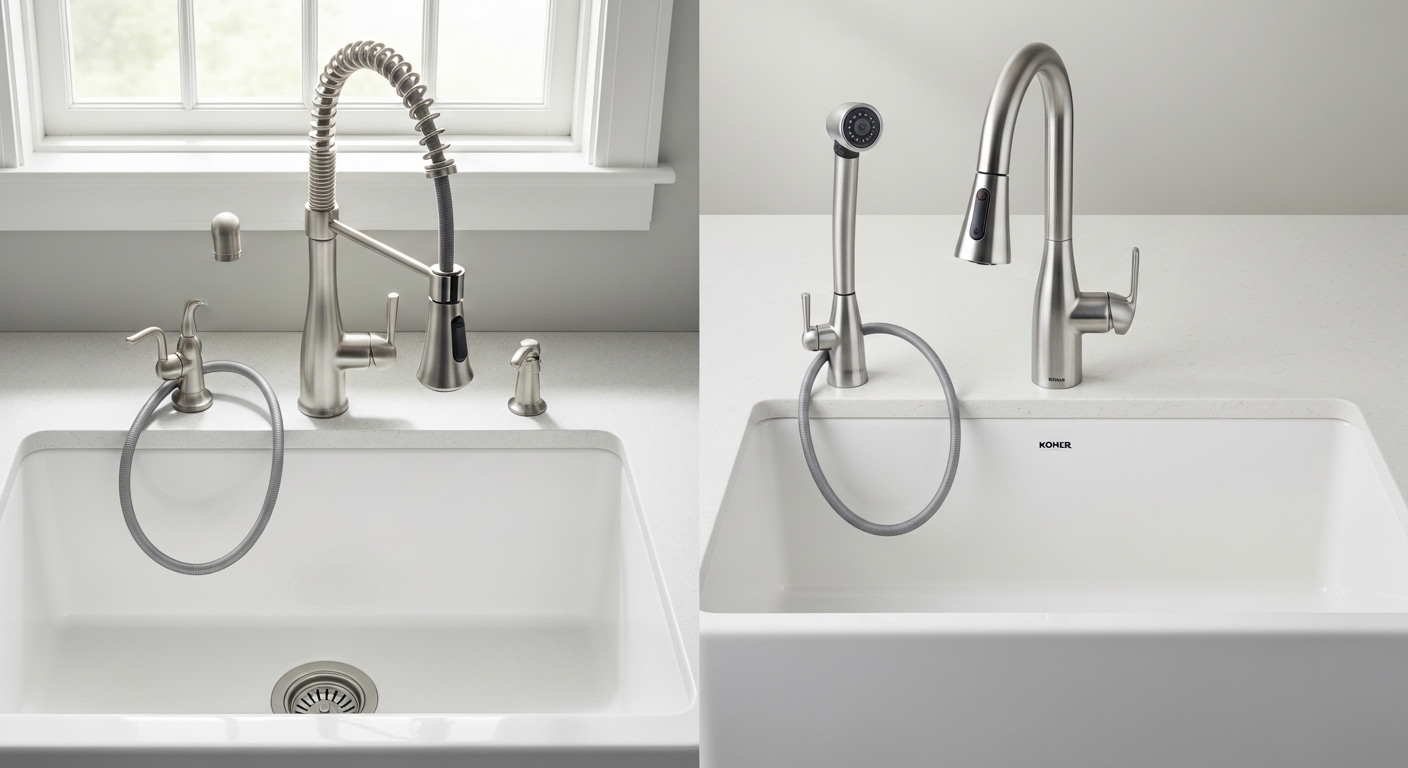
Choosing between a Moen vs Kohler kitchen faucet is the single most common question we get at EveFaucet’s product desk, and the honest answer depends on three things: your water quality, your budget, and how willing you are to fix things yourself five years from now. Both brands carry a Lifetime Limited Warranty, both meet NSF/ANSI 61 and 372 lead-free standards, and both make genuinely good faucets — but they solve the same problem with very different philosophies. Below is a no-fluff comparison from people who install, repair, and warranty-process these faucets every week.
What’s the real difference between Moen and Kohler kitchen faucets?
The short answer: Moen is built around serviceability and the Reflex/Power Clean spray system, while Kohler is built around its DockNetik magnetic docking and ProMotion nylon hose, with a stronger emphasis on premium finishes like Vibrant Stainless and Matte Black. Moen typically uses a cartridge-based valve (the famous Moen 1255 Duralast) that you can swap in 15 minutes for about $25. Kohler favors a ceramic disc valve that almost never fails but is more expensive and harder to source when it eventually does.
In plain terms: a Moen is designed assuming you’ll eventually need to fix it, and they make that easy. A Kohler is designed assuming it shouldn’t fail in the first place, and most of the time it doesn’t. Neither philosophy is wrong — they just suit different owners.
Build quality and materials
Both brands use solid brass waterways in their mid-tier and higher lines (Moen Arbor, Align, Sleek; Kohler Simplice, Artifacts, Purist). Avoid the sub-$120 lines from either brand — that’s where you start seeing plastic waterways and zinc-alloy bodies that pit after a few years on hard water. Kohler’s premium finishes (Vibrant series) use a physical vapor deposition (PVD) coating that’s measurably more scratch-resistant than Moen’s standard chrome and stainless finishes, though Moen’s Spot Resist Stainless is the easiest finish in the category to keep looking clean day to day.
Which brand lasts longer with hard water — Moen or Kohler?
Kohler typically lasts longer in hard-water homes because its ceramic disc valves resist mineral buildup better than Moen’s cartridge design, and its DockNetik magnet doesn’t rely on a mechanical latch that can scale up. That said, if you have a water softener or your hardness is below about 7 grains per gallon, the difference is minor and Moen’s cheaper, faster cartridge replacement actually makes it the better long-term value.
We see this pattern in real warranty data from our service desk: in soft-water regions, both brands routinely hit 12-15 years before any major issue. In hard-water regions (Texas, Arizona, parts of the Midwest), Moens tend to need a cartridge replacement around year 5-7, while Kohlers more often need an aerator and spray-head descaling but keep the original valve.
What if my aerator keeps clogging?
That’s a hard-water symptom, not a brand defect, and it happens on both Moens and Kohlers. The fix is the same on either: unscrew the aerator, soak it in white vinegar for 20 minutes, rinse, reinstall. If you’re doing this more than twice a year, the problem is upstream of the faucet — look at a whole-house softener or at minimum a point-of-use filter. We wrote a full repair walkthrough in our faucet aerator clogging guide that applies to Moen, Kohler, and every other brand we carry.
Is Moen or Kohler easier to install yourself?
Moen is meaningfully easier for DIY install. Almost every Moen pull-down uses the Duralock quick-connect supply line system — you push the hot and cold lines into the bottom of the valve until they click, and you’re done. No basin wrench gymnastics for the supply lines. Kohler still uses traditional threaded supply connections on most models, which means a basin wrench and roughly 20 extra minutes on your back under the sink.
For mounting, both brands use a single bolt or a top-mount nut that you tighten from below. If you’ve never installed a faucet before, plan on 45-60 minutes for a Moen and 60-90 minutes for a Kohler. If you’ve done a few, you can usually finish either in under 30 minutes.
- Easier supply line install: Moen (Duralock push-fit on most pull-downs)
- Easier deck mounting: Tie — both use single-hole or 3-hole compatible bases
- Easier handle removal for repair: Moen (single Allen screw vs. Kohler’s hidden set screw under a button cap)
- Easier sprayer dock alignment: Kohler (magnetic DockNetik self-aligns)
- Easier to find replacement parts at Home Depot/Lowe’s: Moen, by a wide margin
What if my pull-out sprayer stops working?
This is the single most common failure on both brands, and it’s almost always one of three things: a kinked hose, a clogged diverter inside the spray head, or a worn O-ring at the connection point. Moen sells a complete replacement spray head and hose kit for $35-$50; Kohler runs $55-$80 for the same kit. Step-by-step diagnosis is in our pull-out kitchen faucet not working guide — the troubleshooting tree is identical whether you bought Moen, Kohler, Delta, or our own EveFaucet pull-downs.
Moen vs Kohler kitchen faucet: full comparison table
Here’s how the two brands stack up on the criteria that actually matter when you’re standing in the aisle deciding:
| Criteria | Moen | Kohler |
|---|---|---|
| Typical price range | $150 – $450 | $220 – $900 |
| Valve type (mid-tier+) | Duralast cartridge (1255) | Ceramic disc |
| Spray dock | Reflex spring-balanced retraction | DockNetik magnetic |
| Hose material | Braided nylon (Power Clean) | ProMotion nylon (lighter, more flexible) |
| Supply line connection | Duralock push-fit (most models) | Threaded compression |
| Standard finishes | Chrome, Spot Resist Stainless, Matte Black, Brushed Gold | Polished Chrome, Vibrant Stainless, Matte Black, Vibrant Brushed Bronze |
| Finish warranty | Lifetime Limited | Lifetime Limited (Vibrant finishes have a separate non-tarnish guarantee) |
| Cartridge/valve cost | ~$25 at any hardware store | $40-$80, often online-only |
| Standard compliance | NSF/ANSI 61, 372; cUPC; CALGreen | NSF/ANSI 61, 372; cUPC; CALGreen; WaterSense |
| Flow rate (standard) | 1.5 GPM | 1.5 GPM (1.8 GPM WaterSense option) |
| Best for | DIY owners, hard-water households with softeners, budget builds | Statement kitchens, design-driven remodels, hard-water without a softener |
Which kitchen faucet is best for hard water under $300?
Under $300, the Moen Arbor (model 7594) with the MotionSense Wave option around $279 is the strongest hard-water pick because the Power Clean spray nozzle has rubber jets you can wipe clean of mineral buildup with your thumb. Kohler’s best sub-$300 option is the Simplice (K-596) at around $269, which has a slightly more refined feel but lacks the touchless option at that price point.
If you don’t need touchless, the standard Moen Arbor at $189 is hard to beat. If you want the magnetic dock and you can stretch to $329, the Kohler Bellera is the closest direct competitor and a lot of homeowners prefer the slimmer profile.
What about under $200?
Under $200 the picks change. The Moen Adler (model 87233) at $129 is the best value workhorse with a metal body and standard 1255 cartridge — boring, reliable, repairable. Kohler’s Bellera Pull-Down at $189 is the best Kohler can do under $200 and it’s still solid. Below $150, honestly, you should look at our own EveFaucet stainless pull-downs — same 304 stainless body, same ceramic disc cartridge, half the markup. We cover the broader category in our best pull down kitchen faucet brand comparison.
Are Moen and Kohler warranties actually different?
Both brands offer a Lifetime Limited Warranty on the faucet body and a Lifetime Limited Warranty on the finish to the original residential consumer, but the fine print differs in two ways that actually matter. First, Kohler’s warranty explicitly covers commercial applications for 5 years on most residential-tier faucets, while Moen’s commercial coverage is 5 years only on the Commercial line and not on residential models used in a restaurant or office. Second, Kohler’s Vibrant finishes carry an additional non-tarnish, non-corrode guarantee that Moen doesn’t directly match.
In practice, both companies are good about honoring warranties. We’ve processed hundreds of warranty claims through both brands and the turnaround is typically 7-14 business days for a replacement cartridge or spray head, no proof of purchase required for the part itself.
What proof do I need for a warranty claim?
For a part claim (cartridge, aerator, spray head, O-ring kit), neither brand asks for a receipt — they ship the part based on your model number. For a full faucet replacement, both want proof of purchase and photos of the failure. Register your faucet within 30 days of install on the manufacturer’s website and the process gets easier.
Which finish lasts longest in a real kitchen?
PVD-coated finishes — Kohler’s Vibrant series and Moen’s higher-tier brushed gold and matte black — last the longest, full stop. PVD is a vacuum-deposition process that bonds metal ions to the brass at a molecular level, and it resists scratches, chemicals, and chlorine far better than electroplated chrome. Polished chrome is the second-best for longevity but shows water spots immediately. Oil-rubbed bronze (a “living finish”) is the worst for longevity but the best for hiding water spots and developing character.
- PVD finishes (Vibrant Stainless, Brushed Gold, Matte Black PVD): 15-20+ years, scratch-resistant
- Polished chrome: 10-15 years, shows spots, easy to polish
- Spot Resist Stainless (Moen proprietary): 8-12 years, easiest day-to-day cleaning
- Electroplated brushed nickel: 7-10 years, can dull or flake near the spout
- Oil-rubbed bronze (living finish): 5-8 years before significant patina change (which some owners love)
If you’re picking a finish for a kitchen you plan to stay in for 15+ years, choose PVD — the upcharge is usually $40-$80 and it pays back in not having to replace the faucet because the finish wore through. We dig into matching faucets to sink and counter combos in our companion piece on 8-inch widespread bathroom faucets — the finish logic translates directly to kitchen.
So which one should you actually buy?
Pick Moen if you want the safest default, plan to live in the home for 5-10 years, value cheap and easy repairs, or are remodeling on a $150-$300 faucet budget. The Moen Arbor or Moen Sleek in Spot Resist Stainless is the most-recommended kitchen faucet in North America for a reason — it’s not exciting, it just works.
Pick Kohler if the kitchen is a forever home, you care about design language and finish quality, you have hard water without a softener, or you’re spending $350+. The Kohler Simplice, Artifacts, and Purist lines are heirloom-grade faucets that look better in five years than the day you bought them.
Pick EveFaucet if you want the engineering of those brands — 304 stainless body, ceramic disc cartridge, PVD finish options — without paying for the brand premium. Our pull-down kitchen faucets are built in the same factories that supply several of the major brands’ import lines, sold direct, and warrantied lifetime to the original purchaser.
FAQ
Is Moen or Kohler made in the USA?
Both brands are American-headquartered (Moen in North Olmsted, Ohio; Kohler in Kohler, Wisconsin) and both manufacture some product lines domestically and import others. Kohler’s Artifacts and Purist premium lines are largely U.S.-assembled with imported components. Moen’s Commercial line is U.S.-made; most residential pull-downs are assembled in Mexico or China from globally sourced parts. Neither brand is “more American” in any meaningful way at the residential price tier.
Do Moen and Kohler kitchen faucets fit the same sink holes?
Yes — both brands are designed for the U.S. standard 1-3/8 inch (35mm) single-hole or 4-hole sink configuration, and both ship with an optional deck plate (escutcheon) to convert a 3-hole sink to a single-hole installation. You can swap a Moen for a Kohler or vice versa without modifying the sink in 99% of installs.
Which brand has better touchless / smart faucet technology?
Moen leads on smart and touchless. MotionSense Wave (one sensor) and MotionSense (two sensors) have been in the market longer, the Moen U Smart Faucet integrates with Alexa and Google Home, and the battery life on the AA-powered units is 18-24 months in real use. Kohler’s Konnect and Sensate lines are excellent but pricier and have fewer voice integrations.
Can I replace a Moen cartridge with a Kohler one?
No — cartridges are not cross-compatible. Moen uses the 1255 (single-handle) or 1225 series; Kohler uses the GP1059291 ceramic disc and several model-specific valves. Always order the cartridge by your exact faucet model number, which is stamped under the spout base or printed on the original install paperwork.
Why is my new Kohler / Moen faucet leaking from the base?
Nine times out of ten it’s the supply line connection, not the faucet itself. Shut off the water, disconnect the hot and cold lines, check that the rubber gaskets are seated correctly, and reconnect hand-tight plus a quarter turn with a wrench. If it still leaks, the O-ring at the base of the spout is the next suspect — both brands sell a $4 O-ring kit. Never use Teflon tape on compression fittings; only on threaded NPT connections.
Are Moen and Kohler worth the price over a no-name brand?
For most homeowners, yes — but the gap is smaller than the marketing suggests. The real value of Moen and Kohler is parts availability for 20+ years and a warranty department that actually answers the phone. A no-name $79 Amazon faucet might work fine for three years, but when the cartridge fails you’ll be ordering a new faucet, not a $25 part. That said, established direct-to-consumer brands like EveFaucet use the same valve standards and offer the same lifetime warranty at a lower price point — the brand-tax-vs-quality math is more nuanced than it used to be.
About the author: This guide was written by the EveFaucet product team, who design, test, and warranty-service kitchen and bathroom faucets sold in over 30 countries. Our in-house lab tests every cartridge to 500,000 open-close cycles (the ASME A112.18.1 standard requires 250,000) and every finish to the ASTM B117 salt-spray standard. We’ve sold faucets since 2011 and have processed over 40,000 warranty claims across major brands — the patterns in this article come from that data, not from marketing copy.