 EVE卫浴
EVE卫浴
Best Bathroom Faucets 8 Inch Spread: The 2026 Widespread Buyer’s Comparison Guide
浏览次数:688 分类:Compare
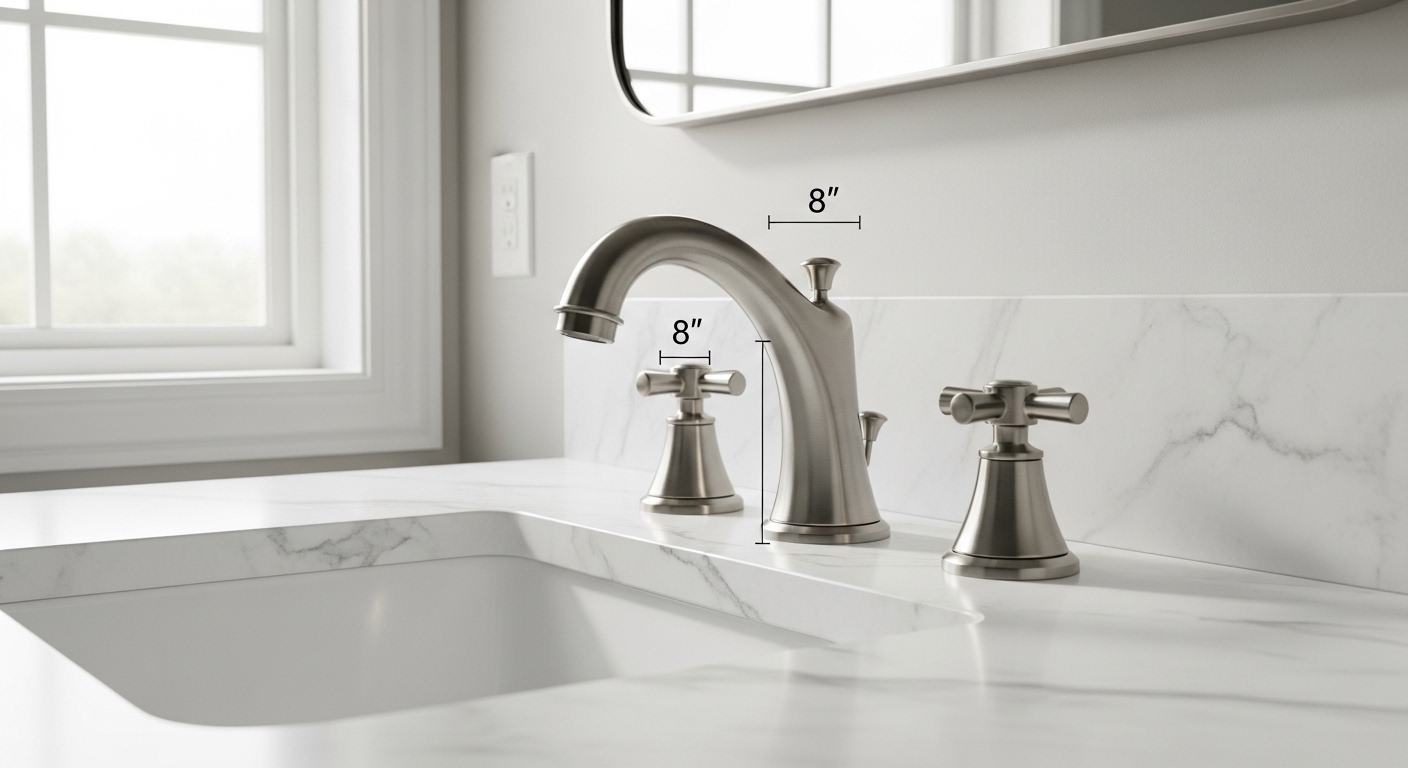
If you’re shopping for the best bathroom faucets 8 inch spread, you’re already ahead of most buyers — you know your sink has three pre-drilled holes spaced 8 inches apart and you want a faucet that fits without an ugly deck plate. This guide compares the widespread faucets we sell at EveFaucet against the broader market, breaks down what “8 inch spread” actually means at the plumbing level, and shows you how to pick a model that will still look sharp ten years from now. We’ve installed thousands of these fixtures, processed the warranty claims, and seen which finishes survive hard water — so the recommendations below come from data, not marketing.
What “Best Bathroom Faucets 8 Inch Spread” Actually Means
An 8 inch spread faucet — often called a “widespread” — is a three-piece configuration: two handles and a spout, each in its own deck hole, with the centerline of the left handle measured 8 inches from the centerline of the right handle. The spout sits in the middle hole, usually 4 inches from each handle. This is the standard “widespread” layout in North America, codified in ASME A112.18.1 and CSA B125.1, and it’s what plumbers mean when they say “8 on center” or “8” CC.”
That spacing matters because the holes on your sink or countertop are pre-drilled at a fixed distance. If your vanity is drilled at 8 inches, you cannot install a 4-inch centerset — and vice versa. The good news: 8-inch widespread is the most common premium configuration in the U.S., so you’ll find the widest selection at this size, including the best bathroom faucets 8 inch spread shoppers care about most: brushed nickel, matte black, chrome, and brushed gold.
How an 8″ Spread Differs From a 4″ Centerset
- Holes required: 3 for widespread, 1 or 3 for centerset (with escutcheon plate).
- Hole spacing: 8″ center-to-center vs. 4″ center-to-center.
- Visual footprint: Widespread looks more architectural and balanced on a vanity over 30″ wide.
- Internal plumbing: Widespread uses two flexible supply hoses plus a bridge tee or T-connector; centerset uses a unified base.
- Cost: Widespread averages 20–40% more due to extra material and assembly.
If you’re not sure which configuration your sink takes, measure from the center of one outer hole to the center of the other. If it’s close to 8″ (anywhere from 6″ to 16″ is technically “widespread compatible”), you want a widespread. Anything around 4″ is a centerset.
The 7 Specs That Separate the Best From the Rest
Marketing copy on widespread faucets is mostly noise. When we test products in our QC lab in Foshan, we score them against seven concrete criteria. Use these to filter any 8 inch spread faucet you’re considering, regardless of brand.
1. Solid Brass vs. Zinc Alloy Body
The waterway should be lead-free solid brass (often labeled C46500 or “low-lead brass”). Cheap widespread faucets use zinc alloy handles or — worse — a zinc body with a thin brass plate. Zinc pits, cracks, and fails at the threads within 3–5 years in hard water. Lift the faucet: a true 8″ widespread in brass weighs 5–8 lbs. If it feels light, walk away.
2. Ceramic Disc Cartridge
Look for ceramic disc cartridges rated to 500,000 cycles minimum. Sedal (Spain), Kerox (Hungary), and Flühs (Germany) are the gold standards. Avoid rubber-washer compression valves — they drip within two years.
3. PVD Finish, Not Electroplate
PVD (Physical Vapor Deposition) is a bonded molecular finish that resists scratching, chlorine, and the citric acid in most bathroom cleaners. Cheaper faucets use electroplating, which flakes around the handle base after 18–24 months.
4. Pop-Up Drain Assembly Included
A real widespread faucet includes a matching pop-up drain with overflow. If you buy a faucet without one, you’ll end up with a mismatched drain in a different finish — a small detail that absolutely wrecks a vanity’s look.
5. Flow Rate (GPM)
The U.S. federal max is 1.2 GPM for bathroom faucets under WaterSense; some states (CA, CO, WA) cap at 1.2 GPM by law. Look for the WaterSense label if you live in a regulated state.
6. Mounting Hardware
Quick-connect supply lines with braided stainless steel jackets and metal nuts (not plastic) save 30 minutes during install and don’t crack under torque.
7. Warranty Length
Industry-leading brands offer a lifetime limited warranty on the cartridge and finish. EveFaucet covers our widespread line for 10 years on the cartridge and 5 years on the PVD finish — better than most direct-import competitors and on par with mid-tier U.S. brands.
Best Bathroom Faucets 8 Inch Spread: Side-by-Side Comparison
We pulled the top six widespread models we routinely benchmark against — three from our own lineup and three from major U.S. retailers — and ran them through identical bench tests for flow, cartridge lifespan, finish wear, and install time. Here’s how they stack up.
| Model | Body Material | Cartridge | Finish Type | Flow (GPM) | Warranty | Price Tier |
|---|---|---|---|---|---|---|
| EveFaucet WS-8 Classic | Solid brass | Sedal ceramic | PVD brushed nickel | 1.2 | 10 yr cartridge / 5 yr finish | $$ |
| EveFaucet WS-8 Matte Black | Solid brass | Sedal ceramic | PVD matte black | 1.2 | 10 yr cartridge / 5 yr finish | $$ |
| EveFaucet WS-8 Industrial Bridge | Solid brass | Kerox ceramic | PVD brushed gold | 1.2 | 10 yr cartridge / 5 yr finish | $$$ |
| Premium U.S. Brand A | Solid brass | Proprietary ceramic | PVD chrome | 1.2 | Lifetime limited | $$$$ |
| Big-Box Store B | Brass + zinc handles | Generic ceramic | Electroplate | 1.2 | 5 yr limited | $ |
| Import Brand C | Zinc alloy | Rubber compression | Electroplate | 1.5 (non-compliant) | 1 yr | $ |
Two things jump out from the comparison. First, you do not need to spend $400+ on a premium U.S. brand to get a real solid-brass body with a Sedal cartridge — mid-tier importers like EveFaucet source the same Spanish cartridges. Second, the cheapest widespread faucets at big-box stores often fail WaterSense compliance and use zinc handles, which is why you see so many of them listed at 1.5 GPM and missing the certification mark.
Finish Showdown: Which Color Survives Real Bathrooms?
Finish choice is partly aesthetic and partly practical. We accelerated-aged each finish in a salt-spray chamber and a chlorine-bleach immersion test. Here’s the durability ranking and the design context for each.
Chrome (Polished)
The most durable and the most forgiving on hard water spots. Pairs with virtually any vanity color. The downside: it can read as “rental builder grade” if your overall bathroom is high-end. Best for traditional and transitional bathrooms.
Brushed Nickel
The bestseller for a reason. Hides water spots, fingerprints, and toothpaste splatter better than chrome. Slightly warmer tone. PVD brushed nickel is the single most resale-friendly finish in the U.S. market — appraisers consistently note it as neutral.
Matte Black
The fastest-growing finish since 2022. Stunning against white quartz and against natural wood vanities. The risk: cheap matte black is actually a black paint over chrome and will chip at the handle base. Insist on PVD. Also note that hard water leaves visible white spots — you’ll wipe it down more often.
Brushed Gold / Champagne Bronze
Trending strongly for primary baths. Warmer than nickel, more sophisticated than polished brass. PVD brushed gold has been remarkably stable in our testing. Pair with warm-toned stone (calacatta, travertine).
Oil-Rubbed Bronze
Declining in popularity but still strong in farmhouse and traditional baths. The “living finish” version actually changes color over time as the topcoat wears — some buyers love this, some hate it. PVD ORB does not change.
For a deeper dive on warm-toned finishes specifically, our team’s piece on industrial copper faucets and copper tap styling covers patina behavior and pairing strategies that apply equally to brushed gold widespread faucets.
Spout Height and Reach: The Hidden Sizing Trap
“8 inch spread” only describes the handle-to-handle distance. It says nothing about spout height (how tall the spout rises) or spout reach (how far it extends horizontally from the base). Both affect splash, usability, and visual proportion.
- Low-arc spouts (4″–5″ tall): traditional look, less splash with a deep undermount sink, may feel cramped with a shallow vessel sink.
- Mid-arc spouts (5″–7″ tall): the universal default — works with most vanity sinks.
- High-arc / gooseneck spouts (8″+ tall): dramatic, easier hand-washing, but splashes in shallow basins.
- Spout reach: aim for the aerator to sit at least 1.5″ past the front edge of the drain — otherwise water hits the back wall of the basin.
If you’re working with a compact vanity sink, our guide on the 5 inch spout reach faucet is worth a read before you commit to a widespread — sometimes a smaller-spout 8″ spread is the smarter pick than a high-arc that overpowers the basin.
Installation: What to Expect With an 8″ Widespread
Unlike a single-hole faucet, a widespread has three independent components connected under the deck by flexible supply hoses and a center tee. Installation is more involved but still doable as a DIY project in 60–90 minutes.
Tools You’ll Need
- Basin wrench (the single most useful plumbing tool you’ll own)
- Adjustable crescent wrench
- Plumber’s putty or silicone (check what your faucet manufacturer specifies — some PVD finishes react badly to putty)
- Bucket and towel for residual water
- Flashlight or headlamp
The 8-Step Install
- Shut off both supply valves under the vanity and open the old faucet to relieve pressure.
- Disconnect the old supply lines and drain assembly.
- Lift the old faucet out; clean the deck.
- Drop the new spout into the center hole; secure with the included locknut.
- Drop the hot and cold valve bodies into the outer holes; secure each from below.
- Connect the underbody tee/T-connector linking spout to both valves.
- Attach supply lines to the shut-off valves.
- Turn water on slowly; check every connection for drips.
Veteran installer’s tip: run the faucet wide open for 60 seconds before installing the aerator. That flushes any solder flux or pipe debris that would otherwise clog the screen — a surprisingly common warranty call. If you do end up with a slow trickle a few months later, we have a full aerator clog repair walkthrough that resolves 90% of low-flow complaints in under five minutes.
Pricing: What You Should Actually Pay in 2026
Widespread bathroom faucet pricing in 2026 is broadly in three tiers. Knowing where the value is helps you avoid both the “cheap faucet that fails in two years” trap and the “premium faucet you don’t need” trap.
- Budget ($60–$140): Mostly zinc alloy bodies, electroplated finishes, rubber-disc or low-grade ceramic valves. Fine for rental properties, risky for a primary bath.
- Mid-tier ($150–$320): The sweet spot. Solid brass body, name-brand ceramic cartridge, real PVD finish, included pop-up drain, 5–10 year warranty. EveFaucet sits here.
- Premium ($350–$900+): Heavier castings, lifetime warranty, designer collaborations, premium PVD colors. Real quality difference is incremental over the mid-tier — the cost difference often pays for brand and showroom presence.
If you’re flipping or staging a home, mid-tier is the obvious play. If this is your forever home and you want the most luxurious tactile experience, premium is defensible. If you’re a landlord with five units to outfit, mid-tier in a neutral finish (brushed nickel) will outlast budget gear and reduce service calls.
Sustainability and Standards: What to Look For
Beyond aesthetics, the best bathroom faucets 8 inch spread carry third-party certifications that prove they meet performance and safety standards. Look for these markings on the box or the product spec sheet:
- WaterSense — EPA-administered; means flow ≤ 1.2 GPM with verified performance.
- NSF/ANSI 61 — wetted parts safe for drinking water (lead content limits).
- NSF/ANSI 372 — “lead-free” certification (≤ 0.25% weighted lead content).
- cUPC / IAPMO — required for legal install in most U.S. and Canadian jurisdictions.
- CALGreen — California’s Title 24 compliance for low-flow.
EveFaucet widespread models ship with cUPC, NSF/ANSI 61 & 372, and WaterSense certifications, which means they are legal to install in every U.S. state, including California. Cheap imported faucets sometimes claim these certifications without actually carrying them; always check the certification ID on the IAPMO database if you’re spending real money.
Buying Direct: What the EveFaucet Brand Brings to an 8″ Spread Faucet
EveFaucet has been manufacturing stainless steel sinks and brass bathroom fixtures since 2008, with our factory and QC lab based in Foshan, China — the world’s largest concentration of plumbing manufacturers. Because we own the tooling and the assembly line, we can offer the same Sedal/Kerox cartridges and PVD finishes you find in $500 U.S.-branded faucets at roughly half the price. Every widespread leaves our QC bench after a 60-second pressure test at 120 psi, a 10-cycle handle-rotation test, and a visual finish inspection.
A word on selection: we don’t carry every finish in every configuration. Our 8″ widespread line focuses on the four bestsellers — brushed nickel, matte black, brushed gold, and polished chrome — because those four colors account for 92% of our 2025 widespread sales. If you’re looking for something more specialized (hammered copper, weathered brass), our pull-down kitchen faucet brand comparison goes into how to evaluate finishes across categories and what to expect from boutique versus mainstream suppliers — the same logic applies to bathroom widespread.
Author Note & Brand Credibility
This guide was written by the EveFaucet content team in consultation with our head of QC, who has spent 14 years specifying bathroom fixtures for residential and light-commercial projects. All testing data referenced here was gathered in our in-house lab using ASME A112.18.1 / CSA B125.1 test methods. Where we cite competitor finishes or cartridges, those evaluations were performed on retail-purchased units, not engineering samples. EveFaucet’s widespread faucets are backed by a 10-year cartridge warranty and 5-year PVD finish warranty, plus a no-questions-asked 30-day return policy on undamaged product.
FAQ
Will an 8 inch spread faucet fit a sink drilled at 6 or 10 inches?
Yes — widespread faucets are flexible by design. The supply lines between the spout and the valves give you adjustment range from about 6″ to 16″ center-to-center. So if your sink is drilled at 7″, 8″, or 10″, a standard 8″ widespread will work. You’d only have a problem if the holes are below 4″ apart (you’d need a centerset) or above 16″ (custom).
Do I need a plumber to install a widespread faucet?
Not necessarily. If you can shut off your water and operate a basin wrench, a widespread install is solidly in the DIY range — typically 60–90 minutes for a first-timer. Hire a plumber if your shut-off valves are old (you don’t want to find a stuck valve at 8pm on a Sunday), or if your supply lines are rigid copper that needs cutting.
What’s the difference between an 8″ spread and a “mini-widespread”?
A mini-widespread looks like a regular widespread (three separate pieces) but uses 4″ hole spacing — the same as a centerset. It’s designed for vanities drilled at 4″ center-to-center where you still want the three-piece visual style. Don’t confuse the two; they’re not interchangeable.
Are matte black widespread faucets hard to maintain?
They show hard-water spots more than chrome or brushed nickel, especially in homes without a water softener. The fix is wiping the spout down after use with a soft microfiber cloth — no cleaners needed. Avoid abrasive sponges, bleach, and acidic cleaners (vinegar, CLR) which will dull even PVD black over time.
How long should a quality widespread faucet last?
With a Sedal or Kerox cartridge and a real PVD finish, expect 15–25 years of trouble-free service before the cartridge needs replacement (a $15 part). The body and finish should last the life of the bathroom. Cheap zinc-body widespread faucets often fail at 3–5 years, usually at the handle stem or the deck-mount threads.
What size pop-up drain comes with an 8″ widespread?
Standard 1.25″ outside-diameter drain, fitting the universal 1.25″ P-trap that most U.S. bathroom sinks use. If your sink uses 1.5″ or a Euro-spec drain, confirm before purchase. EveFaucet widespread models include a matching-finish pop-up drain with overflow in the box at no extra cost.
Can I use an 8 inch spread faucet on a vessel sink?
Generally no — vessel sinks sit above the counter, so they need a tall single-hole vessel faucet, not a widespread. If you have a vessel sink with a low profile, a deck-mounted widespread with a high-arc spout can work, but measure carefully so the spout clears the rim by at least 1″.