 EVE卫浴
EVE卫浴
5 Inch Spout Reach Faucet: The Complete Guide to Choosing the Right Compact Tap
浏览次数:462 分类:Faq
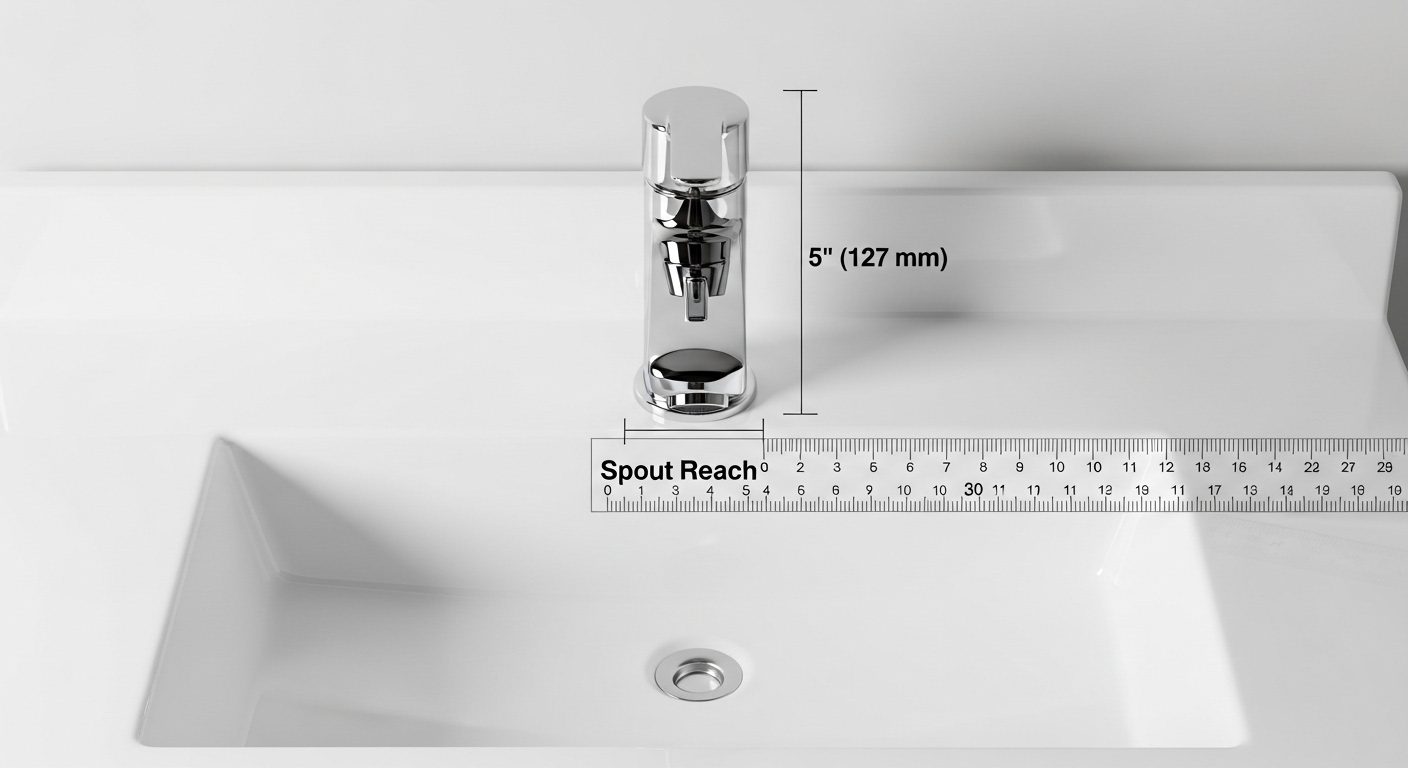
If you have ever stood in front of a tight powder-room vanity and watched water splash all over the counter, you already understand why the 5 inch spout reach faucet exists. Spout reach — the horizontal distance from the center of the faucet body to the center of the water stream — is one of the most overlooked specs in bathroom and bar-sink shopping, and a five-inch reach hits a sweet spot for small basins, wall-hung sinks, and second-bathroom installations. In this guide we walk through every measurement, finish, valve type, and installation gotcha you need to know before you click “add to cart.”
What Exactly Is a 5 Inch Spout Reach Faucet?
“Spout reach” is the horizontal projection of the spout, measured from the vertical centerline of the faucet body to the point directly under the aerator where the water stream lands. A 5 inch spout reach faucet therefore puts the water stream five inches in front of the faucet base. This is a relatively short reach compared with kitchen faucets (which typically run 8–10 inches) or full-size bathroom lavatory faucets (commonly 5.5–6.5 inches), and it is specifically engineered for small basins where excessive reach would cause the stream to hit the back rim or splash off the basin edge.
Spout reach is not the same as spout height — the latter is the vertical distance from the deck (or wall) to the underside of the aerator. A faucet can have a tall, arching silhouette while still keeping a modest five-inch reach, which is exactly why this category has become so popular for mid-century, transitional, and modern compact bathrooms. The pairing of generous clearance under the spout with a contained landing point is what makes a 5-inch reach feel premium even in the smallest WC.
Why Five Inches Specifically?
Most modern compact lavatory basins have an internal bowl width between 12 and 16 inches and a drain that sits roughly 4–6 inches behind the deck-mount faucet hole. Five inches lands the water column directly over the drain in the majority of these basins — not in front of it (which causes pooling and soap-scum buildup) and not behind it (which causes splash-back). It is the Goldilocks measurement for small-sink hydraulics.
Who Should Buy a 5 Inch Spout Reach Faucet?
Compact-reach faucets are not for every install. They shine in five specific scenarios, and they are a poor match in two others. Match your situation to the list below before you commit.
- Powder rooms and half-baths with vanities under 24 inches wide.
- Wall-hung or pedestal lavatories where the basin is shallow and the drain is set close to the wall.
- Bar sinks and prep sinks with internal bowl widths under 14 inches.
- RV, tiny-home, and boat bathrooms with strict spatial envelopes.
- Vessel-sink installations using a low-profile vessel where you need clearance but not extension.
Conversely, a 5-inch reach is too short for standard 18–24 inch wide rectangular basins, undermount sinks set far back from the faucet hole, or any kitchen prep work where you need to fill stockpots. If your sink bowl is wider than 16 inches at the rim, step up to a 6 inch or 6.5 inch reach instead.
Key Specifications to Verify Before You Buy
Manufacturers occasionally describe their products loosely, so before you purchase a 5 inch spout reach faucet, verify these numbers in the spec sheet — not the marketing copy.
- Spout reach: 5 inches (127 mm), measured center-of-body to center-of-aerator.
- Spout height: typically 4.5–7 inches; pick taller for vessel sinks, shorter for shallow basins.
- Mounting hole diameter: 1.25–1.375 inches (32–35 mm) for single-hole; 4-inch centerset for compact two-handle units.
- Deck thickness range: most fit decks up to 1.5 inches; thicker stone counters need an extended mounting kit.
- Flow rate: WaterSense-listed models are capped at 1.2 GPM; standard US compliance is 1.5 GPM.
- Valve type: ceramic disc cartridges are the modern standard and outlast compression valves by 5–10x.
- Supply connection: 3/8″ compression or 1/2″ NPT — confirm before ordering supply lines.
Spout Reach Comparison: 4 inch vs 5 inch vs 6 inch vs 8 inch
Spout reach is a continuum, and choosing the right number on that continuum is the single most consequential decision in the buying process. The table below shows how a 5-inch reach compares with adjacent sizes for typical residential applications.
| Spout Reach | Best Basin Width | Typical Application | Splash Risk | Drain Coverage |
|---|---|---|---|---|
| 4 inches | 10–12 inches | Bar sinks, RV lavs, micro powder rooms | Low | Excellent for small bowls |
| 5 inches | 12–16 inches | Powder rooms, half-baths, prep sinks | Very low | Ideal for compact basins |
| 6 inches | 16–20 inches | Standard full bathrooms | Low–moderate | Good for mid-size basins |
| 8 inches | 20+ inches | Kitchen, utility, vessel sinks | Moderate–high in small basins | Over-reaches small bowls |
Finishes and Materials: What to Look For at the 5-Inch Size
Because compact-reach faucets often install in highly visible powder rooms where guests scrutinize details, finish quality matters more than in a working kitchen. The big four are polished chrome, brushed nickel, matte black, and brushed gold — but each behaves differently over time. Polished chrome is the most forgiving on water spots and the most affordable; matte black hides everything except hard-water mineral residue, which shows up dramatically as white streaks; brushed nickel sits in between; and brushed gold (PVD) has come a very long way in durability over the past five years but still carries a price premium.
Underneath the finish, look for a solid brass body. Zinc-alloy bodies are cheaper but corrode within a few years in humid bathrooms. If you are unsure, lift the faucet at the store — a real brass-body unit feels noticeably heavier than its zinc cousin. The same lift-test logic applies to copper construction; for the broader story on solid copper bathroom and kitchen taps, our deep dive on copper taps and industrial-style faucets walks through alloy grades and patina behavior in detail.
Coatings and Certifications That Actually Matter
“PVD” (Physical Vapor Deposition) is the gold standard for finish durability — it bonds the color layer to the brass at the molecular level instead of electroplating it on top. Look for the PVD designation explicitly on the spec sheet. For US installations, also confirm cUPC certification (potable-water safety), NSF/ANSI 61 and 372 (low-lead compliance, mandatory in California, Vermont, Maryland, and Louisiana), and ADA compliance if accessibility matters. WaterSense labeling is optional but indicates a 1.2 GPM cap that can shave noticeable dollars off the annual water bill in a high-use bathroom.
Single-Handle vs Two-Handle vs Wall-Mount Configurations
At the 5-inch reach size, you will see three dominant mounting configurations. Each has trade-offs in counter footprint, ease of one-handed use, and price.
| Configuration | Counter Holes | Pros | Cons | Best For |
|---|---|---|---|---|
| Single-handle deck mount | 1 hole (35 mm) | Easy one-hand temperature/flow, fewer leak points | Less precise temperature setting | Powder rooms, modern designs |
| Two-handle centerset | 3 holes on 4″ centers | Classic styling, precise temperature | Two valves = two failure points | Traditional and transitional decor |
| Wall-mount single lever | 0 deck holes (in-wall valve) | Frees up counter, easy to clean under | Requires in-wall plumbing work | Vessel sinks, floating vanities |
If you are leaning toward a wall-mount configuration with a 5-inch reach over a vessel basin, the rough-in work is more involved than a typical deck install. Our in-wall concealed lavatory faucet installation diagram walks through the valve-box depth, finish-to-rough offset, and supply stub-out spacing you need to get right before tile goes up.
How to Measure Your Sink for a 5-Inch Reach
Measure twice, plumb once. Before ordering, take these four measurements with a tape measure and a level:
- From the back edge of the faucet hole (or wall, for wall-mount) forward to the front rim of the basin. This is your maximum allowable spout reach plus a 1–2 inch safety margin.
- From the back edge of the faucet hole forward to the center of the drain. This is your ideal spout reach.
- From the deck to the rim of the basin (vessel sinks only). Add this to your minimum desired clearance above the rim to get your minimum spout height.
- The deck thickness through which the faucet shank will pass.
If measurement #2 lands between 4 and 6 inches, a 5-inch reach is your match. If it lands at 6.5 inches or more, step up; if under 4 inches, step down to a 4-inch reach.
Installation Tips From Our Workshop
A 5-inch reach faucet installs much like any other deck-mount lavatory faucet, but there are three details specific to compact units that catch first-time DIYers off guard.
First, supply line length. Compact faucets often have shorter under-deck shanks, which means standard 20-inch flexible supply lines can be unnecessarily long and create kinks. Order 12 or 16-inch supply lines instead — straight runs leak less and look cleaner. Second, the mounting nut. Many compact single-hole units use a horseshoe-clip mounting system rather than a threaded nut; the clip is fast but requires that the deck not exceed the rated thickness, or the shank will bottom out. Third, the aerator. Compact aerators clog faster because they have less screen area. Plan to clean it every 6–12 months. For a step-by-step on clearing a clogged aerator without damaging the threads, our team put together a faucet aerator unclogging walkthrough from the EveFaucet workshop.
Common Problems and Quick Diagnostics
Even a well-chosen 5-inch reach faucet can underperform if a small issue goes unaddressed. Here are the four most common complaints and what to check first.
- Splashing despite the short reach: the basin is too shallow (under 4 inches deep). Try a laminar-flow aerator instead of an aerated one to soften the stream.
- Stream lands in front of the drain: spout reach is too long for your basin — measure and consider stepping down to 4 inches.
- Stream lands behind the drain: spout reach is too short — step up to 6 inches, or shim the faucet forward (not always possible).
- Weak flow: 95% of the time it’s the aerator. Unscrew, soak in vinegar for 30 minutes, rinse and reinstall. If flow is still weak, check the angle stops under the sink — they’re often only partially open.
How a 5 Inch Reach Fits Into the Wider Bathroom Refresh
A faucet swap is often the cheapest, highest-impact bathroom upgrade you can make — but it works best when the sink, drain, and counter all cooperate. If you are also rethinking your basin, our guide on choosing the right basin for your lavatory faucet — above-counter vs under-counter will help you align bowl geometry with spout reach before you commit. For shoppers who haven’t pinned down a brand strategy yet, our pull-down kitchen faucet brand comparison guide is a useful primer on the build-quality red flags that apply equally to lavatory units.
EveFaucet’s Approach to Compact-Reach Lavatory Faucets
At EveFaucet, every compact-reach unit we ship is built around a forged brass body, a German-engineered ceramic disc cartridge rated for 500,000 open/close cycles, and a PVD finish layer that we salt-spray test to 200 hours per ASTM B117. Each faucet is pressure-tested at 1.6 MPa before it leaves the factory, certified to NSF/ANSI 61 and 372 for low-lead potable use, and backed by our five-year finish warranty and lifetime ceramic-cartridge warranty. We have shipped lavatory faucets to homes, hotels, and commercial properties since 2007, and our compact 5-inch reach models are among our most-requested SKUs for powder-room and bar-sink applications.
FAQ
Is a 5 inch spout reach enough for a vessel sink?
It can be, but only for narrow vessel sinks (under 14 inches in diameter) where the drain sits roughly four to five inches in front of the faucet hole. For wider vessels, step up to a 6-inch reach so the water column lands inside the bowl rather than splashing over the rim. Also pay attention to spout height — vessel sinks need at least 4 inches of clearance between the rim and the underside of the aerator for comfortable hand-washing.
What’s the difference between spout reach and spout length?
Spout reach is the horizontal distance from the centerline of the faucet body to the center of the water stream where it exits the aerator. Spout length is the total physical length of the spout itself, often measured along its arc. Reach is the more useful number because it tells you exactly where the water will land — which is what determines splash and drain coverage.
Can I install a 5 inch reach faucet on a standard 4-inch centerset sink?
Yes, as long as you buy a centerset (three-hole, 4-inch center-to-center) configuration rather than a single-hole one. Many manufacturers offer the same spout design in both configurations. If your sink has three holes but the centers are 8 inches apart (widespread), you need a widespread faucet — the 4-inch centerset will not span the holes.
Do 5 inch reach faucets come in WaterSense certified versions?
Yes. Look for the EPA WaterSense label on the spec sheet; certified models cap flow at 1.2 GPM at 60 psi. In compact bathrooms with small basins, the lower flow rate actually improves performance — it reduces splash and gives you better temperature control at the handle.
How long should a quality 5 inch spout reach faucet last?
A faucet with a forged brass body, ceramic disc cartridge, and PVD finish should last 15–25 years of normal residential use with only routine aerator cleaning. Compression-valve faucets and zinc-alloy-bodied units typically need cartridge replacement or full replacement within 3–7 years. The cartridge is the single most important durability spec — always verify it is ceramic disc, not rubber compression.
Will a 5 inch reach faucet fit on a pedestal sink?
In most cases, yes. Pedestal sinks typically have either a single 35 mm hole or 4-inch centerset holes, both of which match standard 5-inch reach faucet configurations. Measure the back-of-hole to drain-center distance on your specific pedestal to confirm; vintage pedestal sinks sometimes have unusual hole spacings that require a custom-fit faucet.
Can a 5 inch spout reach faucet be paired with a touchless or motion-sensor valve?
Yes, several manufacturers (including EveFaucet) offer infrared-sensor versions in the compact-reach size, which work especially well in powder rooms where guests appreciate the hygiene benefit. The sensor module typically sits in the base of the faucet and requires either a battery pack or a hardwired transformer mounted under the sink. Sensor faucets do require occasional troubleshooting — check the supply filters and sensor lens first if performance drops.
Author Note
This guide was written by the EveFaucet product team, drawing on more than fifteen years of designing, manufacturing, and field-testing residential lavatory faucets across North American, European, and Asian markets. Specifications cited reflect industry standards as of 2026, including current EPA WaterSense, NSF/ANSI 61 and 372, and cUPC requirements. For product-specific questions, our customer support team responds within one business day at www.evefaucet.com.